
A sales operations lead configured the AI-driven lead scoring model with a low qualification threshold so that most inbound leads are marked 'hot' and routed to sellers for immediate follow-up. After a month, sellers report that a large share of their 'hot' queue turns out to be unqualified, and they are spending more time filtering leads manually than before scoring was introduced. A consultant is asked to adjust the configuration to fix this without disabling scoring. What should the consultant recommend?
Select an answer to reveal the explanation.
Short Explanation
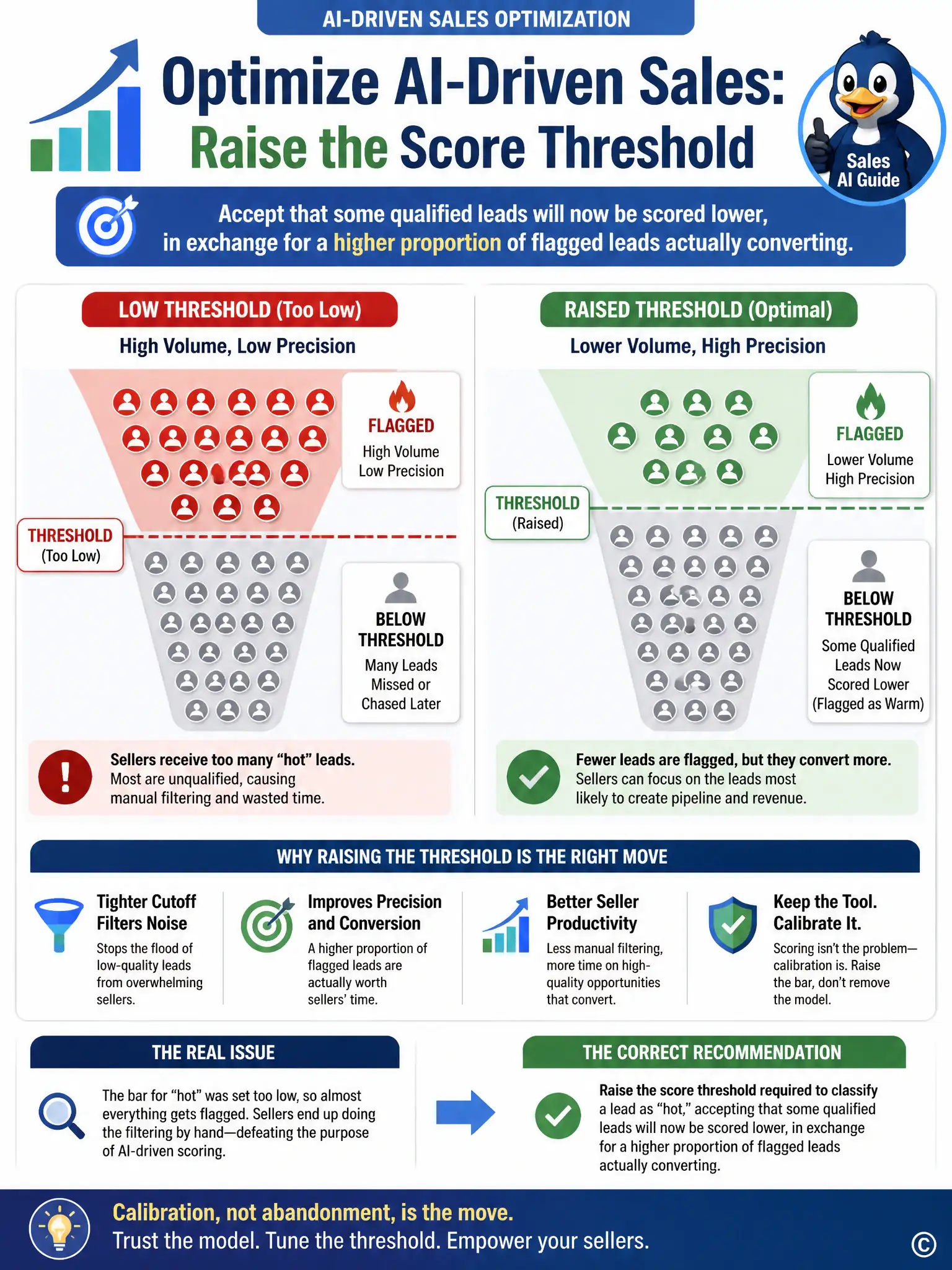
The problem isn't scoring itself; it's that the 'hot' bar was set too low, so sellers still do the filtering by hand. Raise the score threshold so fewer leads qualify as 'hot,' and you'll trade a few borderline leads for a queue sellers can actually trust.
Full Explanation
Raising the score threshold required to classify a lead as 'hot' trades some recall for precision: fewer leads will clear the bar as 'hot,' and some qualified leads will now be scored lower, but a larger share of those that do will genuinely be worth immediate seller attention and a higher proportion of flagged leads will actually convert, which directly addresses sellers spending time filtering unqualified leads out of an oversized queue. Retraining the model on a larger historical dataset without changing the threshold is incorrect because adding training volume without changing the cutoff does not change which score range counts as 'hot'; a model trained on more data can still assign a wide range of leads above a low threshold, leaving the same filtering burden. Disabling automated scoring for inbound leads and routing all leads to sellers in the order received is incorrect because removing scoring entirely discards the benefit of prioritization altogether and returns sellers to first-in-first-out handling, which is a regression rather than a fix for a threshold that is merely miscalibrated. Lowering the threshold further so more leads qualify as 'hot' is incorrect because it increases the size of the 'hot' pool and would make the unqualified-lead problem worse, not better, since more low-scoring leads would be admitted into the queue sellers are already struggling to filter.