
A seller uses Copilot's email drafting assistance to prepare an outreach message to a new contact at a manufacturing prospect. The draft comes back generic, with no reference to the prospect's industry or the specific product line the seller is pursuing, even though Copilot successfully drafts detailed, contextual emails for other contacts. Reviewing the record, the consultant finds the industry and product interest fields on this contact and its parent account are blank. What should the consultant conclude?
Select an answer to reveal the explanation.
Short Explanation
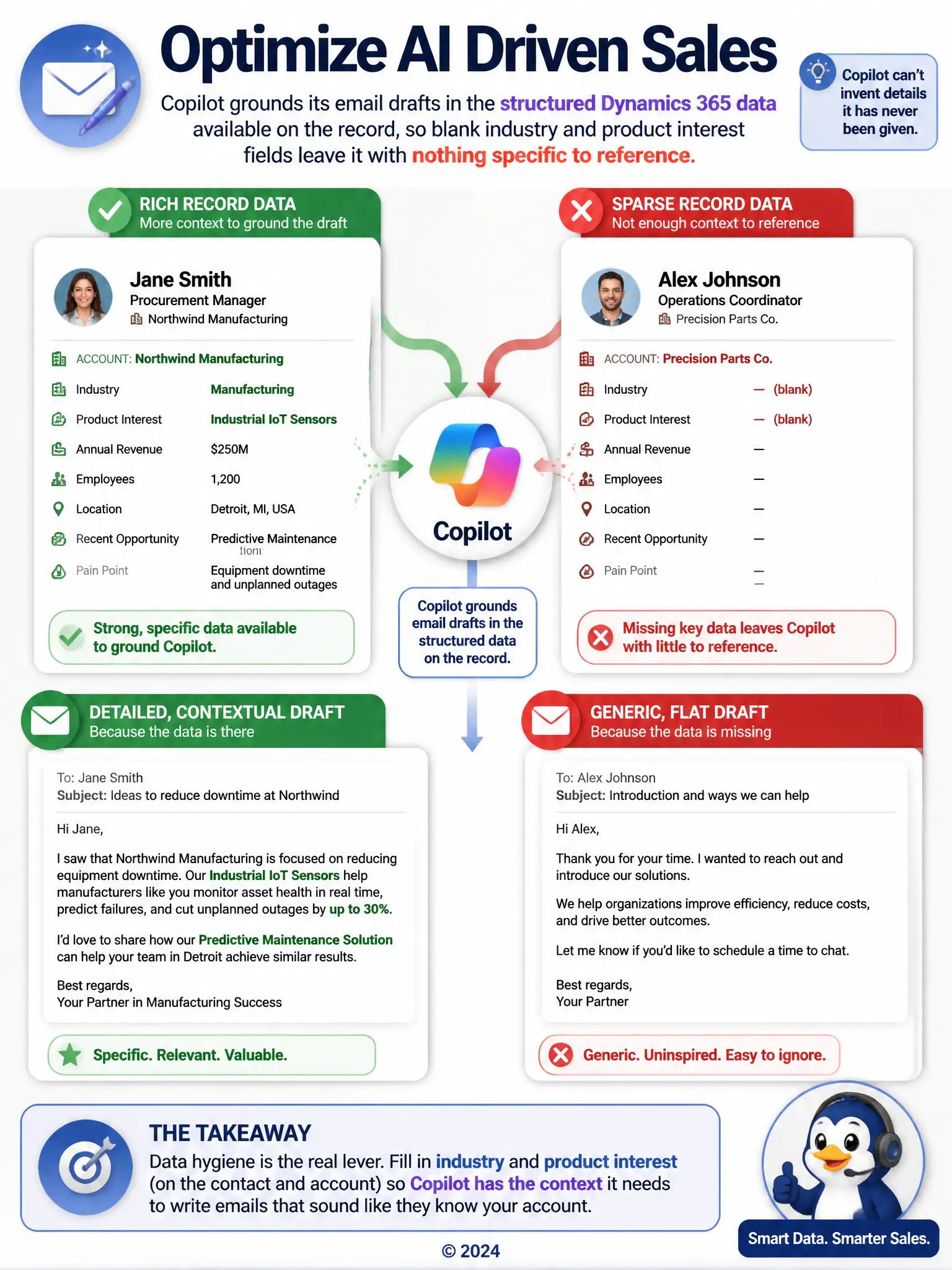
You can't expect Copilot to invent details it was never given. If the industry and product interest fields are blank, there's nothing specific for it to pull into the email. Fill in the record data, and the drafts get sharper.
Full Explanation
The correct conclusion is that Copilot grounds its email drafts in the structured Dynamics 365 data available on the record, so blank industry and product interest fields leave it with nothing specific to reference. Copilot's email drafting grounds its output in the structured data present on the contact, account, and related records; it can only reference details like industry or product interest when those fields are actually populated. Because this contact and its parent account had blank industry and product interest fields, Copilot had no specific signal to draw on and produced a generic draft, which is consistent with it drafting detailed emails for other contacts whose records carry richer data. The practical takeaway is that draft quality is a direct function of data quality on the record, not a limitation of the feature itself. The claim that email drafting only personalizes messages for contacts who have an active opportunity in the Proposal stage or later is incorrect because email drafting personalization is not gated by opportunity stage; Copilot draws on available record data regardless of where an associated opportunity sits in the pipeline. The suggestion that the generic draft indicates the seller's security role lacks read access to the account table is incorrect because a security role access gap would typically block the seller from viewing the account entirely rather than producing a generic-but-functional draft, and nothing in the scenario indicates an access failure. The idea that Copilot caches the first draft it generates for any new contact and reuses that same generic template for all subsequent requests is incorrect because Copilot does not cache and reuse a single template per contact; each drafting request evaluates the record's current data at that time.