
A consultant is preparing to enable AI-driven predictive opportunity scoring for a sales organization migrating to Dynamics 365 Sales. (Select TWO.) Which two conditions should the consultant confirm before turning the model on so that it produces reliable scores?
Select all correct answers, then click Submit.
Short Explanation
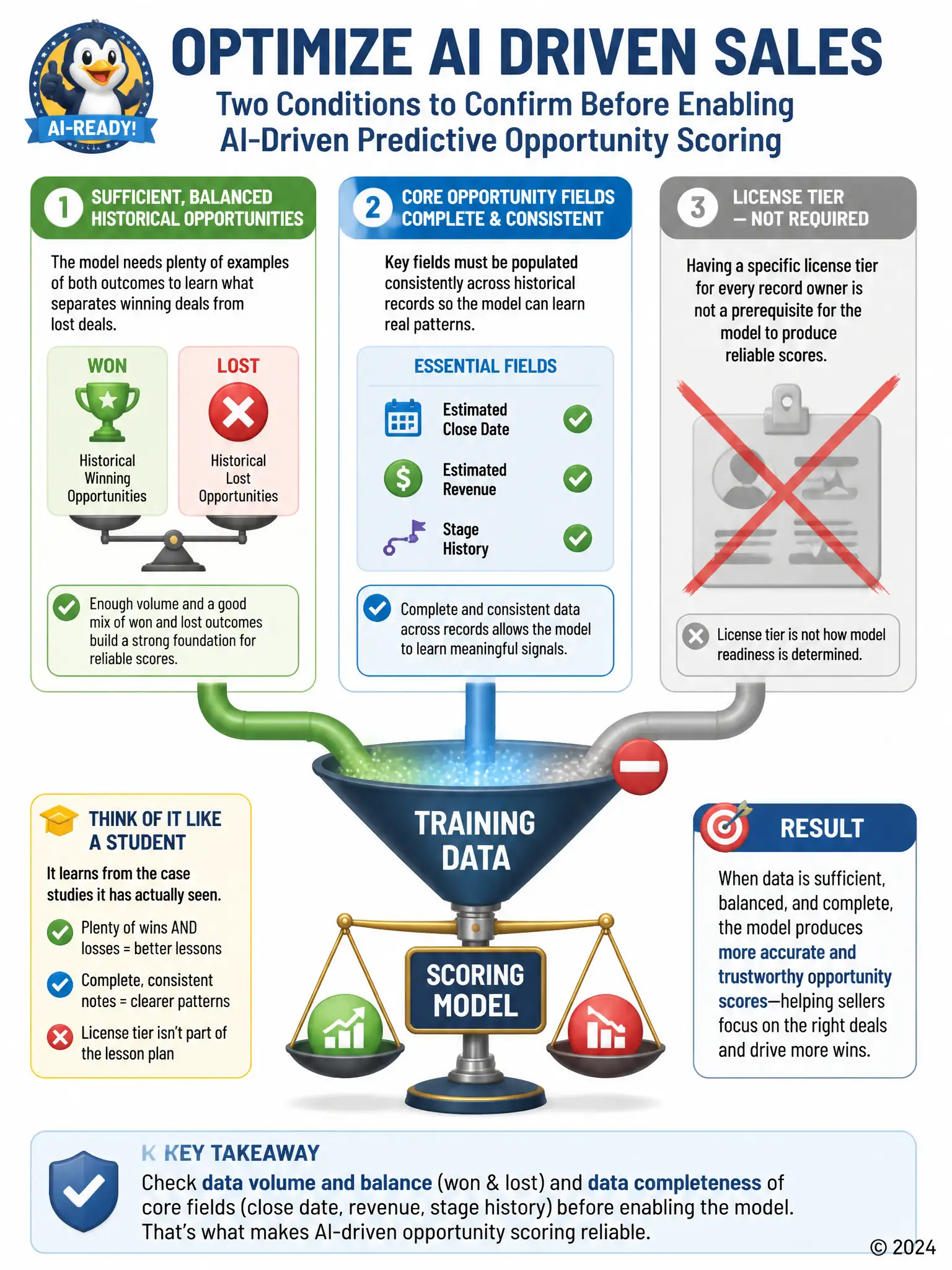
Think of predictive opportunity scoring as a student that can only learn from real case studies, so you need enough historical opportunities with both won and lost outcomes to see what separates them. You also need core fields like estimated close date, estimated revenue, and stage history filled in consistently, because the model can't learn patterns from blank or messy records. Don't worry about custom fields or owners' licenses; data volume, balance, and completeness are what matter.
Full Explanation
The correct conditions are the sufficient historical volume with both won and lost outcomes, and the consistent population of core opportunity fields. Predictive opportunity scoring is a machine learning model trained on historical opportunity data, so it needs enough past opportunities with both won and lost outcomes to learn what distinguishes a deal that closes from one that does not; a dataset skewed toward only wins, or too small, produces an unreliable model. It also depends on core fields like estimated close date, estimated revenue, and stage history being populated consistently across those historical records, since gaps or inconsistent entry starve the model of the signals it needs to score new opportunities meaningfully. Confirming both conditions before enabling the model is standard pre-flight due diligence during a migration. The condition about every opportunity owner holding a Sales Enterprise license is incorrect because the model scores opportunity records based on their data, not the licensing tier of the record owner; there is no such licensing gate on which records get scored. The condition about disabling all custom fields on the opportunity table is incorrect because predictive scoring is not restricted to out-of-box fields only, and disabling custom fields is unnecessary and would only remove potentially useful signals rather than help the model.