
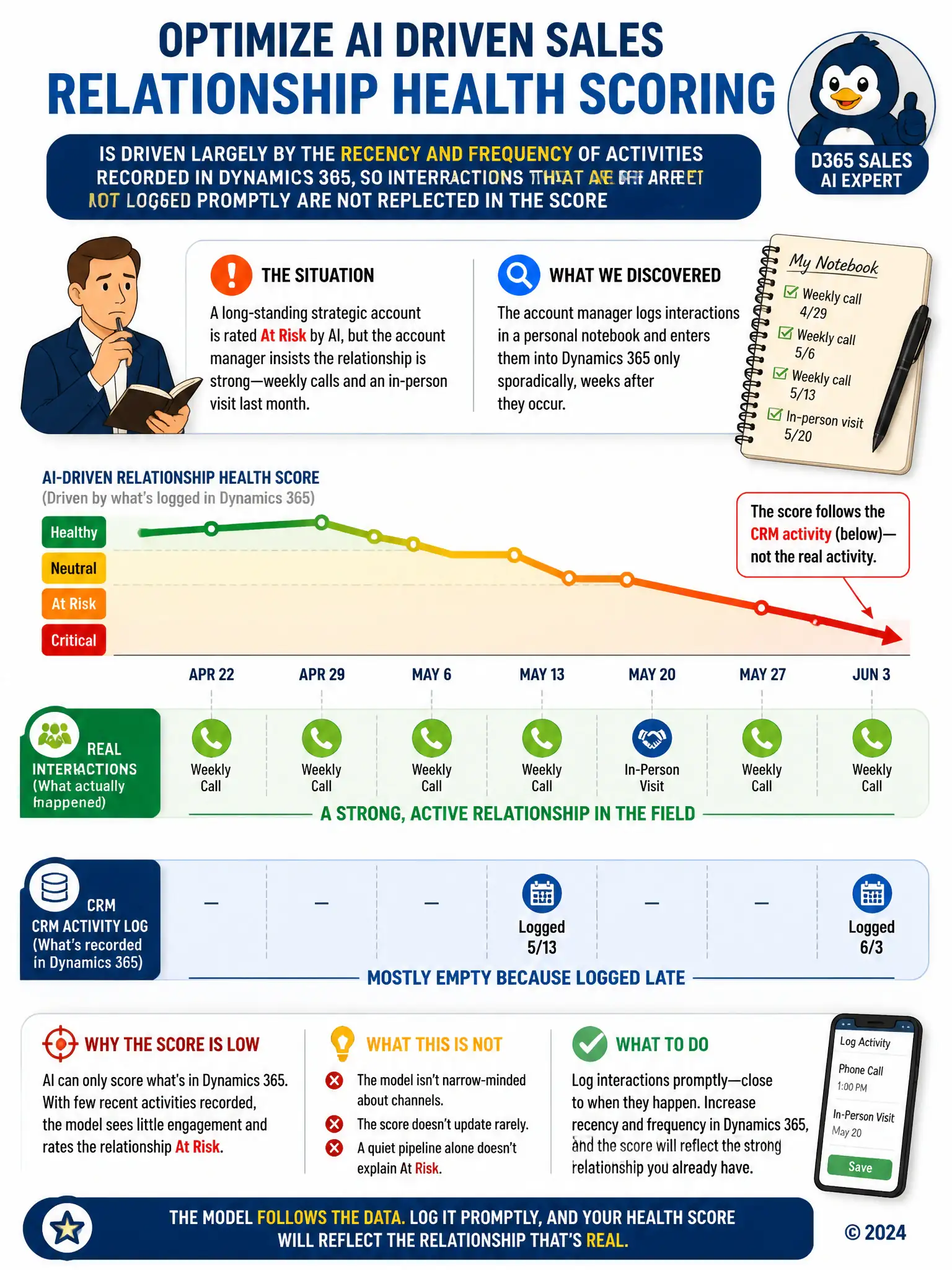
A consultant reviews the AI-driven relationship health score for a long-standing strategic account and finds it rated At Risk despite the account manager insisting the relationship is strong, with weekly phone calls and an in-person visit last month. Investigating further, the consultant finds that the account manager logs these interactions in a personal notebook and enters them into Dynamics 365 only sporadically, weeks after they occur. What is the best explanation for the low score?
Select an answer to reveal the explanation.
Short Explanation
You can't blame the model for missing calls and visits that never made it into the CRM. If the account manager keeps them in a notebook, the score thinks the account is quiet. Log them promptly, and the health score will catch up to the real relationship.
Full Explanation
The correct explanation is that relationship health scoring is driven largely by the recency and frequency of activities recorded in Dynamics 365, so interactions that are not logged promptly are not reflected in the score. The model has no visibility into interactions that happen but are never entered into the system, or that are entered only after a significant delay. Because the account manager's weekly calls and recent visit lived in a personal notebook rather than the CRM, the model had no timely data to reflect a healthy, active relationship, and the score understandably trended toward At Risk. This is a data-entry problem, not a model failure. The option claiming the relationship health model only accounts for email and Teams chat activity, so phone calls and in-person visits are structurally excluded regardless of logging, is incorrect because relationship health incorporates a broader set of activity types, not solely email and Teams chat; phone calls and in-person visits, once logged, are legitimate signals. The option claiming the score is At Risk because the account has not generated a new opportunity in the current fiscal quarter, which the model weighs above all other signals, is incorrect because the absence of a new opportunity is not the dominant or exclusive driver of the score; engagement recency and frequency carry substantial weight independent of open pipeline. The option claiming relationship health scores refresh only once per fiscal year, so the score reflects data from before the recent calls and visit occurred, is incorrect because relationship health scores update far more frequently than annually, so a full year of staleness is not a plausible explanation for a score that should reflect the account manager's recent activity once logged.