
A sales director reviews the Dynamics 365 Sales AI-generated predicted forecast for a business unit and finds it does not match the sum of opportunities the team has manually marked as Committed. The predicted total is higher and shifts week to week even when no committed opportunities changed stage. A consultant is asked to explain the discrepancy. What is the correct explanation?
Select an answer to reveal the explanation.
Short Explanation
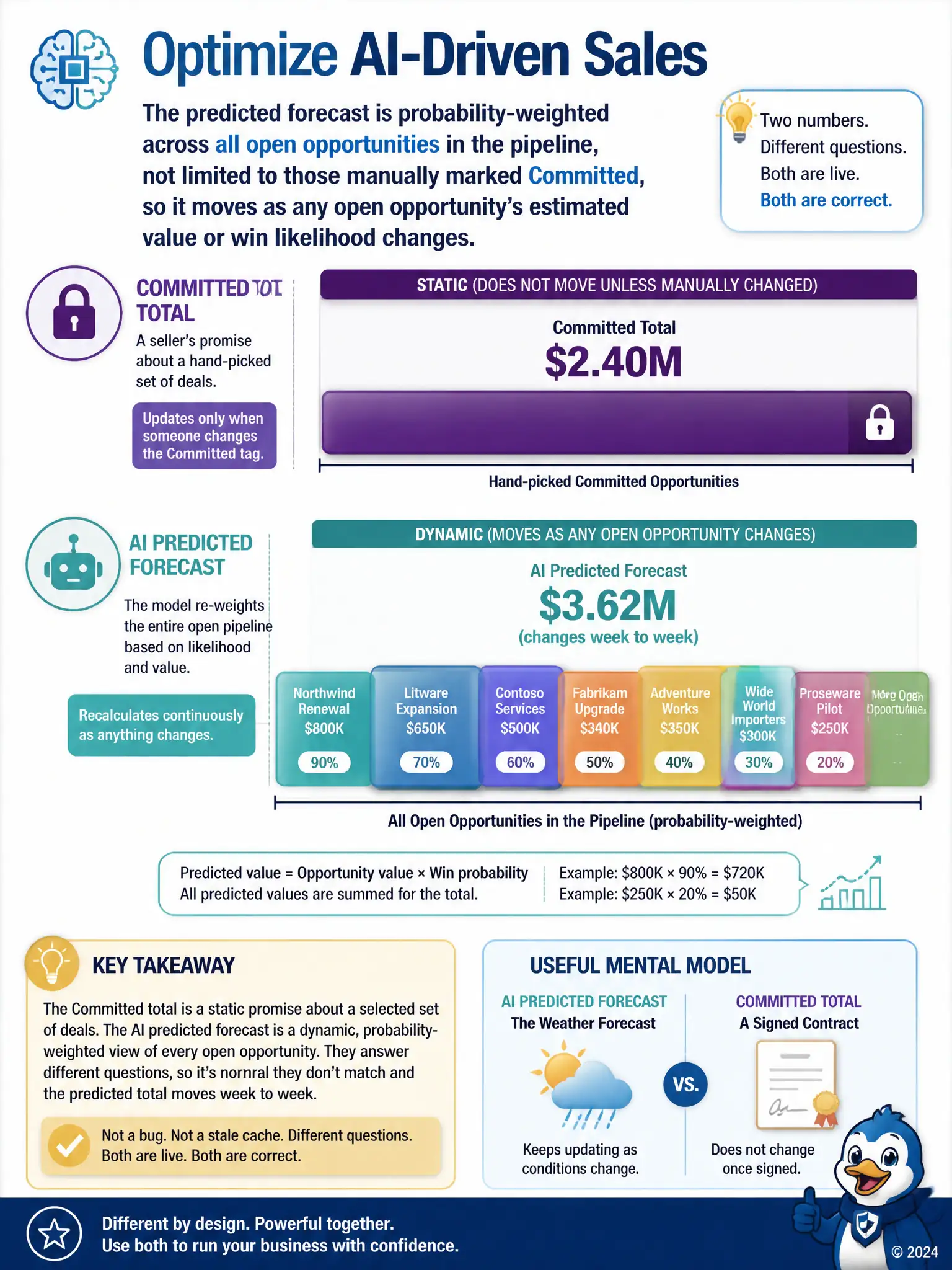
You're comparing two different things: the Committed total is a seller-managed promise about selected deals, while the predicted forecast probability-weights the whole open pipeline. That's why the predicted number can move week to week even when no Committed opportunity changed stage.
Full Explanation
The correct explanation is that the predicted forecast is probability-weighted across all open opportunities in the pipeline, not limited to those manually marked Committed, so it moves as any open opportunity's estimated value or win likelihood changes. The AI-generated predicted forecast applies win-probability weighting across the full set of open opportunities, not just the subset a seller has manually tagged as Committed. Because any open opportunity's estimated revenue or predicted likelihood can shift week to week as new activity, engagement, or data comes in, the aggregate predicted figure moves even when the Committed-tagged opportunities themselves are untouched. This is expected behavior reflecting two different, complementary views of the pipeline: a seller-driven category and a model-driven probability estimate. The claim that the predicted forecast recalculates only once per fiscal quarter and that the discrepancy is a caching artifact resolving at quarter close is incorrect because the predicted forecast updates continuously as underlying opportunity data changes, not on a fixed quarterly cache cycle. The claim that the Committed category total is a fixed snapshot taken at record creation and never updates, while the predicted forecast is the only figure kept current, is incorrect because the Committed category is a seller-managed field that can be updated at any time; it is not frozen at record creation. The claim that the predicted forecast includes closed-won opportunities from the prior quarter until an administrator manually purges them from the model is incorrect because closed-won opportunities are excluded from open-pipeline predictions once closed, and there is no manual purge step required to remove them from the current forecast calculation.