
A sales director enables AI-assisted forecasting in a Dynamics 365 Sales Premium environment for a business unit that migrated from a spreadsheet-based process six weeks ago, with only two months of opportunity history in Dynamics 365. After enabling the feature, the forecast grid shows manager and rep submitted numbers but never displays an AI-predicted forecast line. What should the consultant tell the director?
Select an answer to reveal the explanation.
Short Explanation
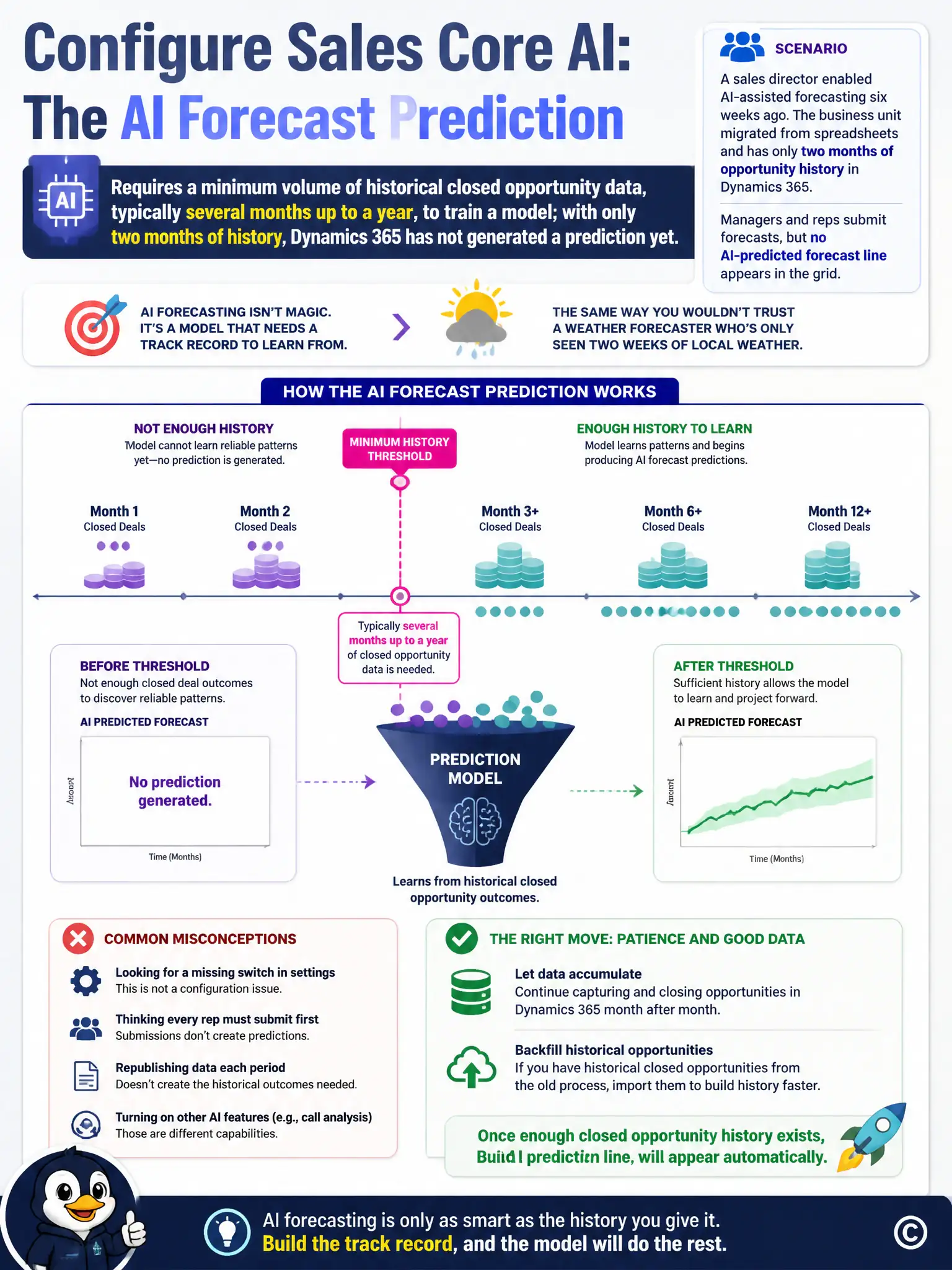
AI forecasting isn't magic; it needs a track record. With only two months of closed opportunity history, Dynamics 365 doesn't have enough data to train a confident prediction, so the AI line stays hidden. Let more history accumulate, or backfill old opportunities if you can.
Full Explanation
The correct guidance is that AI forecast prediction requires a minimum volume of historical closed opportunity data, typically several months up to roughly a year, to train a model; with only two months of history, Dynamics 365 has not generated a prediction yet. AI-assisted forecast predictions are generated by a model trained on historical closed-opportunity data, and Dynamics 365 Sales needs a meaningful volume of that history before it will produce a confident prediction line. With only two months of opportunities recorded, the model has not accumulated enough data to render a forecast. The claim that AI-predicted forecasting only activates once every rep in the business unit has submitted at least one manual forecast is incorrect because the AI prediction is calculated independently of whether every rep has submitted a manual forecast; manual and AI-predicted numbers are separate columns that do not gate one another. The claim that the forecast configuration record must be republished after every fiscal period change or the AI line will not calculate is incorrect because forecast configuration records do not need to be republished on a recurring schedule for the AI line to calculate; republishing affects structural changes like hierarchy or category edits, not data volume. The claim that AI forecasting predictions require Conversation Intelligence to be enabled first, since forecast confidence is partly derived from call sentiment, is incorrect because AI forecasting is driven by opportunity pipeline and historical trend data, not by Conversation Intelligence call sentiment, so enabling Conversation Intelligence would not produce a missing prediction. The director should be told to wait until enough opportunity history accumulates, or backfill historical closed opportunities if available, rather than treating this as a broken configuration.