
An organization piloting an autonomous AI seller agent wants the agent to keep negotiating routine renewal discounts with customers automatically, but any discount the agent proposes above 15 percent must be reviewed by a human account manager before it is sent. What should the implementation team configure to enhance the agent's behavior for this requirement?
Select an answer to reveal the explanation.
Short Explanation
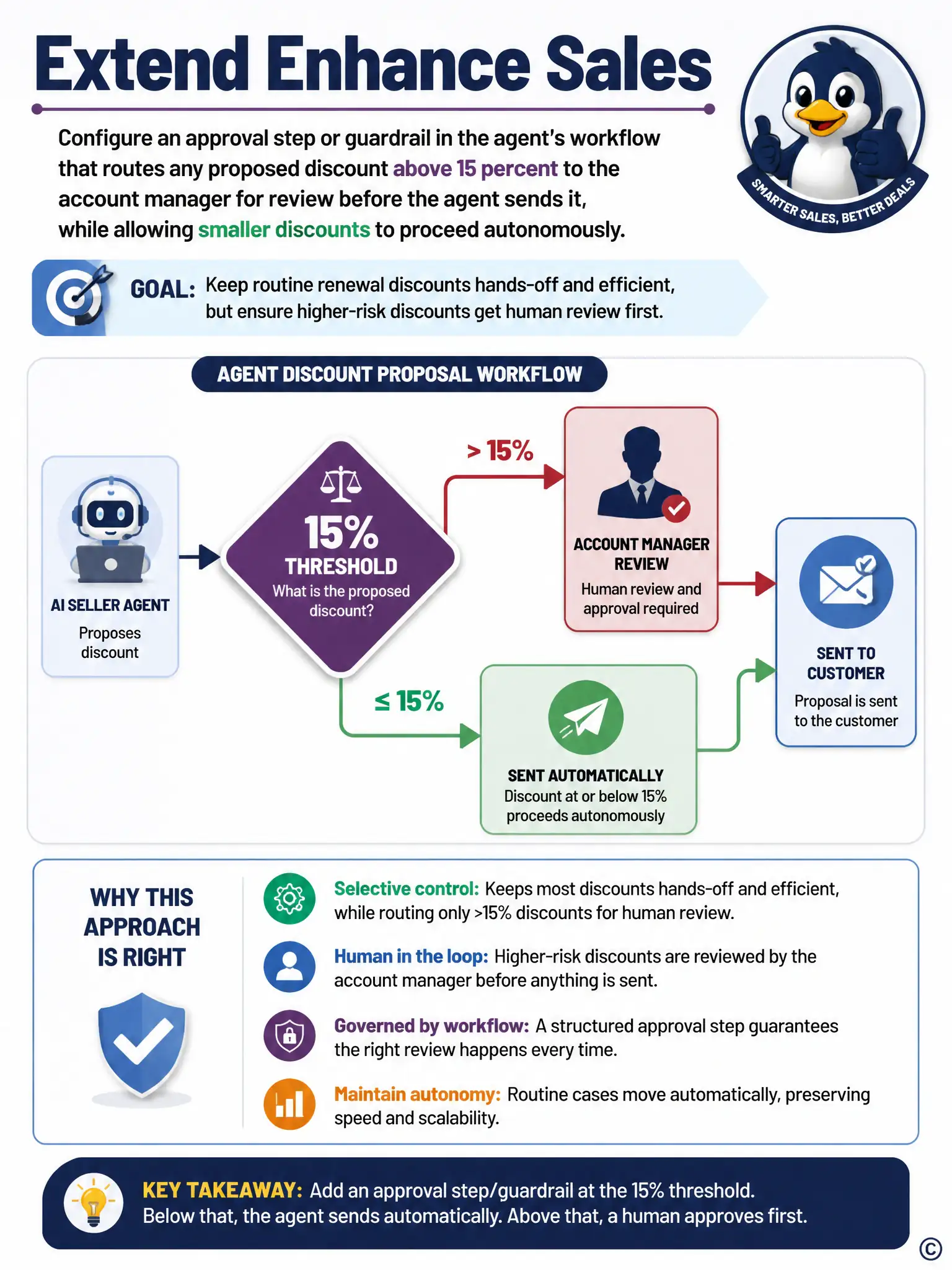
You need a workflow guardrail that sends only discounts over 15 percent to a human account manager before they're sent. That keeps routine renewals moving on their own while putting a hard checkpoint on the riskier offers.
Full Explanation
Configure an approval step or guardrail in the agent's workflow that routes any proposed discount above 15 percent to the account manager for review before the agent sends it, while allowing smaller discounts to proceed autonomously. This matches the requirement because routine, lower-value renewals stay hands-off, but anything riskier waits for a human before reaching the customer. The approach that caps the agent's maximum discount authority at 15 percent and takes no further action is wrong because it prevents the agent from ever proposing a larger discount, removing the scenario that was supposed to get reviewed instead of adding the requested review step. The approach that turns off autonomous mode entirely and requires an account manager to approve every message, including routine renewals below 15 percent, is wrong because it eliminates the autonomous handling the organization wants to keep and creates unnecessary review workload. The approach that adds a system-prompt note asking the agent to be careful with discounts above 15 percent, relying on the language model to self-enforce the threshold without a workflow control, is wrong because a prompt-level instruction isn't an enforced control; a language model can drift from soft guidance under ambiguous inputs, so nothing structurally stops the agent from sending a large discount without review. A workflow-level guardrail, unlike a prompt suggestion, deterministically enforces the threshold regardless of how the agent reasons about any individual negotiation.