
A sales enablement team wants Conversation Intelligence to detect when a prospect raises a pricing objection during a recorded call (phrases like 'that's more than we budgeted' or 'can you do better on price') and automatically surface a battlecard about pricing flexibility to the rep during the call. What should the team configure to extend Conversation Intelligence for this purpose?
Select an answer to reveal the explanation.
Short Explanation
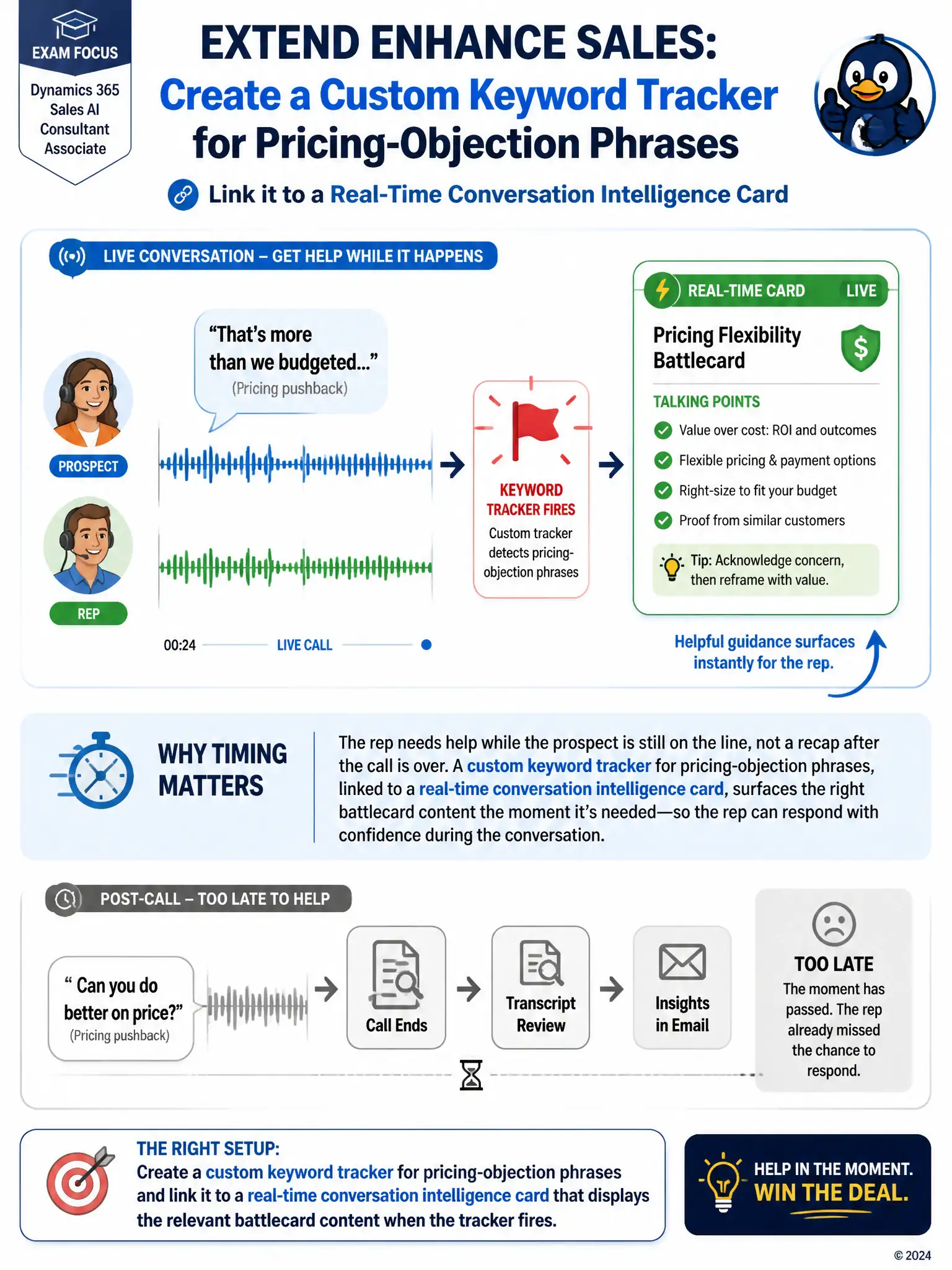
You need the rep to get help while the prospect is still on the line, so build a custom keyword tracker for pricing-objection phrases and wire it to a real-time card that surfaces the battlecard when it fires. Competitor trackers or post-call transcript searches won't catch budget pushback in the moment, and disabling sentiment doesn't unlock anything.
Full Explanation
The right configuration is to create a custom keyword tracker for pricing-objection phrases and link it to a real-time conversation intelligence card that displays the relevant battlecard content when the tracker fires. Conversation Intelligence supports custom keyword trackers, and linking a pricing-objection tracker to a real-time card lets the rep see the relevant battlecard content the moment the prospect raises a price concern, while the call is still in progress and actionable. The approach of waiting for the call recording to finish, then having a sales manager manually search the transcript for pricing keywords and email the rep a battlecard afterward, is incorrect because reviewing the transcript after the call and emailing a battlecard afterward cannot influence how the rep handles the objection during that same conversation, which is the stated goal. The approach of setting a competitor-mention tracker, on the assumption that pricing objections are classified the same way as competitor mentions, is incorrect because a competitor-mention tracker is scoped to competitor names and would not reliably fire on generic pricing-objection language, since trackers match the terms and phrases configured for their specific purpose. The approach of disabling sentiment analysis for the call, on the assumption that sentiment scoring and keyword trackers cannot run in the same session, is incorrect because sentiment analysis and keyword trackers are independent features that run concurrently in the same call; disabling sentiment analysis would not enable or improve keyword tracking and only removes an unrelated signal the team might still want. Building a purpose-built tracker tied to a live card is the extension point that actually connects detection to real-time guidance for the rep.