
An implementation team is enhancing the Sales Order Agent for a distributor that uses internal SKU codes different from the codes vendors use in incoming purchase orders (e.g., 'DST-4471' internally vs. 'V-4471-A' from a specific vendor). The agent currently fails to match line items from that vendor's POs to the correct products. The team wants the agent to reliably resolve the vendor's codes to internal SKUs going forward. (Select TWO.)
Select all correct answers, then click Submit.
Short Explanation
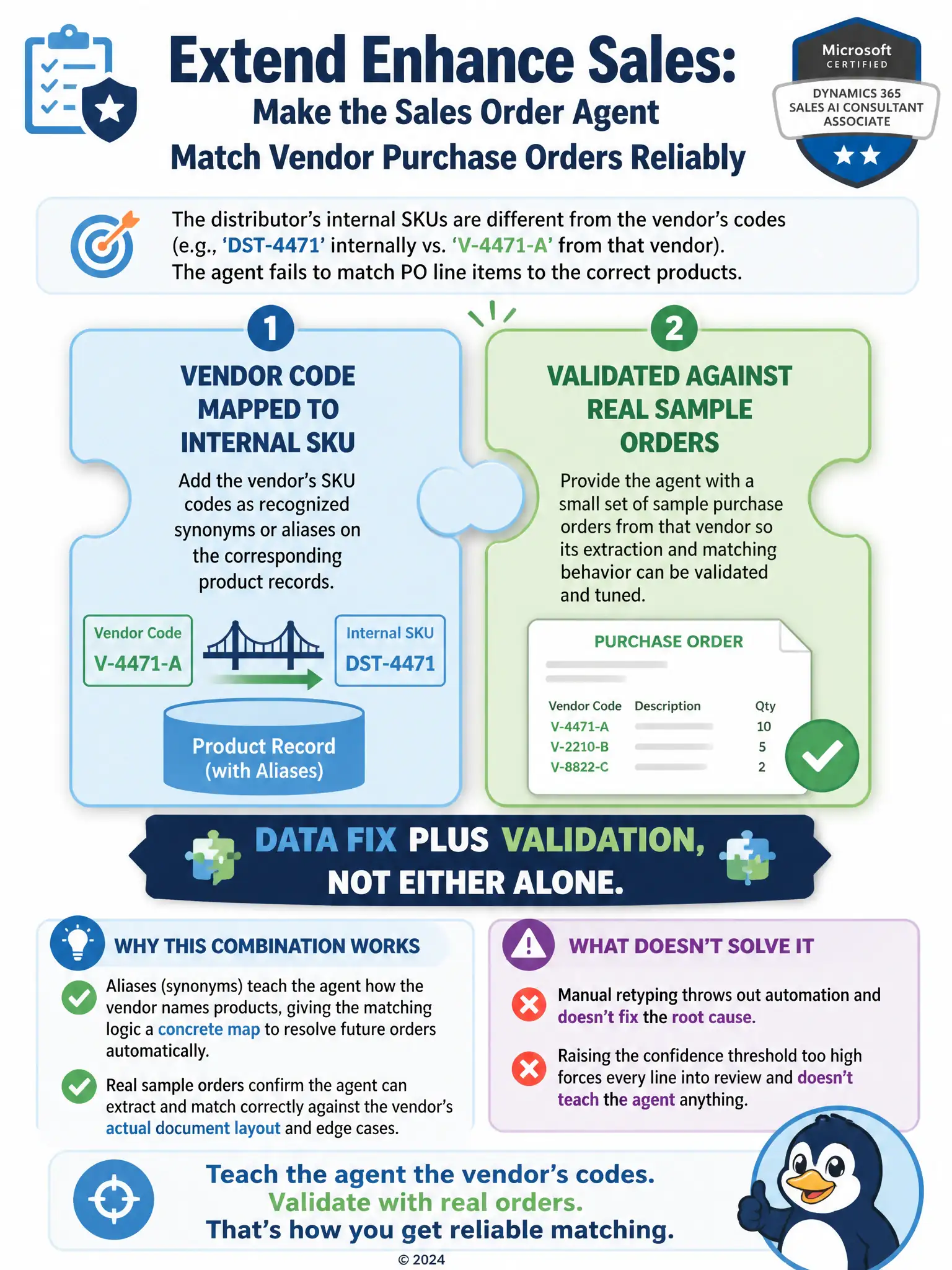
You need to teach the agent the vendor's codes and prove it can handle that vendor's paperwork. Add the vendor's codes as synonyms or aliases on the matching product records, then run a few real purchase orders from that vendor through the agent to validate extraction and matching.
Full Explanation
The correct answers are adding the vendor's SKU codes as recognized synonyms or aliases on the corresponding product records, and providing the agent with a small set of sample purchase orders from that vendor so its extraction and matching behavior can be validated and tuned against real formatting. The Sales Order Agent matches incoming purchase order line items to Dynamics 365 Sales products, and when a vendor uses its own code scheme, registering that vendor's codes as synonyms on the product record gives the agent a direct mapping to resolve future purchase orders correctly. Feeding the agent sample purchase orders from that vendor lets the team confirm the agent extracts and matches line items correctly against that vendor's real formatting before relying on it in production, catching any edge cases the synonym mapping alone might miss. Instructing reps to manually retype every purchase order from that vendor instead of letting the agent process it is incorrect because reverting to fully manual entry abandons the automation goal entirely instead of fixing the underlying matching gap. Increasing the Sales Order Agent's confidence threshold to 100 percent so it stops attempting automatic matches entirely is incorrect because it does not teach the agent the vendor's code scheme; it simply guarantees the agent flags every line item for manual review, which does not solve the mismatch and effectively disables automated matching rather than enhancing it. Combining a data-level fix, the synonym mapping, with a validation step against real samples addresses both the immediate mismatch and the risk of similar mismatches with that vendor's future orders.