
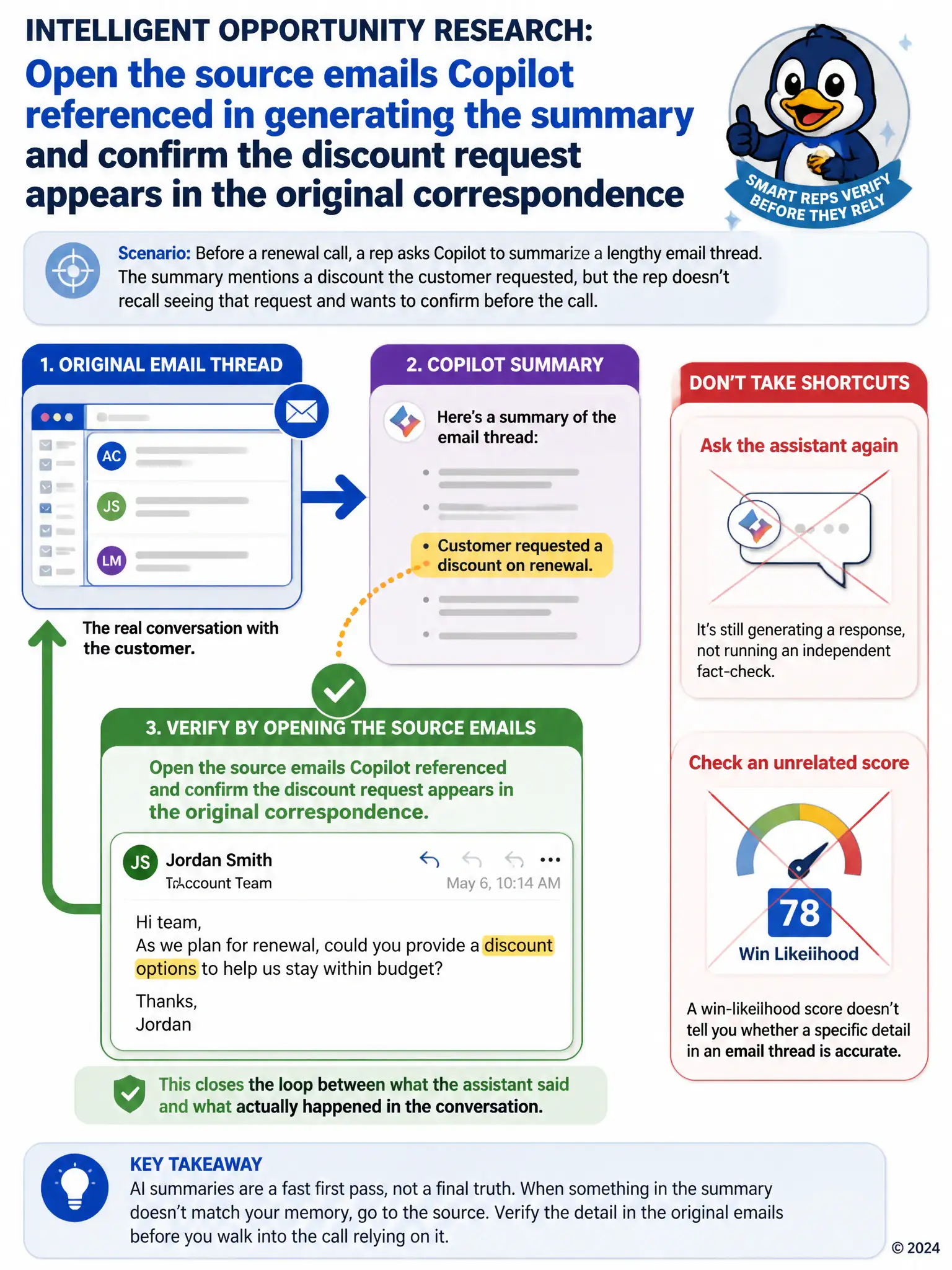
Before a renewal call, a rep asks Copilot to summarize a lengthy email thread with the customer. The summary mentions a discount the customer requested, but the rep does not recall seeing that request and wants to confirm before the call. What is the most reliable way for the rep to verify the summary's accuracy?
Select an answer to reveal the explanation.
Short Explanation
When a summary mentions a discount you don't remember, go back to the source emails Copilot referenced and read them yourself. That is the only way to confirm the claim against the actual customer correspondence. Treat the summary as a fast first pass, not proof.
Full Explanation
The most reliable approach is to open the source emails Copilot referenced in generating the summary and confirm that the discount request appears in the original correspondence. Because Copilot's summary is grounded in the actual email thread, tracing a specific claim back to the source messages and reading the original text directly closes the loop between the AI-generated summary and the underlying record of truth. The option that suggests regenerating the summary a second time and treating slightly different wording as confirmation is incorrect because comparing wording does not verify factual accuracy; a second generation could restate the same error in different words, or vary stylistically without changing whether the underlying claim is true. The option that suggests asking Copilot directly whether the summary is accurate is incorrect because asking the assistant to confirm its own prior output does not constitute independent verification; the assistant does not have a reliable self-checking mechanism distinct from generating another response, so this does not substitute for reviewing source material. The option that suggests checking the opportunity's predictive score is incorrect because the predictive opportunity score reflects likelihood to win based on different signals entirely and has no relationship to whether a specific detail in an email summary is accurate. When AI-generated content will inform how a rep prepares for a customer conversation, tracing claims back to their source records is the practical safeguard against acting on a misremembered or misrepresented detail.