
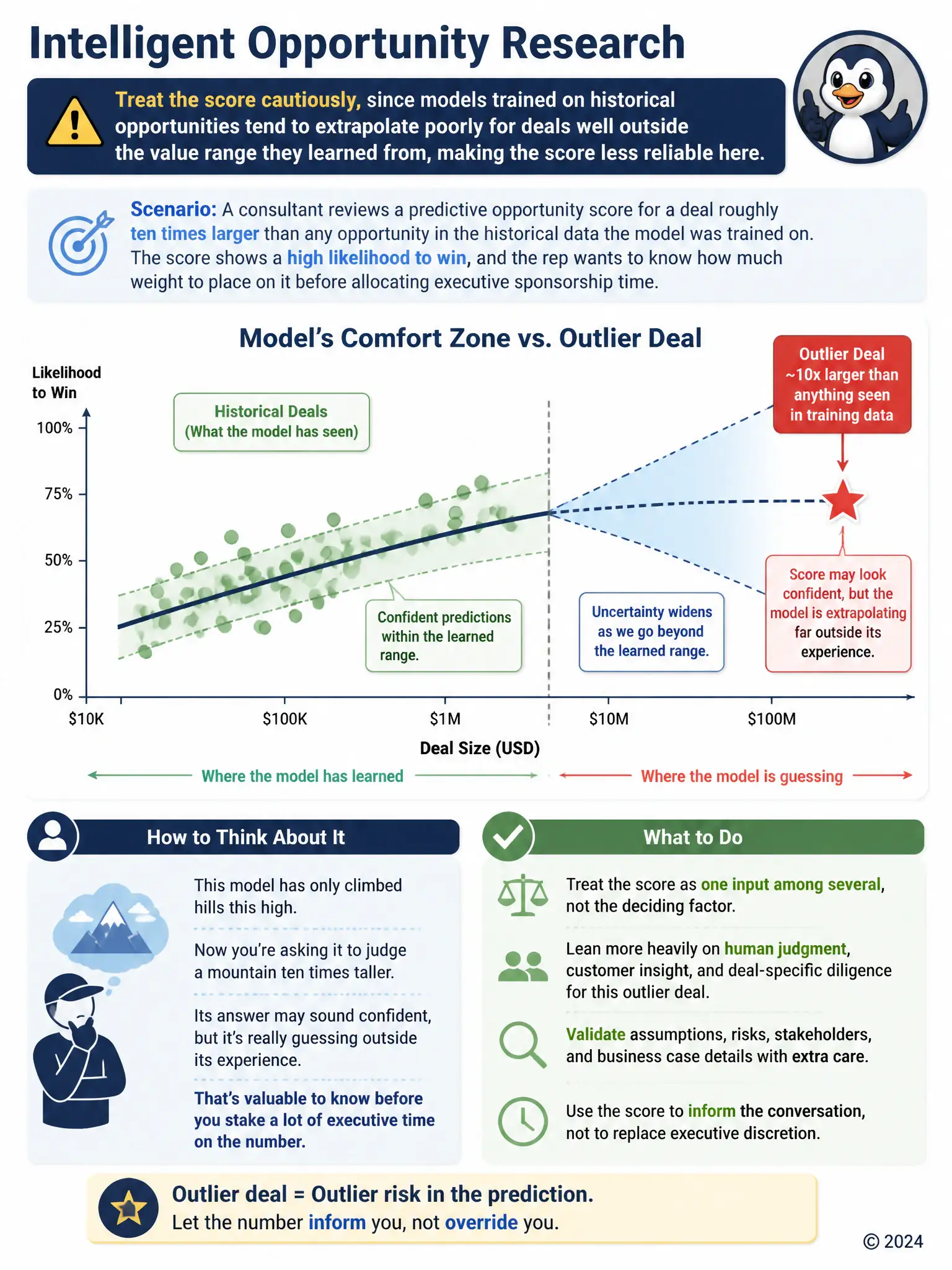
A consultant reviews a predictive opportunity score for a deal roughly ten times larger than any opportunity in the historical data the model was trained on. The score shows a high likelihood to win, and the rep wants to know how much weight to place on it before allocating executive sponsorship time. What should the consultant advise?
Select an answer to reveal the explanation.
Short Explanation
Treat the score cautiously. The model learned from deals far smaller than this one, so it's extrapolating outside its experience and the number is less reliable. Lean on human judgment and deal-specific diligence before you commit executive time.
Full Explanation
The correct advice is to treat the score cautiously, since predictive models learn patterns from the historical opportunities they were trained on, and when a new deal falls far outside the range of values the model has seen, its predictions for that deal become less reliable because the model is extrapolating rather than interpolating from familiar territory. Advising caution and supplementing the score with human judgment for this large outlier is the appropriate response before committing executive sponsorship time. The option to disregard the score entirely, because predictive opportunity scoring cannot generate a value for any opportunity above the largest historical deal size, is incorrect because the scoring engine will still generate a numeric score for an outlier opportunity; it does not refuse to score deals above a size threshold, it simply produces a less trustworthy estimate. The option to trust the score fully, because predictive models weight deal value more heavily than other signals and larger deals always produce more accurate scores, is incorrect because deal value is only one signal among many the model considers, and there is no guarantee that larger deals produce more accurate scores; in fact the opposite is often true when the model has little comparable training data at that scale. The option to wait a day before deciding, since the model automatically retrains itself whenever an outlier opportunity is scored, correcting the estimate, is incorrect because predictive opportunity scoring does not automatically retrain itself in response to a single outlier being scored; retraining typically happens on a scheduled or administrator-initiated basis, not reactively within a day. Recognizing where a model's training data thins out is a core part of using model-driven scores responsibly rather than treating every number as equally trustworthy.