
A rep working an opportunity disagrees with an AI-generated next-best-action suggestion to schedule a pricing call, because the rep knows from an offline conversation that the customer explicitly asked to pause discussions for a month. This context exists only in the rep's personal notebook, not anywhere in Dynamics 365 Sales. What should the rep do so future recommendations account for this?
Select an answer to reveal the explanation.
Short Explanation
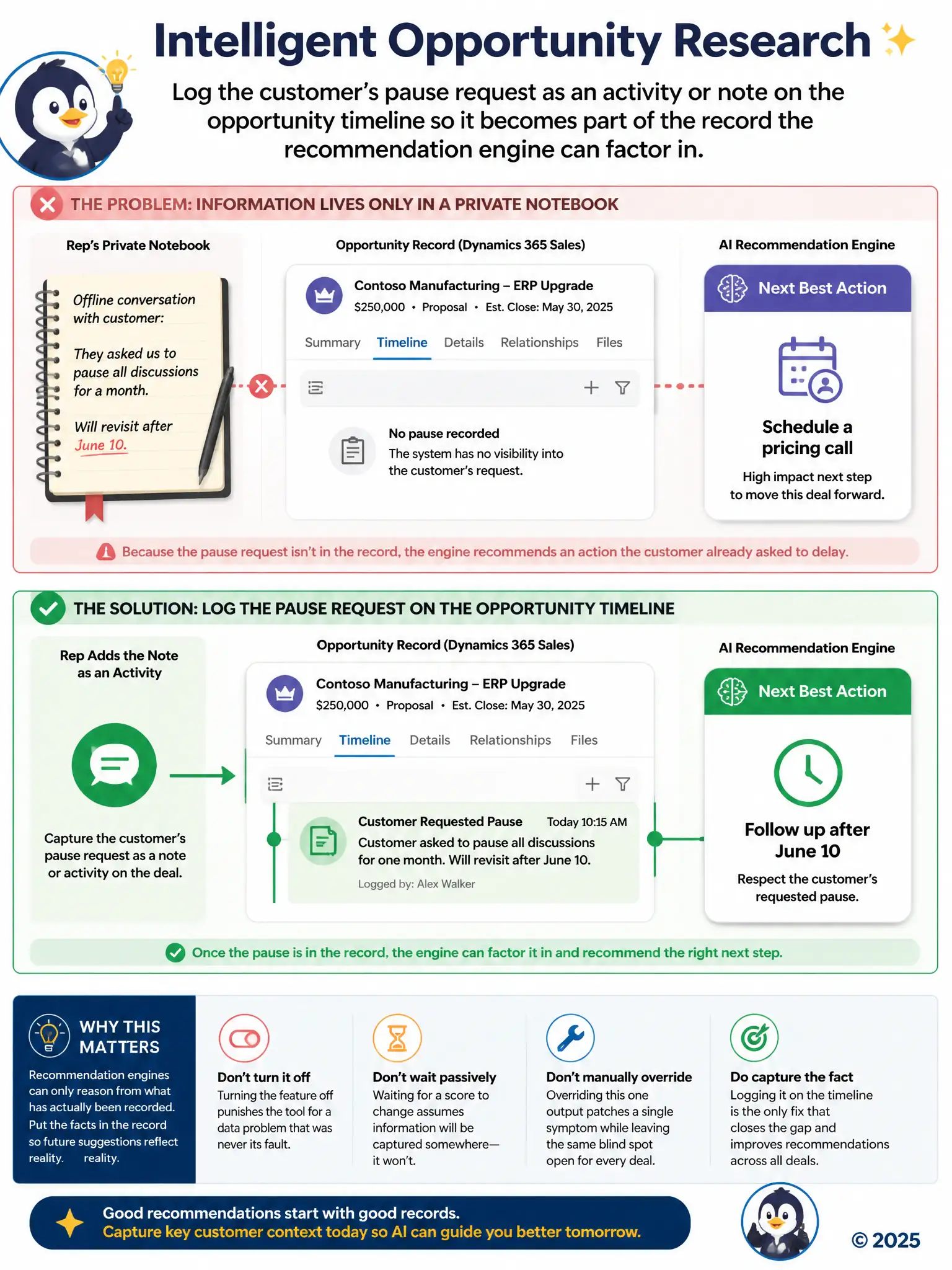
If the customer's pause request only lives in your notebook, the system can't see it. Log it as an activity or note on the opportunity timeline so future recommendations can reflect reality instead of repeating a suggestion the customer already declined.
Full Explanation
The correct answer is logging the customer's pause request as an activity or note on the opportunity timeline so it becomes part of the record the recommendation engine can factor in. Next-best-action suggestions are generated from what exists in the system, and the customer's pause request currently lives only in the rep's personal notebook, invisible to any recommendation engine. Logging it as an activity or note on the opportunity timeline puts that fact into the record the AI can actually read, so future suggestions can reflect a paused deal instead of recommending a pricing call the customer explicitly declined. Dismissing the suggestion and disabling next-best-action recommendations for the opportunity is incorrect because it throws away a feature that will become useful again once the missing context is captured, and it does nothing to fix the actual cause, which is a data gap rather than a broken engine. Waiting for the predictive opportunity score to update automatically is incorrect because predictive opportunity score and next-best-action suggestions are related but distinct outputs, and passively waiting for a score change does nothing to inform the system about a pause request that was never recorded anywhere. Asking a system administrator to manually override the next-best-action engine's output for this specific opportunity record is incorrect because it addresses only this single instance and does not fix the underlying gap, so the same kind of mismatched suggestion will keep recurring on other opportunities where offline context is not captured.