
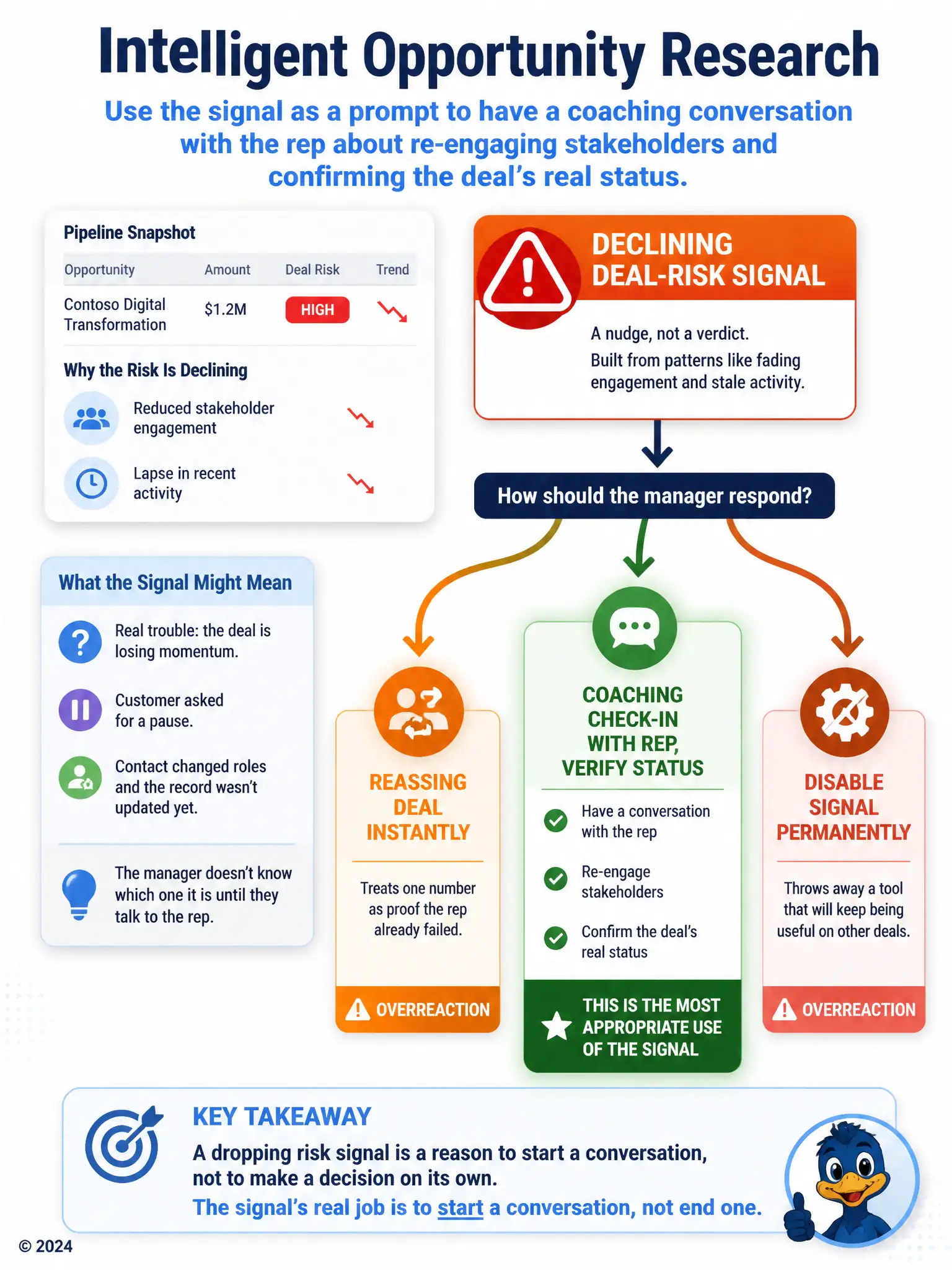
A sales manager reviews a pipeline dashboard and sees that a large opportunity has been flagged with a declining deal-risk signal, driven by reduced stakeholder engagement and a lapse in recent activity. The manager is deciding how to respond. What is the most appropriate use of this AI-generated signal?
Select an answer to reveal the explanation.
Short Explanation
That dropping risk signal is a nudge to go find out what's really going on, not a verdict you should act on by itself. It can come from fading engagement or stale activity, which might mean real trouble, a customer-requested pause, or a contact change nobody updated yet. Use it to start a coaching conversation with the rep and confirm the deal's real status.
Full Explanation
The correct choice is the coaching-conversation approach: use the signal as a prompt to talk with the rep about re-engaging stakeholders and confirming the deal's real status, rather than acting on the score alone. The deal-risk signal built on engagement and activity data is a useful early warning, but it does not know everything happening on the account, such as a stakeholder change already in motion or a deal that has simply paused for a legitimate business reason. The appropriate response is to treat the signal as a prompt for a conversation with the rep, verifying what is actually happening and deciding on next steps together, rather than treating the score as a final verdict. The immediate-reassignment approach is incorrect because reassigning the opportunity based on one risk flag overreacts to a signal that may reflect a temporary lull rather than the rep losing the account, and it skips the step of finding out what is actually true. The remove-from-forecast approach is incorrect because removing the opportunity from the forecast without checking with the rep overrides firsthand knowledge the rep may have, such as a delay the customer requested, and treats an imperfect signal as certain. The disable-signals approach is incorrect because disabling the signal entirely based on a single instance discards a tool that remains useful going forward; one flagged deal does not establish that the feature is broadly miscalibrated.