
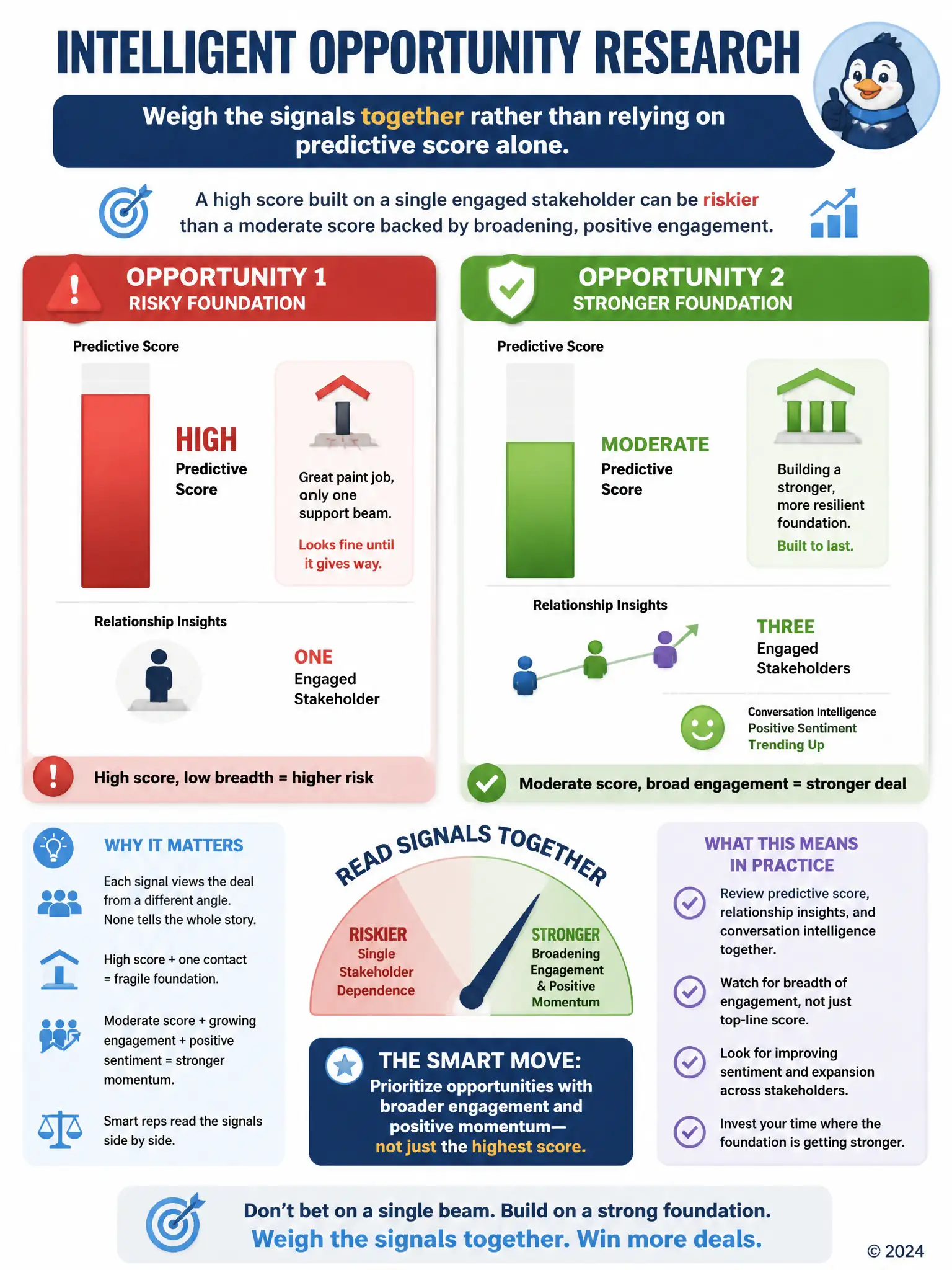
At the start of the week, a rep with a large pipeline wants to decide which opportunities need the most attention. One deal shows a high predictive score but a relationship-insights graph with only one engaged stakeholder, while another shows a moderate predictive score but rising engagement across three stakeholders and positive conversation intelligence sentiment. How should the rep prioritize using the available AI signals?
Select an answer to reveal the explanation.
Short Explanation
Don't let a shiny predictive score fool you. A high score with only one engaged stakeholder is risky, while a moderate score with rising, positive engagement across multiple stakeholders is often the safer bet. You should weigh the signals together and focus on the deal with the stronger overall story.
Full Explanation
The correct approach is to weigh the signals together rather than relying on predictive score alone, because predictive score, relationship insights, and conversation intelligence each measure something different, and no single one captures the full picture of a deal's health. The first opportunity looks strong on score but rests on a single stakeholder, which is a real vulnerability if that person leaves or loses influence, while the second has a lower score but broadening, positive multi-stakeholder engagement, which often signals durable momentum. Weighing the signals together gives a more accurate read than trusting any one of them in isolation. The option that prioritizes strictly by predictive score is incorrect because predictive score is generated primarily from opportunity and activity data patterns and does not fully incorporate relationship breadth or live sentiment, so treating it as comprehensive overstates what it measures. The option that prioritizes strictly by conversation intelligence sentiment is incorrect because elevating sentiment as universally more predictive than the other signals is an unsupported assumption; sentiment is one useful input, not an automatic override of score or relationship data. The option that disregards all artificial-intelligence signals for prioritization and relies solely on deal value and stage is incorrect because discarding both artificial-intelligence signals over an apparent disagreement throws away real, complementary information instead of reconciling it, when the more productive step is to interpret the two together.