
Before turning on predictive opportunity scoring for a client, a consultant reviews the Dynamics 365 Sales data to judge whether the model will produce trustworthy results. (Select TWO.) Which two conditions should the consultant confirm are true?
Select all correct answers, then click Submit.
Short Explanation
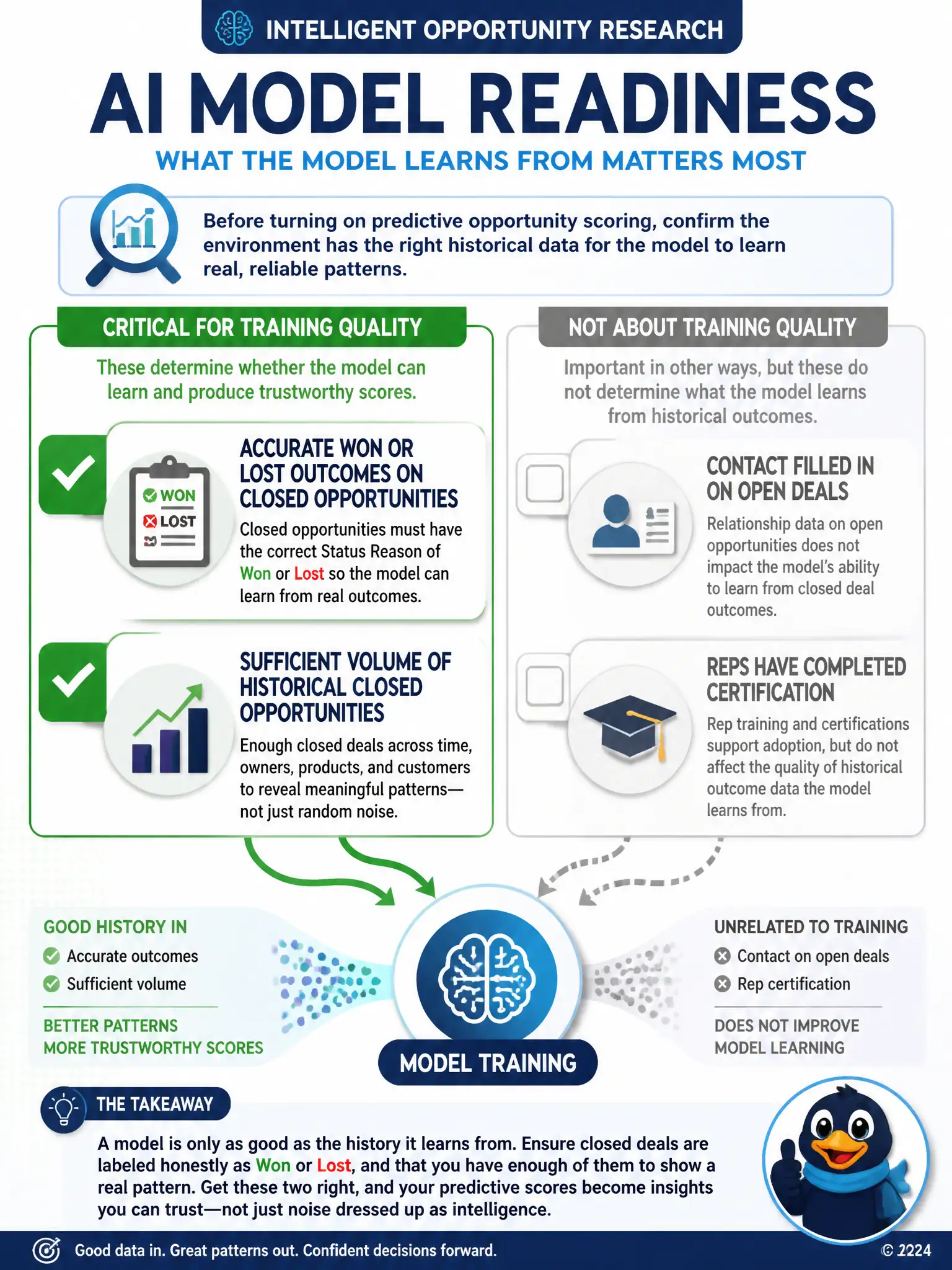
Before you trust predictive opportunity scoring, you need enough closed-won and closed-lost history to learn from, and those past outcomes must be labeled accurately as Won or Lost. If either piece is missing, the scores are just noise. Open-deal contact completeness and rep certifications don't prove the model has trustworthy training data.
Full Explanation
The correct conditions are that the environment has a sufficient volume of historical closed opportunities for the model to detect meaningful patterns and that closed opportunities have an accurate Status Reason recorded as Won or Lost so the model can learn from real outcomes. Predictive opportunity scoring learns by finding patterns that distinguish opportunities that were actually won from ones that were actually lost, so it depends on closed records having an accurate Status Reason: without that, the model has no reliable outcome label to learn from. It also depends on there being enough historical closed opportunities to detect a real pattern rather than noise from a handful of records, since a model trained on too few outcomes will not generalize to new, open opportunities. Both conditions speak directly to whether the training data is sufficient and trustworthy. The condition that every open opportunity currently in the pipeline has an assigned primary contact listed on the account is incorrect because whether an open pipeline opportunity has an assigned primary contact affects relationship tracking, not whether historical outcome data exists to train the model; scoring can be enabled and calibrated correctly even if some open records lack a listed contact. The condition that all sales reps on the team have completed a Dynamics 365 Sales certification course before scores are enabled for their opportunities is incorrect because reps completing a certification course has no bearing on the historical data quality or volume that predictive scoring depends on; it may be good practice for adoption, but it is not a prerequisite the model itself requires to produce trustworthy scores.