
A consultant is configuring predictive lead scoring for an insurance brokerage that sells both auto and commercial policies through the same Dynamics 365 Sales environment. Auto leads close in days with high volume and low deal value, while commercial leads close over months with low volume and high deal value. After enabling scoring, the auto team reports the grades feel accurate, but the commercial team says nearly every lead lands in the same middling band regardless of outcome. What should the consultant do to fix the commercial team's scoring without disrupting the auto team?
Select an answer to reveal the explanation.
Short Explanation
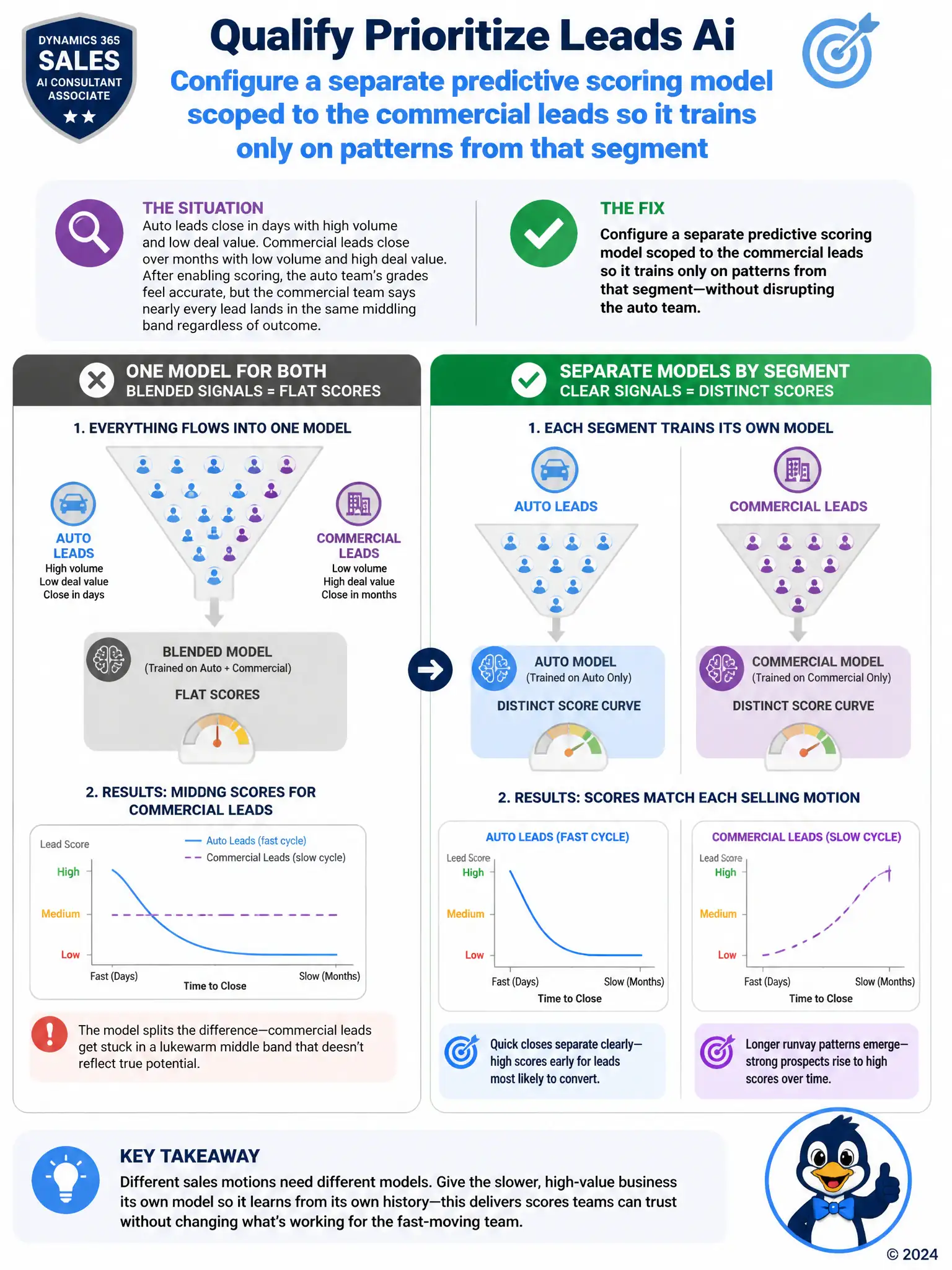
When auto and commercial leads behave differently, one shared scoring model averages them together and buries commercial leads in a middling band. You need to give commercial leads their own predictive scoring model trained only on commercial history. That lets it learn what actually predicts commercial conversion while leaving the auto team's working setup alone.
Full Explanation
The correct approach is to configure a separate predictive scoring model scoped to the commercial leads so it trains only on patterns from that segment. Auto and commercial leads convert on fundamentally different patterns and timelines, so a single shared model trained across both segments learns an averaged pattern that fits neither well, which is why commercial leads cluster in a flat middle band despite real differences in quality. Scoping a second model to only the commercial leads lets it learn the signals and timing that actually predict commercial conversion, while leaving the existing auto model untouched. The approach of lowering the minimum data threshold for the model is incorrect because it makes an underpowered model even less reliable rather than addressing the mismatch between segments. The approach of turning off predictive scoring organization-wide and having both teams qualify leads manually until more commercial data accumulates is incorrect because it sacrifices the auto team's working model to fix a problem that only affects commercial leads. The approach of increasing the weight of email engagement signals in the shared model so commercial leads generate more scoring variation is incorrect because reweighting a signal within the same shared model still trains on both segments together, so it will not separate the distinct behavioral patterns driving auto versus commercial conversion.