
A consultant configures predictive opportunity scoring for a client that runs two business units through one Dynamics 365 Sales instance: an enterprise hardware division with nine-month sales cycles and a small-business accessories division with two-week cycles. After scoring is enabled, reps in the accessories division report that almost every open opportunity gets a low score, even ones that close within days. What is the most likely cause and correct fix?
Select an answer to reveal the explanation.
Short Explanation
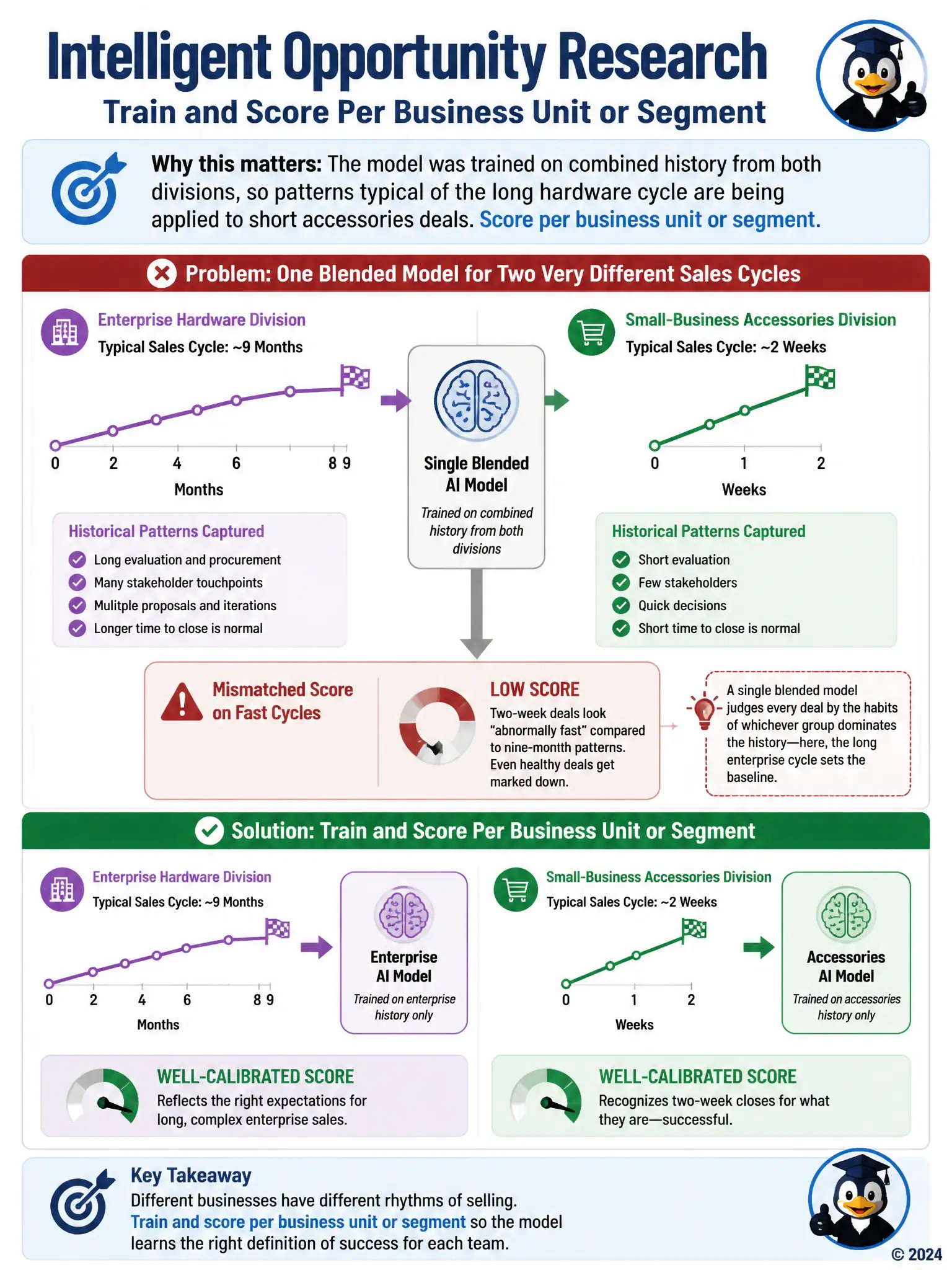
When you train one predictive scoring model on two business units with wildly different sales cycles, the long hardware cycle can dominate the patterns. That makes healthy two-week accessories deals look abnormal and score low. You need to train or configure scoring separately for each business unit or segment.
Full Explanation
The most likely cause is that the model was trained on combined history from both divisions, so patterns typical of the long hardware sales cycle are being applied to short accessories deals. When one model is trained on blended history from two business units with very different sales cycles, it learns patterns dominated by the larger or longer-cycle group and applies those patterns to opportunities that behave nothing like them. Here, hardware-cycle norms are imposed on two-week accessories deals, so fast-moving, healthy opportunities look abnormal and score low. The correct fix is to separate the training data or scoring configuration by segment so each division's model reflects its own historical pattern of wins and losses. The suggestion that the accessories division does not have enough opportunities to generate a real score is incorrect because the division is receiving scores, just poorly calibrated ones; the problem is bad calibration, not absence of data, and telling reps to ignore the feature discards a signal that would be useful once fixed. The claim that predictive scores decay on a fixed schedule and must be manually refreshed weekly is incorrect because predictive scores are recalculated based on record activity and data changes, not a fixed weekly refresh cycle, so staleness is not the mechanism here. The suggestion that low scores appear because opportunities are missing estimated revenue values is incorrect because estimated revenue is one input among many rather than a dominant factor, and populating it would not resolve a segment-level calibration mismatch caused by blended training data.