
Before rolling out predictive lead scoring to the entire sales organization, a consultant proposes running it for one pilot team through a full sales cycle and comparing actual conversion rates against the assigned grades before expanding further. A stakeholder asks why this pilot step is needed if predictive scoring already ships as a supported product capability. What is the best justification for the consultant to give?
Select an answer to reveal the explanation.
Short Explanation
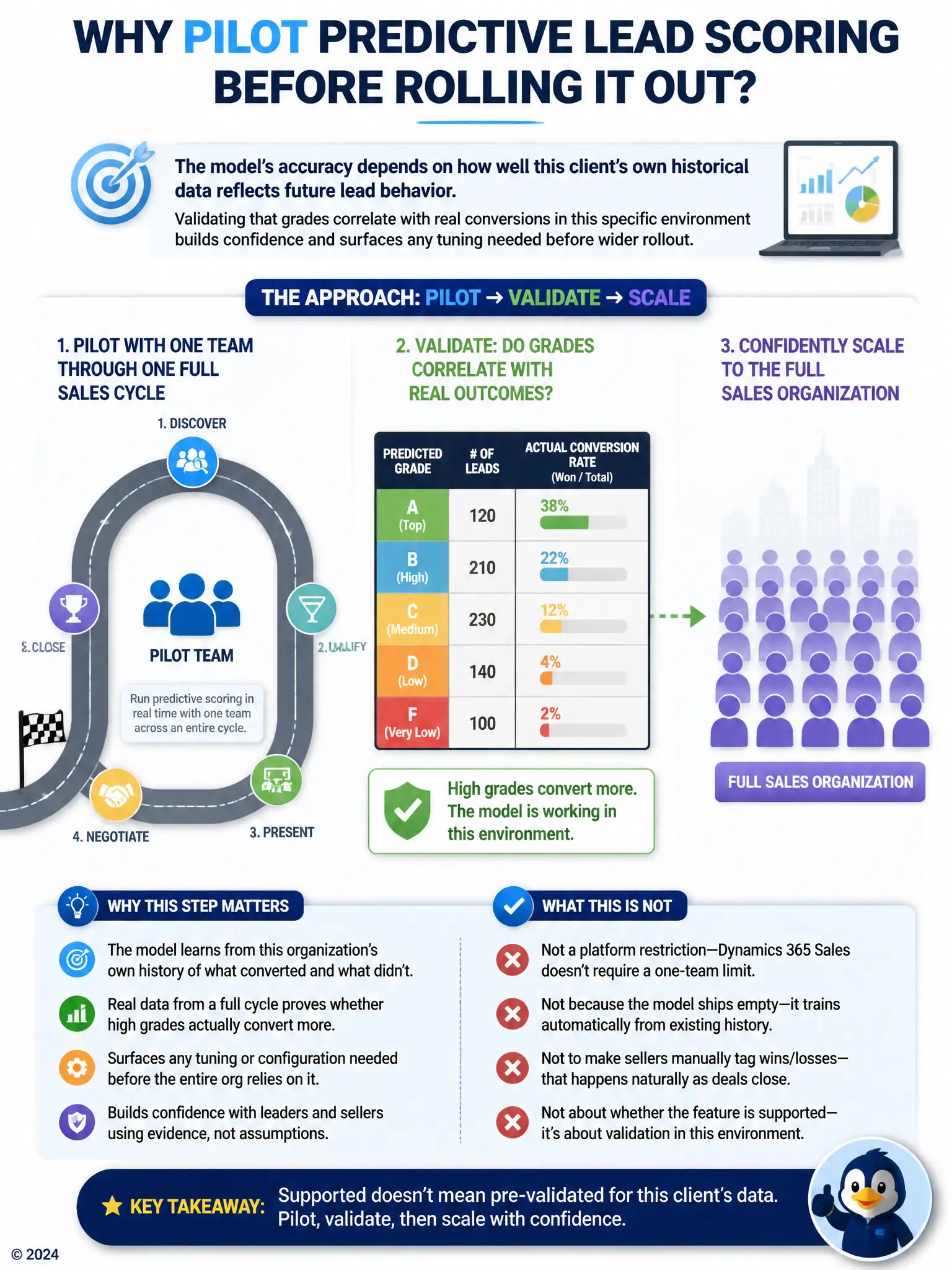
Supported doesn't mean pre-validated for your data. The model learns from your own history, so you need to see if high grades actually convert before the whole sales org trusts it. A pilot gives real evidence and catches tuning issues early.
Full Explanation
The best justification is that predictive scoring trains on a specific tenant's own historical leads, so how well its grades correlate with real outcomes depends entirely on that client's particular data and sales patterns; a supported product capability being available does not guarantee it fits this environment well on day one. Running a pilot with one team through a full cycle and checking assigned grades against actual conversions gives the client concrete evidence of accuracy, builds confidence, and surfaces any tuning issues before the whole organization depends on the scores. The claim that Dynamics 365 Sales technically only allows predictive scoring to run for one team at a time is incorrect because there is no such restriction limiting predictive scoring to one team at a time; the pilot scope is a deliberate rollout choice, not a platform limitation. The claim that the pilot exists to train the underlying model from scratch, since predictive scoring ships without any model until an organization builds one manually, is incorrect because it misdescribes how the feature works; predictive scoring trains automatically from the tenant's existing won and lost lead history rather than requiring an organization to manually build a model from nothing before it can run. The claim that the pilot's real purpose is to give sellers time to manually label every lead as won or lost so the model has training data to learn from is incorrect because leads are already marked won or lost as a natural part of the standard sales process; the pilot is not a mechanism for manufacturing training labels, and framing it that way misrepresents both the purpose of the pilot and how the model already gets its outcome data.