
A consultant investigating why every lead captured through the company's public website contact form receives the same middling predictive score, regardless of company size or engagement, discovers that the web-to-lead integration leaves several fields the model weights heavily, such as industry and employee count, blank at the moment of capture. What should the consultant do?
Select an answer to reveal the explanation.
Short Explanation
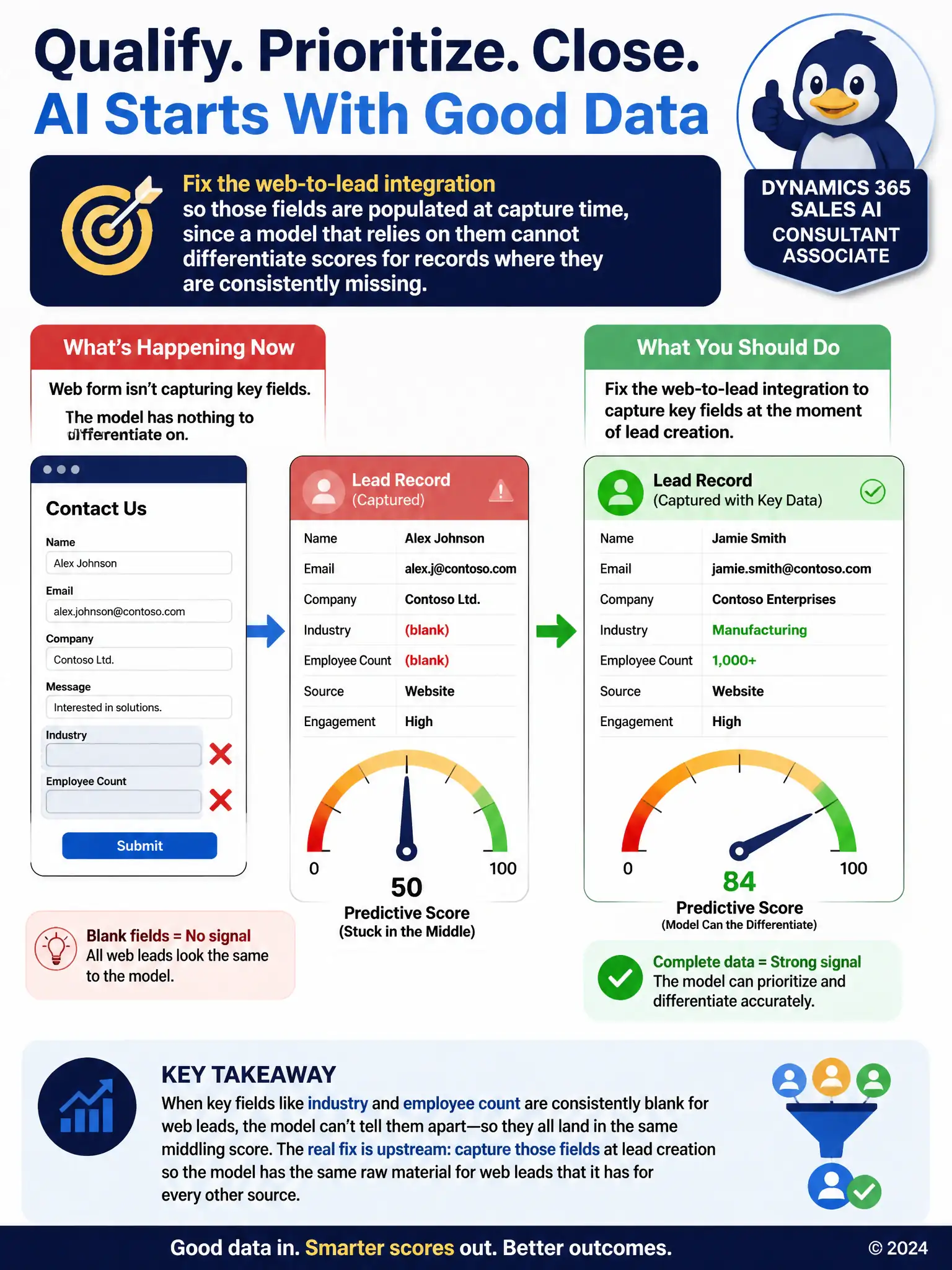
When every web-form lead lands on the same middling score, you usually don't have a model problem; you have a missing-data problem. Fix the web-to-lead integration so fields like industry and employee count populate at capture, because the model can't score what it never receives.
Full Explanation
The correct choice is to fix the web-to-lead integration so fields such as industry and employee count are populated at capture time. When fields the model relies on are consistently null for an entire lead source, the model has nothing to differentiate those records on, so they cluster around a generic score regardless of how promising any individual lead actually is. Fixing the integration addresses the root cause and lets the model score web leads using the same information it uses for leads from other sources. The choice to exclude web-form leads from predictive scoring entirely and score them manually is incorrect because it works around the symptom rather than fixing it, permanently losing the efficiency benefit of predictive scoring for an entire lead source when the underlying data gap is fixable. The choice to retrain the model excluding industry and employee count as factors so scoring stays consistent across every lead source is incorrect because removing those factors to fix one source's data gap would degrade scoring quality for every other lead source that does populate those fields correctly, trading a source-specific problem for an organization-wide one. The choice to increase how frequently leads are rescored is incorrect because rescoring more often does not create data that was never captured in the first place; refresh frequency has no bearing on fields that remain blank at the source, so the clustering would persist no matter how often the score recalculates.