
During training, a seller asks whether a lead graded Hot by predictive scoring should be converted straight into an opportunity, skipping the usual needs-assessment call. How should the consultant respond?
Select an answer to reveal the explanation.
Short Explanation
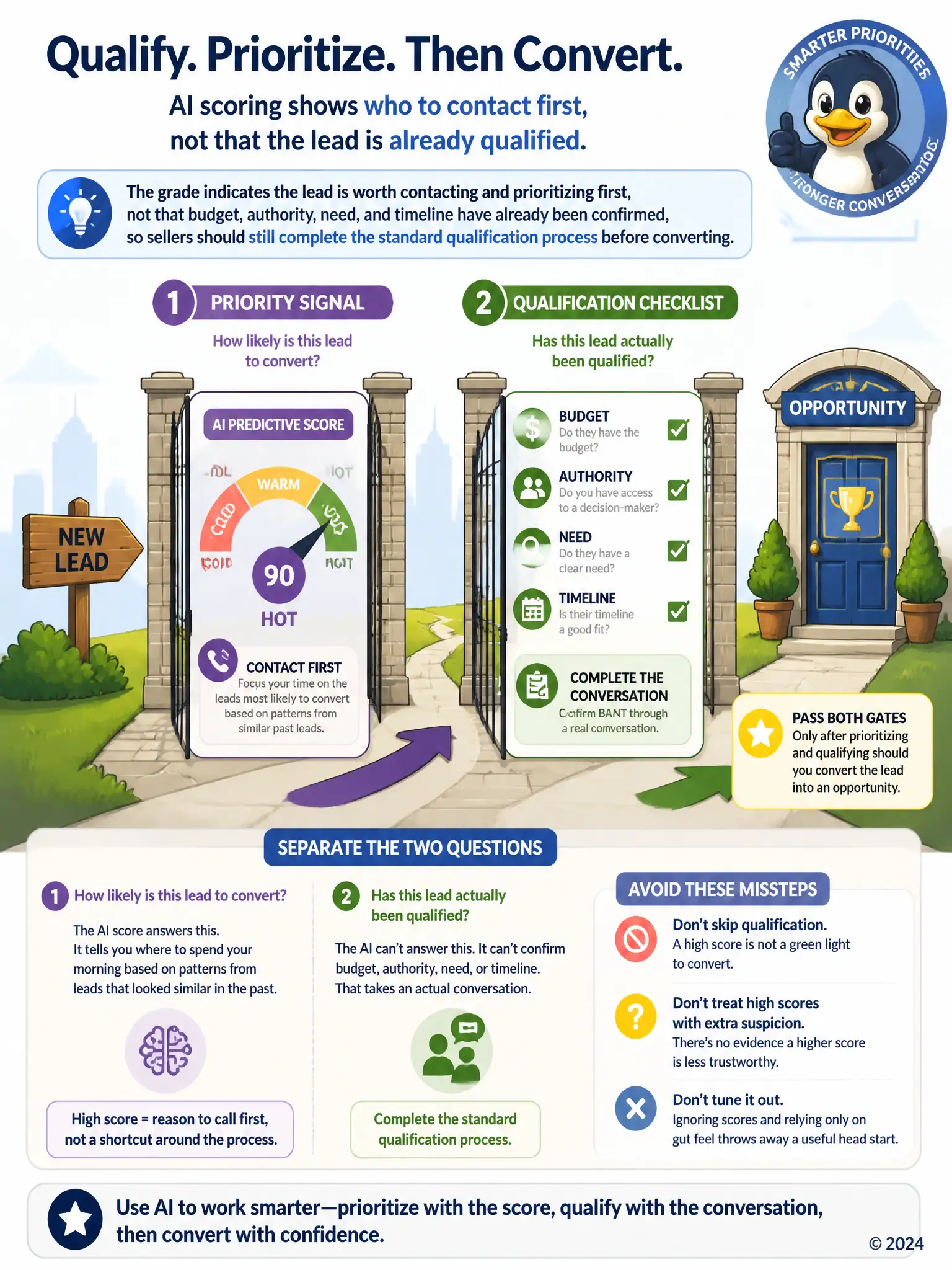
Don't let a Hot grade fool you. It tells you who to call first, not that budget, authority, need, and timeline are confirmed. Make the qualification call before converting the lead.
Full Explanation
The correct response is the one saying the grade indicates the lead is worth contacting and prioritizing first, not that budget, authority, need, and timeline have already been confirmed, so sellers should still complete the standard qualification process before converting. Predictive scoring estimates how likely a lead is to convert based on patterns in historical data, which makes it a useful signal for deciding who to call first, but it says nothing about whether this specific lead actually has a real need, budget, decision-making authority, and a workable timeline. Those qualification criteria still have to be confirmed through the standard process before a lead is converted into an opportunity, regardless of how highly it scored. The response claiming a Hot grade means all standard qualification criteria have already been met is incorrect because it conflates a statistical likelihood-to-convert score with a confirmed qualification outcome; a high score reflects patterns similar to past wins, not verified facts about this lead's budget or authority. The response saying Hot-graded leads should receive more scrutiny because a high score is more likely to be wrong is incorrect because there is no basis for treating higher-graded leads as more error-prone than lower-graded ones; the grade's reliability does not invert based on how high it is. The response saying the score should be ignored entirely because qualification is purely manual is incorrect because it discards a genuinely useful prioritization signal; ignoring the score entirely means falling back purely on manual triage, losing the efficiency benefit predictive scoring is meant to provide even though the score still should not replace the qualification conversation itself.