
A consultant is deploying predictive lead scoring for a conglomerate that sells low-cost transactional products with a two-week sales cycle alongside complex enterprise solutions with a nine-month sales cycle, all tracked in the same Dynamics 365 Sales environment. The sales director wants a single predictive score to reliably prioritize leads across both business lines. What should the consultant advise?
Select an answer to reveal the explanation.
Short Explanation
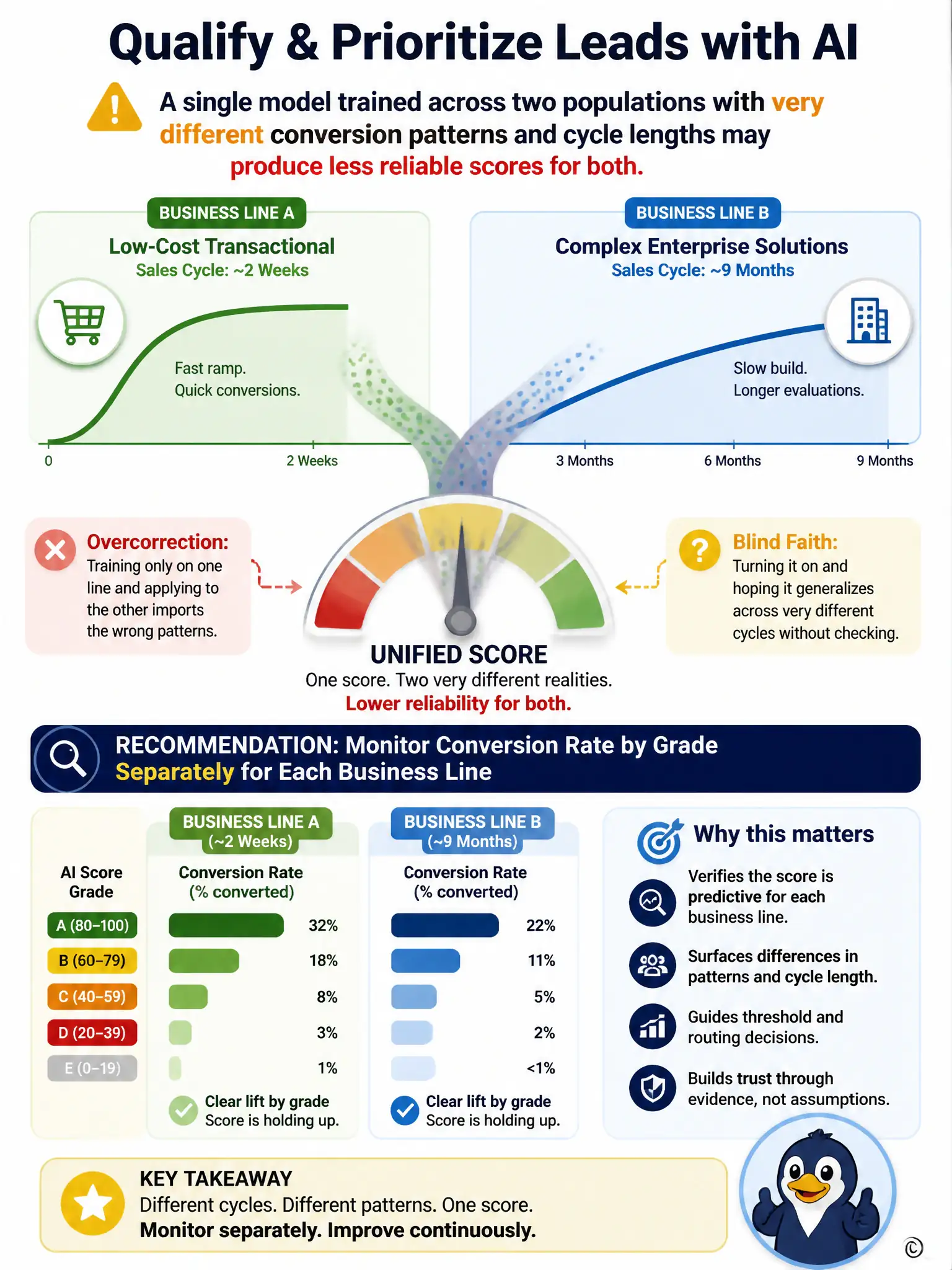
You shouldn't assume one predictive score will handle a two-week transactional line and a nine-month enterprise line equally well. Flag that a single model across those very different populations may produce less reliable scores, then monitor conversion rate by grade separately for each business line. That gives you real evidence instead of blind faith or an overcorrection.
Full Explanation
The correct advice is to flag that a single model trained across two populations with very different conversion patterns and cycle lengths may produce less reliable scores for both, and to recommend monitoring conversion rate by grade separately for each business line to check whether the score is holding up for each. A model trained on a mix of two populations with very different conversion timelines and patterns risks learning a blended signal that fits neither business line particularly well, so raising that risk with the director and then validating it by tracking conversion rate against grade separately for each line is the responsible path; it gives the client real evidence about whether the single score is actually serving both, rather than assuming it will. The approach of enabling predictive scoring as requested on the premise that one model always generalizes well regardless of how different the underlying sales cycles are is incorrect because it dismisses a real risk without evidence; a nine-month enterprise cycle and a two-week transactional cycle do not necessarily share the same behavioral signals, and assuming generalization without checking invites unreliable scores for one or both lines. The approach of training the model using only the transactional product's closed leads, since they convert faster and accumulate more records, and applying the resulting score to the enterprise leads as well is incorrect because training exclusively on the transactional product's faster-converting leads would build a model shaped by that population's patterns and then misapply it to the structurally different enterprise leads, which is likely to produce worse results than the original mixed approach. The recommendation to turn off predictive scoring for the environment entirely, since the client sells more than one type of product, is incorrect because it overreacts to the concern; disabling the feature entirely discards its value for the whole environment when the actual issue is that the model's fit needs to be checked and monitored per business line, not eliminated outright.