
A consultant is asked to explain to a client's sales team why Copilot's lead-qualification response in the record's chat pane sometimes gives a different rationale than the predictive score's contributing-factors list, even though both appear on the same lead. What should the consultant tell the team?
Select an answer to reveal the explanation.
Short Explanation
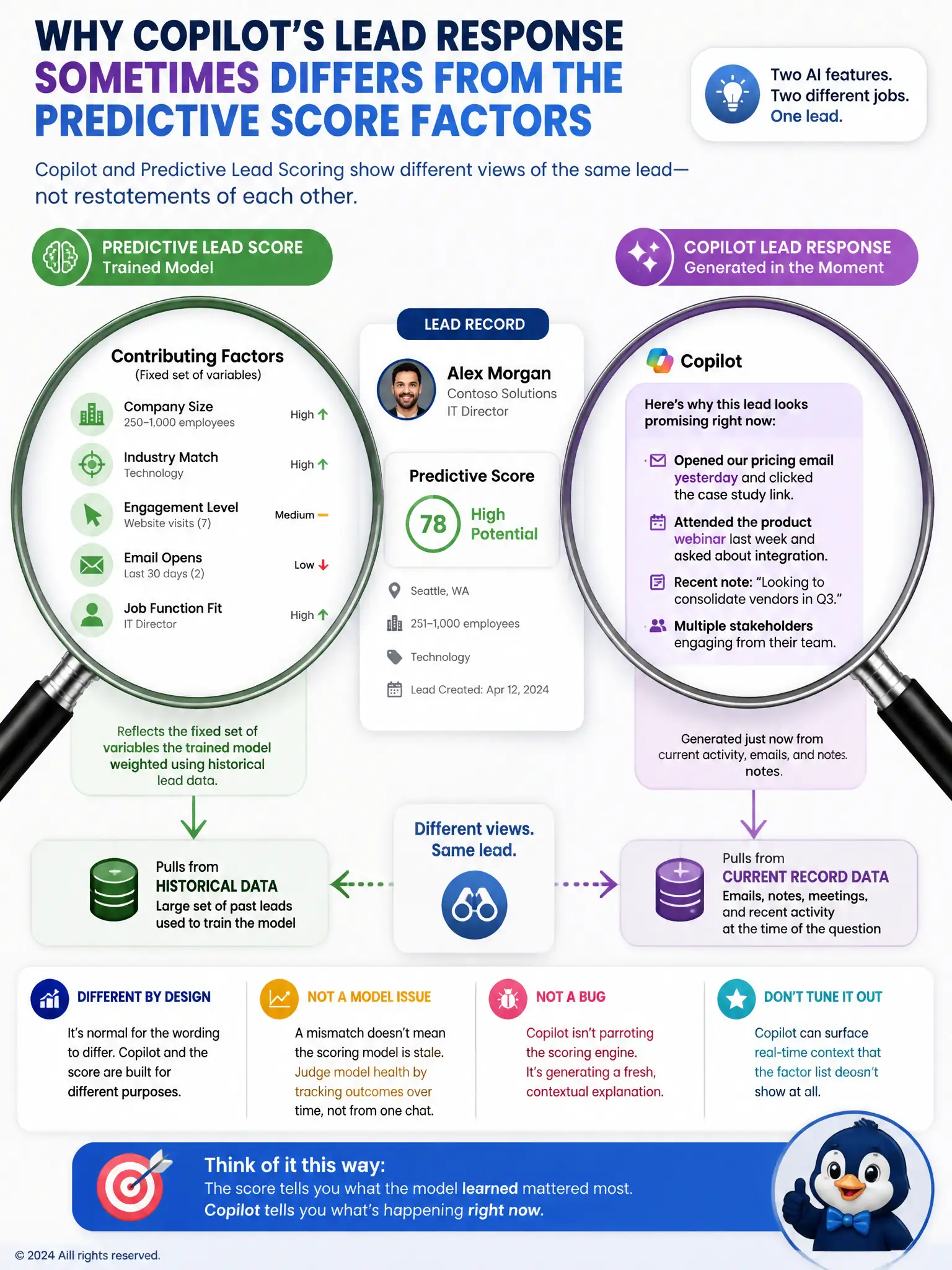
You're looking at two different capabilities doing two different jobs on the same lead. The predictive score reports the fixed factors from its trained model, while Copilot composes a fresh answer from the record's current emails, notes, and activity. That mismatch is normal, not a defect, stale model, or reason to ignore Copilot.
Full Explanation
The correct answer is the explanation that Copilot's chat response is a generated summary drawing on the lead's current activity, emails, and notes at the moment it is asked, while the predictive score's factor list reflects the fixed set of variables the trained model weighted. Predictive scoring and Copilot are two distinct capabilities working from different inputs and methods: the predictive model was trained ahead of time on historical won and lost leads and surfaces the fixed factors it learned to weight, while Copilot generates a conversational answer in the moment by reasoning over the lead's current activity, emails, and notes. Because they draw on different data and operate differently, their explanations can reasonably diverge without either one being wrong. The claim that the mismatch means the predictive model is out of date and needs to be retrained immediately is incorrect because a difference in rationale between two separate capabilities is not itself evidence that the predictive model's training has gone stale; retraining decisions should be based on tracking score accuracy against actual outcomes over time, not on a single side-by-side wording mismatch. The claim that Copilot always pulls its explanation directly from the predictive scoring engine, so any difference should be reported as a product defect, is incorrect because it misdescribes the architecture; Copilot does not simply relay the predictive scoring engine's output, it generates its own response from the record's available signals, so expecting the two to always match exactly is a false premise. The recommendation to stop reading Copilot's explanation and rely only on the predictive score's factor list is incorrect because it discards a useful capability; Copilot's contextual summary can surface recent activity nuances the factor list does not show, and there is no reason to ignore it just because it is phrased differently.