
A seller believes a lead graded Cool by predictive scoring is actually a strong prospect because of a phone conversation that was never logged in Dynamics 365 Sales, and reprioritizes it to work first thing in the morning. A sales manager later asks the consultant whether this kind of override undermines the value of the AI scoring model. How should the consultant respond?
Select an answer to reveal the explanation.
Short Explanation
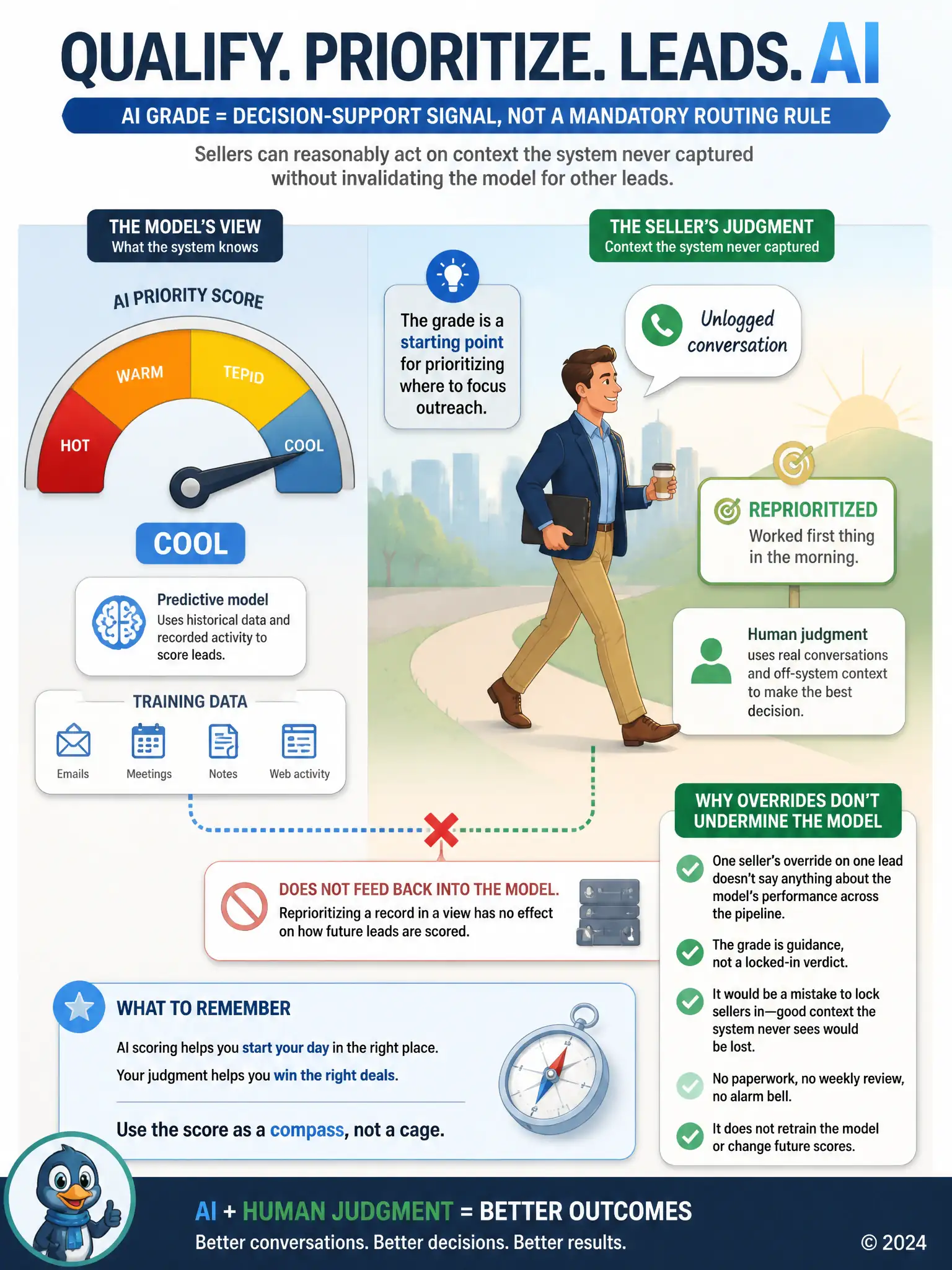
You should treat the grade as a prioritization signal, not a hard rule. If a seller has useful context the system never captured, acting on it doesn't break the model for other leads. Locking sellers out, logging every one-off override, or assuming the score retrains itself are all wrong.
Full Explanation
The correct response is that the grade is a decision-support signal for prioritizing outreach, not a mandatory routing rule, so a seller can reasonably act on context the system never captured without invalidating the model for other leads. Predictive scores are meant to help sellers decide where to focus limited time, drawing only on the signals available in Dynamics 365 Sales; they cannot account for context like an unlogged phone call. A seller acting on real information the system never saw is exercising exactly the kind of judgment the feature is designed to support rather than replace, and one such override says nothing about whether the model is working well for the rest of the pipeline.
The response saying overrides like this should be disabled at the system level so sellers cannot deviate from the predictive grade is incorrect because removing sellers' ability to override the grade would turn a decision-support tool into a rigid mandate, discarding the human judgment and outside context that scores were never meant to fully capture. The response saying every manual override needs to be logged in a custom field and reviewed weekly to determine whether the model requires retraining is incorrect because a single override driven by one seller's private knowledge is not evidence of systematic model drift, and treating every individual override as a retraining trigger would create unnecessary process overhead for something that is expected to happen routinely. The response saying the seller's override will automatically feed back into the model and adjust future scores for similar leads is incorrect because manually reprioritizing a lead in the assigned-leads view does not retrain the model or alter its scoring logic; the underlying predictive model only updates through its normal training and refresh process, not through individual seller actions on a record.