
A consultant is enabling predictive lead scoring for a startup that migrated to Dynamics 365 Sales only three months ago and has closed fewer than 200 leads to date. Predictive scoring needs enough historical won and lost lead outcomes to train a reliable model, and the client's current volume falls well short of that. What should the consultant recommend?
Select an answer to reveal the explanation.
Short Explanation
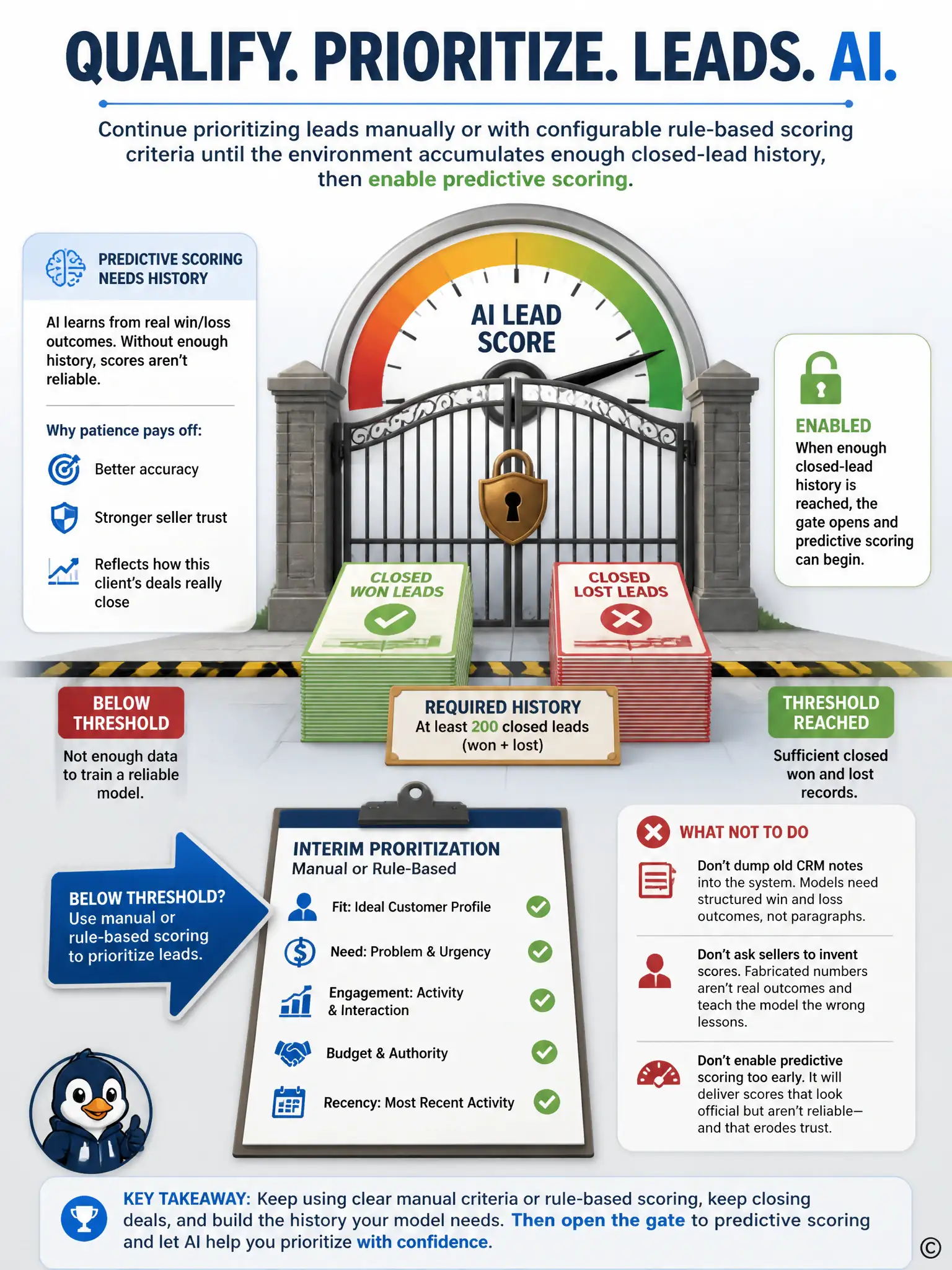
Think of predictive scoring like a forecaster who needs a season of games under their belt before predictions mean anything. With only a couple hundred closed leads, you don't have enough real won and lost outcomes for the model to learn from, so keep prioritizing leads manually or with rule-based scoring until the history builds up. Don't fake it with notes or invented scores, because the model needs structured closed-lead outcomes, not summaries or guesses.
Full Explanation
The recommended approach is to continue prioritizing leads manually or with configurable rule-based scoring criteria until the environment accumulates enough closed-lead history, then enable predictive scoring. Predictive lead scoring trains on a tenant's own history of closed won and lost leads, and with fewer than 200 closed records the model has too little signal to learn patterns that generalize to new leads. Manual prioritization or configurable rule-based scoring keeps the sales team working leads in a sensible order while the environment accumulates the history predictive scoring needs, after which the feature can be enabled with a realistic chance of producing reliable grades. Enabling predictive scoring now is incorrect because insufficient historical data does not simply produce a rougher model that improves gradually; without enough closed-lead outcomes to learn from, the scores produced would not reflect real conversion patterns at all, which risks eroding seller trust before the feature has a fair chance to work. Importing historical leads from the legacy CRM as free-text notes attached to each record is incorrect because free-text notes are unstructured content Copilot can summarize conversationally, but they are not the structured won and lost outcome data the predictive model trains against, so importing them this way does nothing to satisfy the volume requirement. Having the sales team manually assign a numeric score to every existing lead is incorrect because manually assigned scores are not actual sales outcomes; substituting them would not give the model real conversion history to learn from and could bias any future training on the same records.