
A sales manager wants to identify which sellers on a 15-person team need coaching on handling customer objections, drawing on conversation intelligence data already captured across recorded calls over the past quarter. Rather than listening to individual recordings one by one, the manager wants a single aggregated view per seller.
Select an answer to reveal the explanation.
Short Explanation
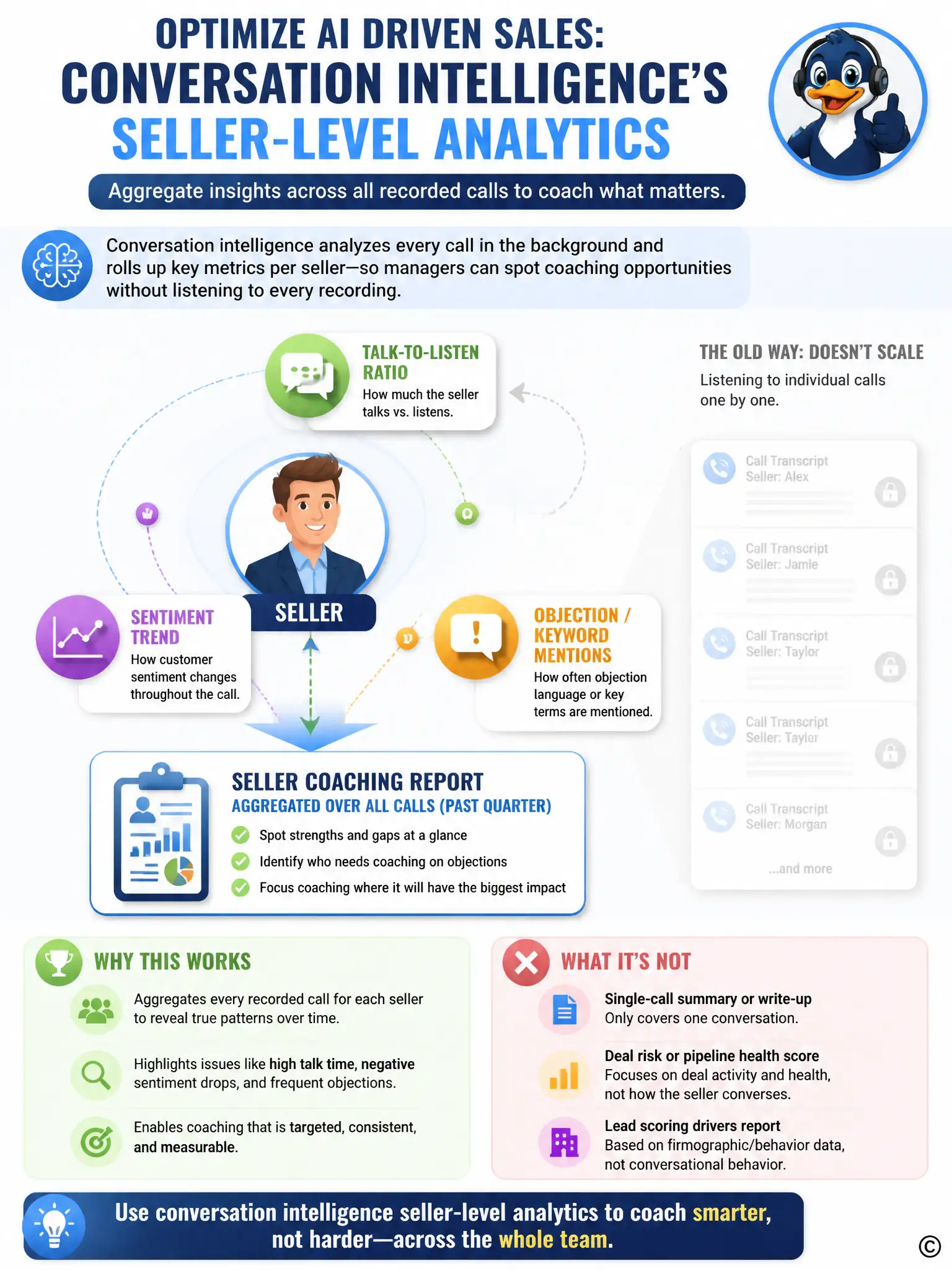
If you want to see which sellers struggle with objections, use conversation intelligence's seller-level analytics. It rolls up talk-to-listen ratio, sentiment trend, and objection or keyword mentions across all recorded calls for each seller, so you get patterns without playing every recording.
Full Explanation
The correct choice is conversation intelligence's seller-level analytics, because it aggregates signals like talk-to-listen ratio, sentiment trend, and tracked keyword or objection mentions across every recorded call for a given seller. That gives the rolled-up, quarter-long view a manager needs to spot coaching patterns without reviewing calls one at a time. The AI-generated call summary field on each individual timeline record is incorrect because it is scoped to one conversation; reading through summaries call by call does not produce an aggregated, seller-level trend and would still require manually reviewing dozens of records. The Sales Copilot deal-risk score is incorrect because it evaluates the health of an opportunity based on pipeline signals like activity gaps and stage duration, not the content or tone of sales conversations, so it cannot reveal how a seller handles objections. The lead scoring model's feature importance report is incorrect because it explains which lead attributes, such as source or firmographic data, drove a numeric score, which has nothing to do with a seller's conversational behavior on calls. Choosing the right tool here depends on recognizing that only conversation intelligence actually analyzes call content and rolls it up per seller, while the other options either operate at the wrong granularity or analyze an entirely different kind of data.