
A sales enablement lead rolled out Copilot email drafting, next-best-action suggestions, and relationship health scoring across the sales team six months ago. Leadership is now asking for objective evidence of how many sellers actually use each feature and whether usage correlates with seller performance, rather than relying on anecdotal feedback before approving continued investment.
Select an answer to reveal the explanation.
Short Explanation
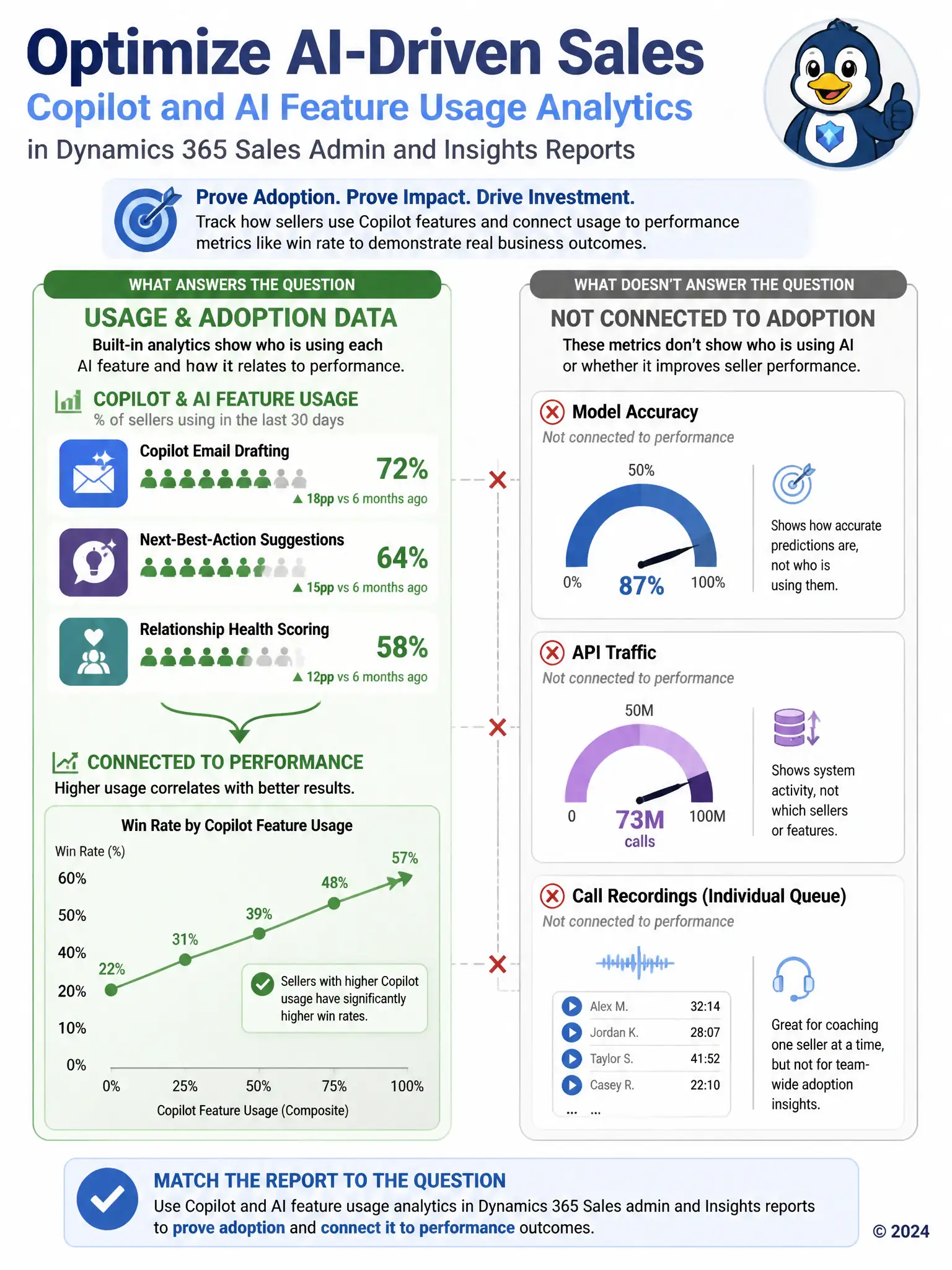
When leadership wants proof an AI rollout is paying off, you need usage and adoption analytics, not accuracy or traffic. Copilot and AI feature usage analytics in Dynamics 365 Sales admin and Insights reports show who's using each feature and can be cross-referenced with seller performance. That gives you objective evidence instead of anecdotes.
Full Explanation
Dynamics 365 Sales and Copilot provide adoption and usage analytics through the admin and Insights reporting surfaces, showing how many sellers are actively using each AI feature, such as email drafting, next-best-action, or relationship health scores, and these usage figures can be joined against seller performance data like win rate or cycle time to build a genuine ROI case. The AI Builder model performance dashboard is incorrect because it reports statistical accuracy of custom prediction models the organization has built, such as precision or recall, and says nothing about how many sellers are opening or acting on Copilot features day to day. The Power Platform admin center's API call metrics are incorrect because API call volume is a technical telemetry signal, useful for capacity planning, but it does not map cleanly to individual sellers or distinguish meaningful feature engagement from background system calls. The conversation intelligence call review queue is incorrect because it surfaces individual calls for manual review and coaching, not an organization-wide summary of which features are adopted or by whom. For a rollout that needs to justify continued investment with data rather than anecdotes, the admin-level usage analytics are the resource built specifically to answer that question, while the other three surfaces answer adjacent but different questions.