
A sales operations lead notices that when two sellers separately ask the Copilot for Sales chat panel 'What is the total pipeline value for the West region?' they get two different totals even though both are querying the same underlying pipeline data. The ops lead wants to understand why this happens before explaining it to the sellers.
Select an answer to reveal the explanation.
Short Explanation
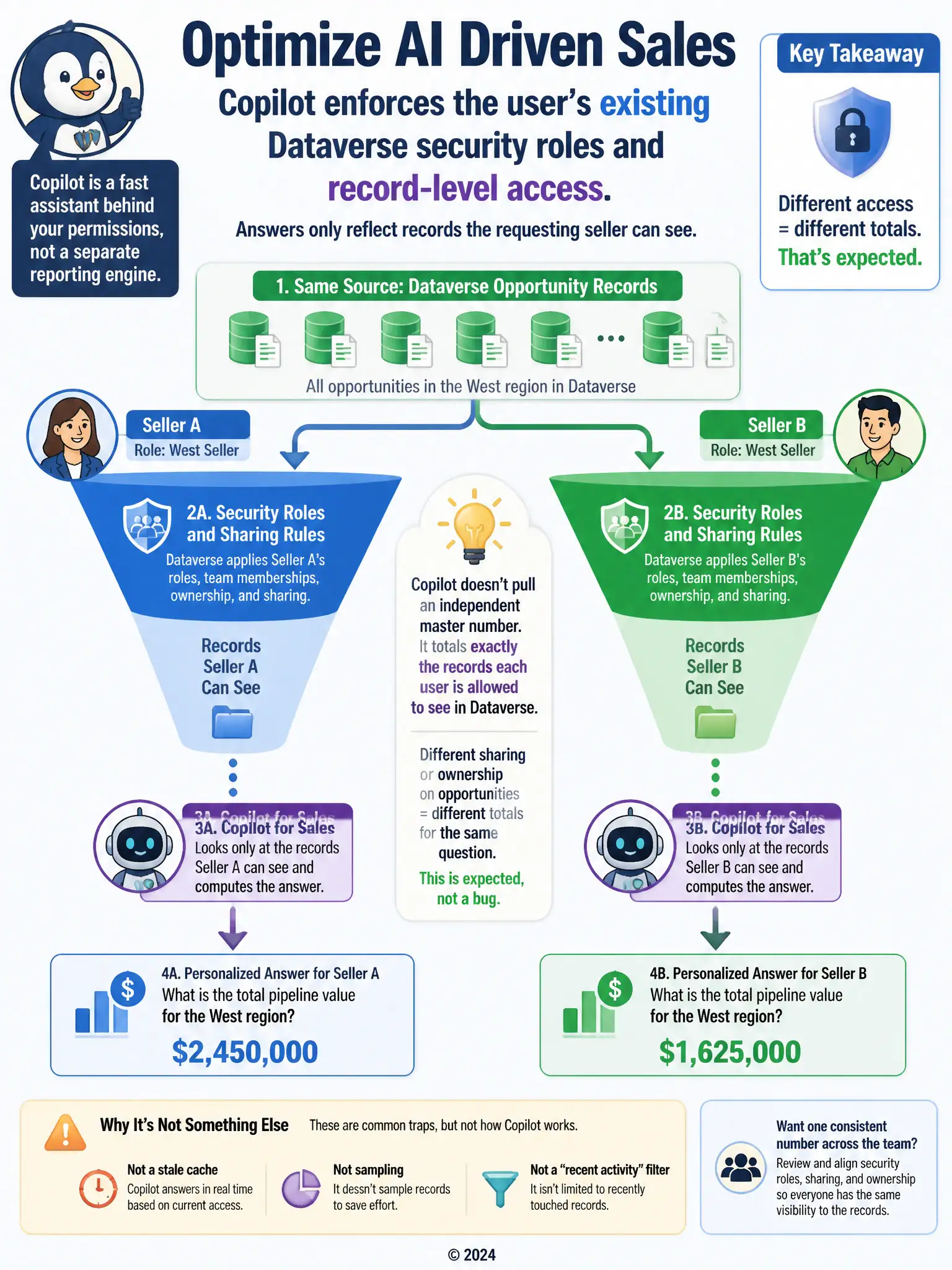
Copilot doesn't have its own pipeline truth; it totals only the records you're allowed to see. If two sellers have different access, they'll get different totals. That's expected, not a bug.
Full Explanation
The correct answer is the one that says Copilot enforces the user's existing Dataverse security roles and record-level access, so answers only reflect records the requesting seller can see. Copilot for Sales operates on top of Dataverse and inherits the requesting user's security roles and record-level sharing rules, so a conversational query about pipeline value only aggregates opportunities the seller is permitted to see; this is exactly why two sellers asking the same question about the same region get different totals when their record access differs. The per-user cache explanation is incorrect because Copilot does not maintain a per-user cache of aggregate totals that goes stale overnight; the variance sellers see is not a timing artifact and persists regardless of when the query is run. The random sampling explanation is incorrect because Copilot does not sample records to save compute; it computes answers from the full set of records the user can access, not a statistical subset. The 24-hour recency explanation is incorrect because Copilot's conversational answers are not scoped to a rolling 24-hour recency window by default; a pipeline value query reflects current open opportunities visible to the user, not only ones touched in the last day. Understanding that Copilot answers ride on top of existing security roles matters for rollout planning: if leadership expects everyone to see the same enterprise-wide numbers, sharing rules or a dedicated reporting view need to be addressed, not the Copilot feature itself.