
A financial-services sales team uses Copilot-generated call summaries that are automatically appended to the opportunity timeline after each customer call. Compliance requires that any customer-facing communication captured in the CRM be reviewed by a licensed representative before it is considered part of the official record. What should the consultant recommend?
Select an answer to reveal the explanation.
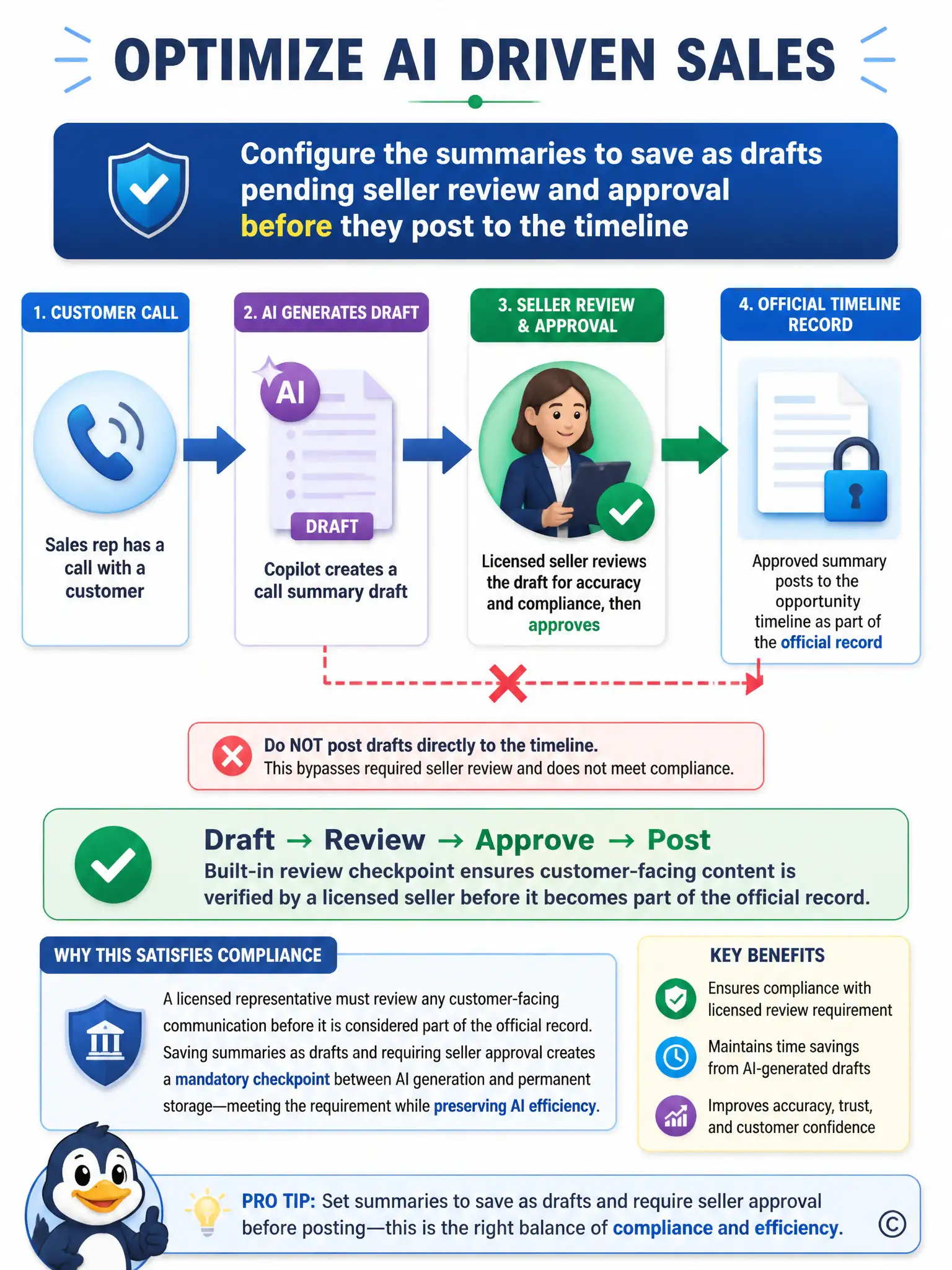
Short Explanation
You need a real checkpoint between Copilot drafting the summary and the CRM treating it as official. Save the summaries as drafts so a seller can review and approve them before they post to the timeline. That keeps the time savings while meeting the licensed-rep review rule.
Full Explanation
The draft-and-approve approach is correct because it inserts a human checkpoint before a Copilot-generated summary becomes part of the official record, while still preserving the time savings Copilot provides. Disabling Copilot call summarization and requiring manual note-taking for every call is incorrect because it discards the efficiency benefit of the feature and forces a return to fully manual note-taking, which is a heavier-handed response than the compliance requirement actually demands. Restricting access to the call summary field so only sales managers can view it after the fact is incorrect because visibility after posting is not the same as approval before posting; the compliance requirement is about review before the content becomes part of the record. Scheduling a nightly batch job that deletes call summaries flagged with low-confidence sentiment scores is incorrect because sentiment confidence is an unrelated and arbitrary criterion that has nothing to do with whether a licensed representative reviewed the content for accuracy, and it could delete accurate summaries or retain inaccurate ones. A draft-and-approve workflow is the direct way to insert the required human review step.