
A consultant reviews an AI-generated sales forecast for a seasonal retail-supply business and finds that the model has overestimated close probability for Q4 opportunities for two consecutive years, apparently because the training data underrepresents the seasonal slowdown pattern. What should the consultant do?
Select an answer to reveal the explanation.
Short Explanation
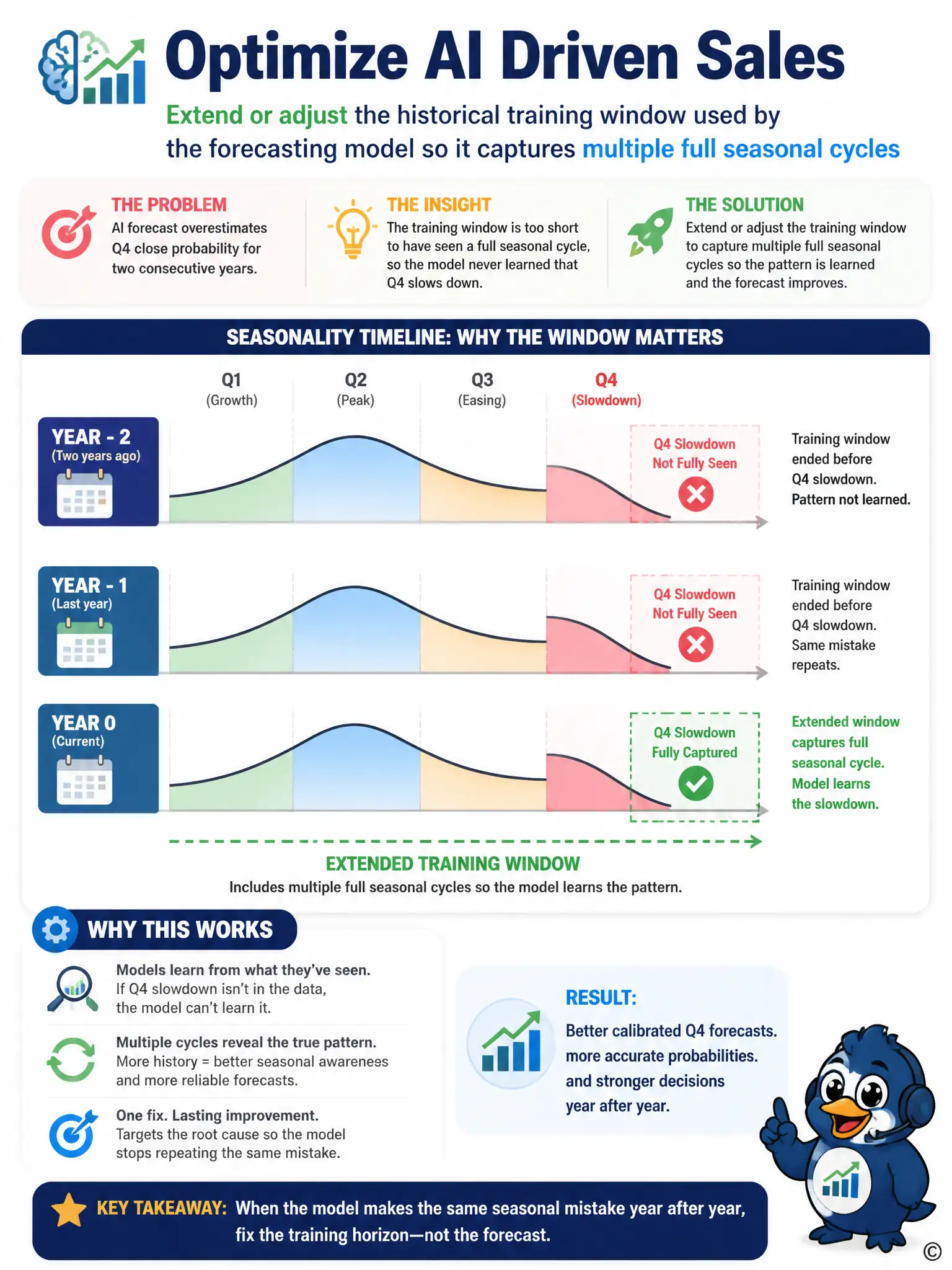
When the model keeps missing the same Q4 seasonal slowdown, the problem is in the data it learned from. You should widen or adjust the training window so it includes multiple full seasonal cycles and can learn the pattern. Hand overrides, turning AI off for Q4, or changing deal-size weight don't fix the root cause.
Full Explanation
The correct answer is the option that extends or adjusts the historical training window used by the forecasting model so it captures multiple full seasonal cycles. The root cause identified is that the model's training data does not adequately represent the recurring seasonal slowdown, so adjusting or extending the historical window to include enough full seasonal cycles gives the model the pattern it needs to weight Q4 appropriately going forward. Manually overriding every Q4 opportunity's close probability at the start of each quarter is incorrect because it is a labor-intensive workaround that must be repeated indefinitely and does not correct the underlying model, leaving the same problem to resurface. Disabling AI forecasting for Q4 and relying solely on seller-submitted judgment for that quarter is incorrect because it discards the value the model provides for the other opportunities and stages within that period, which is a disproportionate response to a data-window problem. Increasing the opportunity scoring weight assigned to deal size for Q4 opportunities is incorrect because deal size is unrelated to the identified issue of seasonal underrepresentation; adjusting that weight would not correct the model's blind spot regarding the recurring Q4 slowdown and could distort scoring for unrelated reasons. Correcting the training data's time horizon is the targeted fix for a seasonally biased model.