
A consultant is preparing to enable AI-driven lead scoring for a sales org whose Dynamics 365 instance has accumulated years of manually entered leads, many of which are duplicates of the same contact from repeated marketing campaigns. Before turning on scoring, what should the consultant prioritize?
Select an answer to reveal the explanation.
Short Explanation
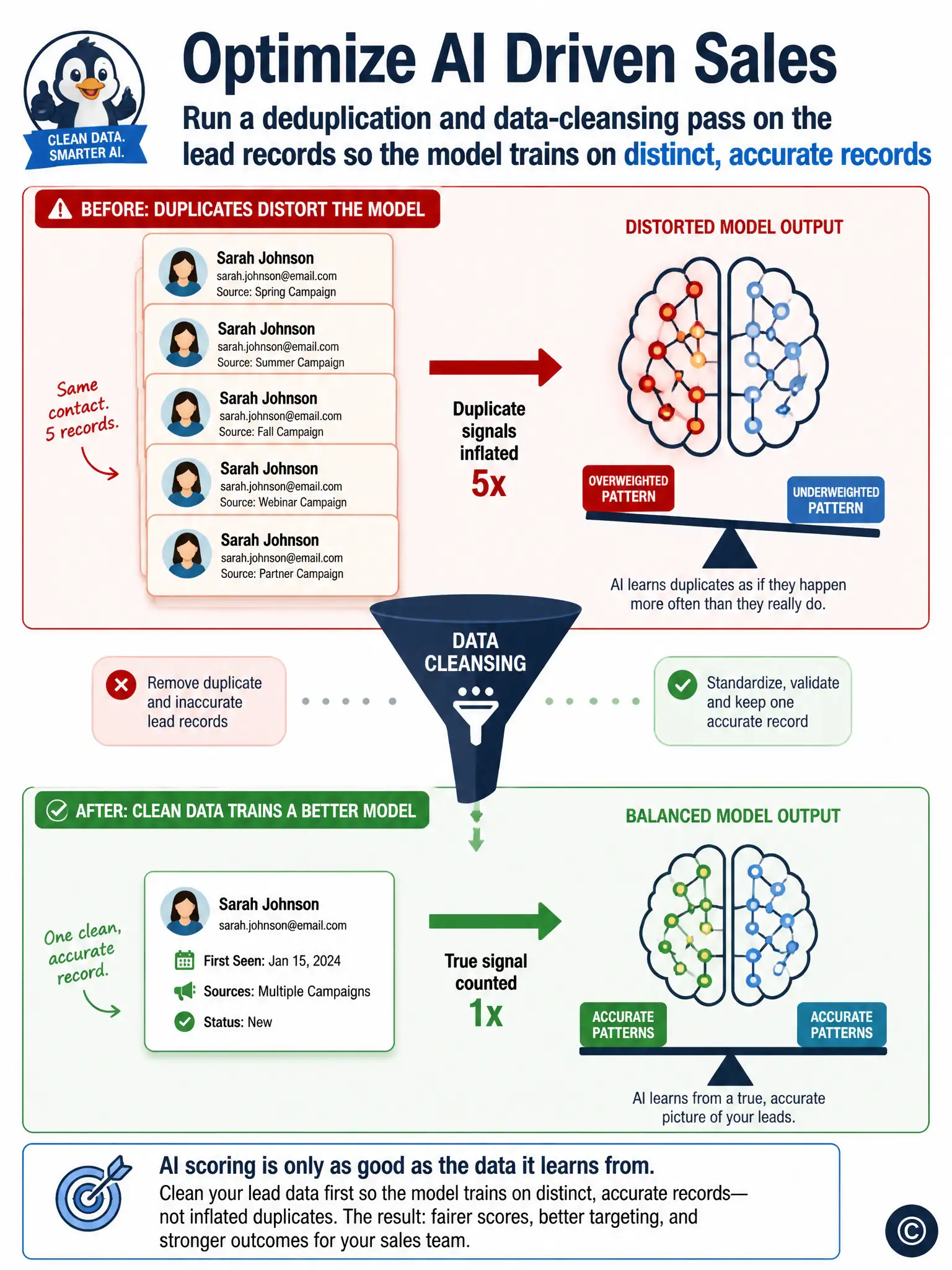
AI scoring is only as good as the data it learns from, so you need to dedupe and cleanse the lead records before turning it on. If the same contact shows up five times, you're teaching the model that behavior happened five times as often. Clean the data first, then enable scoring.
Full Explanation
The correct answer is the deduplication and data-cleansing pass on the lead records so the model trains on distinct, accurate records. AI-driven lead scoring learns patterns from the historical data it is trained on, so duplicate contact records skew those patterns by overrepresenting certain attributes and outcomes; cleansing and deduplicating the data before enabling scoring ensures the model learns from distinct, accurate records and produces reliable scores. Enabling scoring immediately and relying on the model to learn to ignore duplicate records over time is incorrect because scoring models do not inherently detect or discount duplicate records as training noise; the duplicates would continue to distort the training data indefinitely rather than being learned away. Excluding marketing-sourced leads from the scoring model entirely is incorrect because marketing-sourced leads are a normal and often valuable source of pipeline, and excluding them wholesale discards legitimate leads instead of addressing the actual problem, which is duplication rather than the source itself. Increasing the minimum score threshold required before a lead is routed to a rep is incorrect because raising the routing threshold only filters which scored leads reach a rep; it does nothing to fix the underlying data quality issue feeding inaccurate scores in the first place. Addressing data quality before enabling the model is the standard prerequisite for reliable AI-driven scoring.