
A distribution company's pricing depends on real-time inventory levels stored in an external ERP system, not in Dataverse. The sales team wants reps to see a live discount calculation on the Opportunity form based on that ERP data. Which extension approach fits this requirement?
Select an answer to reveal the explanation.
Short Explanation
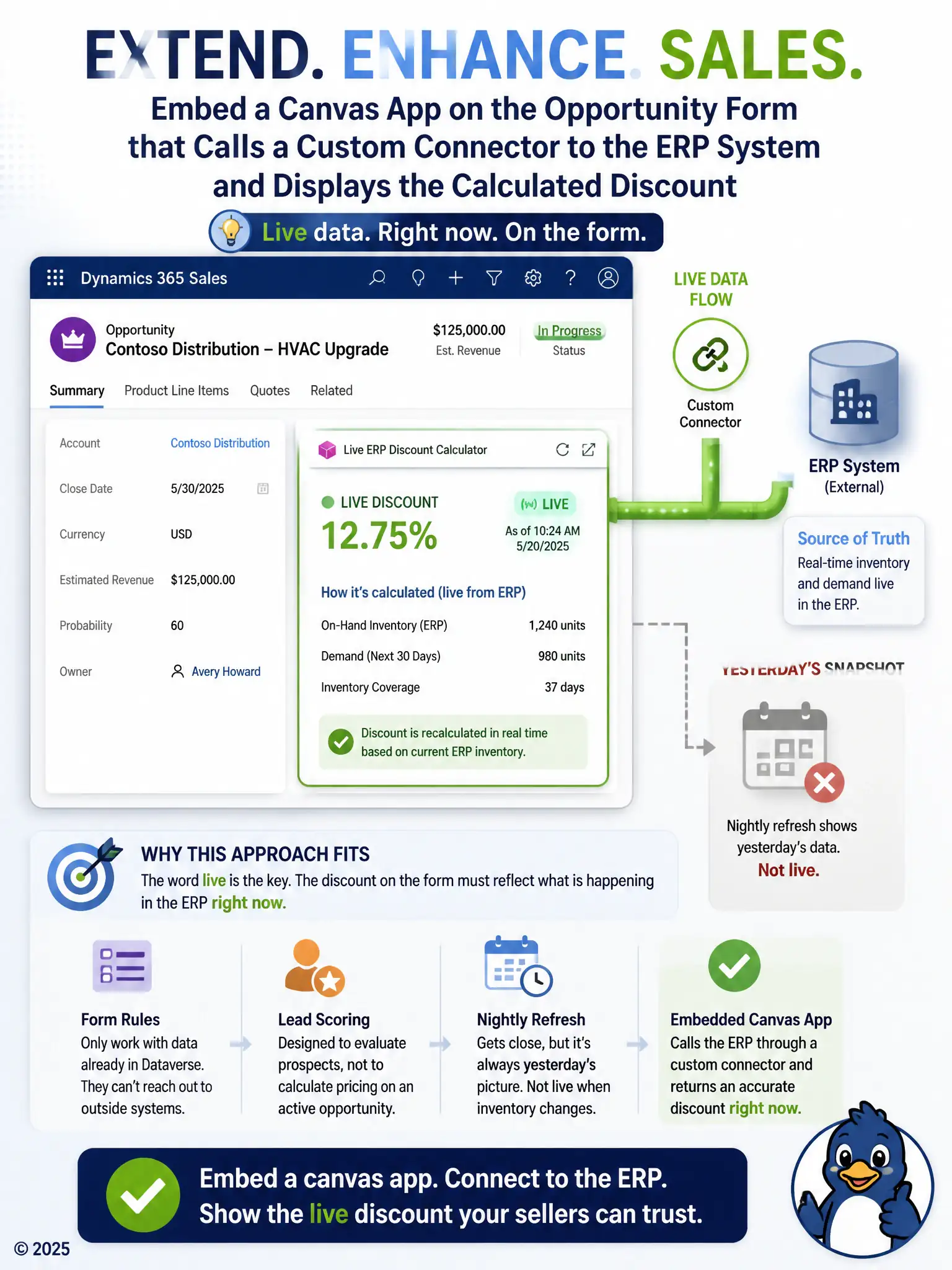
You need live data, so you put a canvas app on the Opportunity form and have it call the ERP through a custom connector. That gives reps a discount that's current when they look at it. Business rules, lead scoring, and nightly workflows can't do real-time external lookups.
Full Explanation
The correct approach is embedding a canvas app on the Opportunity form that calls a custom connector to the ERP system and displays the calculated discount. The requirement is for a live, calculated value shown directly on the Opportunity form that depends on data living outside Dataverse, in an external ERP system; an embedded canvas app can call a custom connector to that ERP system in real time and render the calculated discount right on the form, satisfying both the 'live' and 'on the form' parts of the scenario. The business-rule approach that recalculates the discount field whenever the opportunity is saved is incorrect because business rules operate only on data already present on the form or in related Dataverse records and have no mechanism to call an external system, so they cannot retrieve real-time ERP inventory levels. The Sales Qualification Agent option that pulls ERP inventory data into the lead score is incorrect because the Sales Qualification Agent is designed to assess and score leads, not to calculate pricing or discounts on an active opportunity, so repurposing it for this task misapplies the tool. The classic workflow option that runs nightly to update a discount field with the previous day's ERP data is incorrect because a nightly batch update produces a discount based on the previous day's inventory, which fails the scenario's explicit requirement for a live, real-time calculation rather than a stale snapshot.