
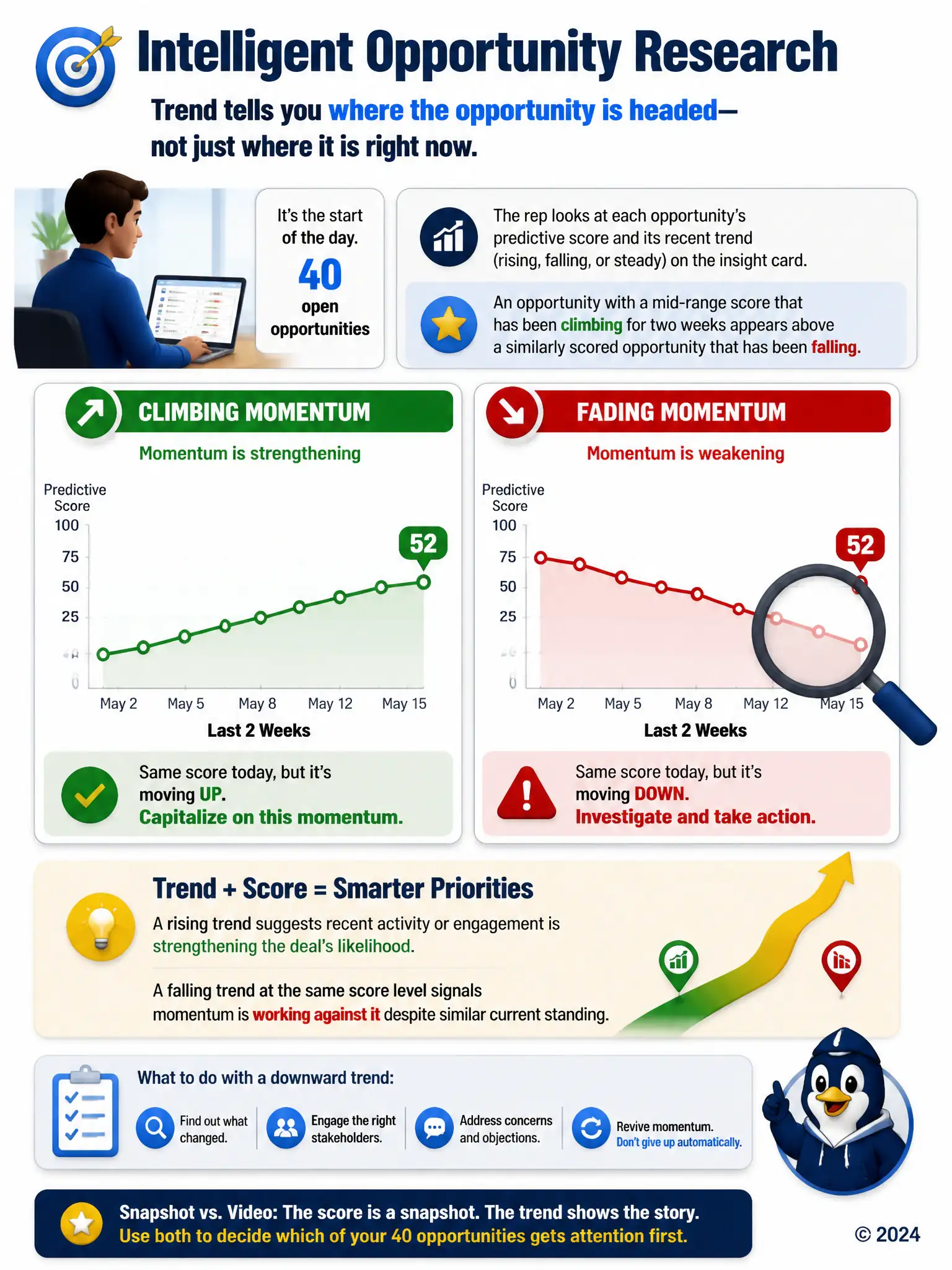
At the start of the day, a rep with 40 open opportunities wants to decide where to focus first. Rather than sorting by deal value alone, the rep looks at each opportunity's predictive score alongside its recent score trend, shown as rising, falling, or steady, on the insight card. An opportunity with a mid-range score that has been climbing for two weeks appears above a similarly scored opportunity that has been falling. Why is trend, not just the current score value, useful for prioritization here?
Select an answer to reveal the explanation.
Short Explanation
Picture two deals with the same score today: one's been climbing, and one's been sliding. The climbing one is picking up momentum worth capitalizing on, while the falling one may be slipping away unless you step in. That's why trend matters as much as the raw number—it's the difference between a snapshot and a video.
Full Explanation
The answer that says a rising trend suggests recent activity or engagement is strengthening the deal's likelihood, while a falling trend at the same score level signals momentum is working against it despite similar current standing, is correct. Two opportunities can share the same current score yet be heading in opposite directions; the trend captures whether recent signals, such as engagement, activity, or stage progress, are pushing the deal's likelihood up or down, which tells the rep which mid-range deal is worth immediate attention and which may already be slipping despite looking similar on paper today. The claim that trend has no analytical value and only the current score matters for prioritization is incorrect because it directly contradicts the value trend adds in this exact scenario, where two equally scored deals warrant different responses once their trajectories are considered. The claim that the trend arrow only reflects how recently the record was last opened by the rep, not deal health, is incorrect because the trend indicator reflects changes in the underlying scoring signals over time, not how recently the rep personally viewed the record, which is an unrelated piece of metadata. The claim that falling scores always indicate the opportunity should be immediately disqualified from the pipeline is incorrect because a falling score is a prompt to investigate and intervene, not an automatic instruction to disqualify the opportunity; treating every decline as a reason to abandon a deal would discard opportunities that could still be recovered with the right attention.