
Before a renewal call, a rep uses Copilot to generate a summary of a lengthy email thread with the customer to refresh on open issues. The summary lists three action items, including one stating the customer agreed to a 15% price increase. The rep does not recall that specific detail from the thread. What should the rep do before relying on this figure in the call?
Select an answer to reveal the explanation.
Short Explanation
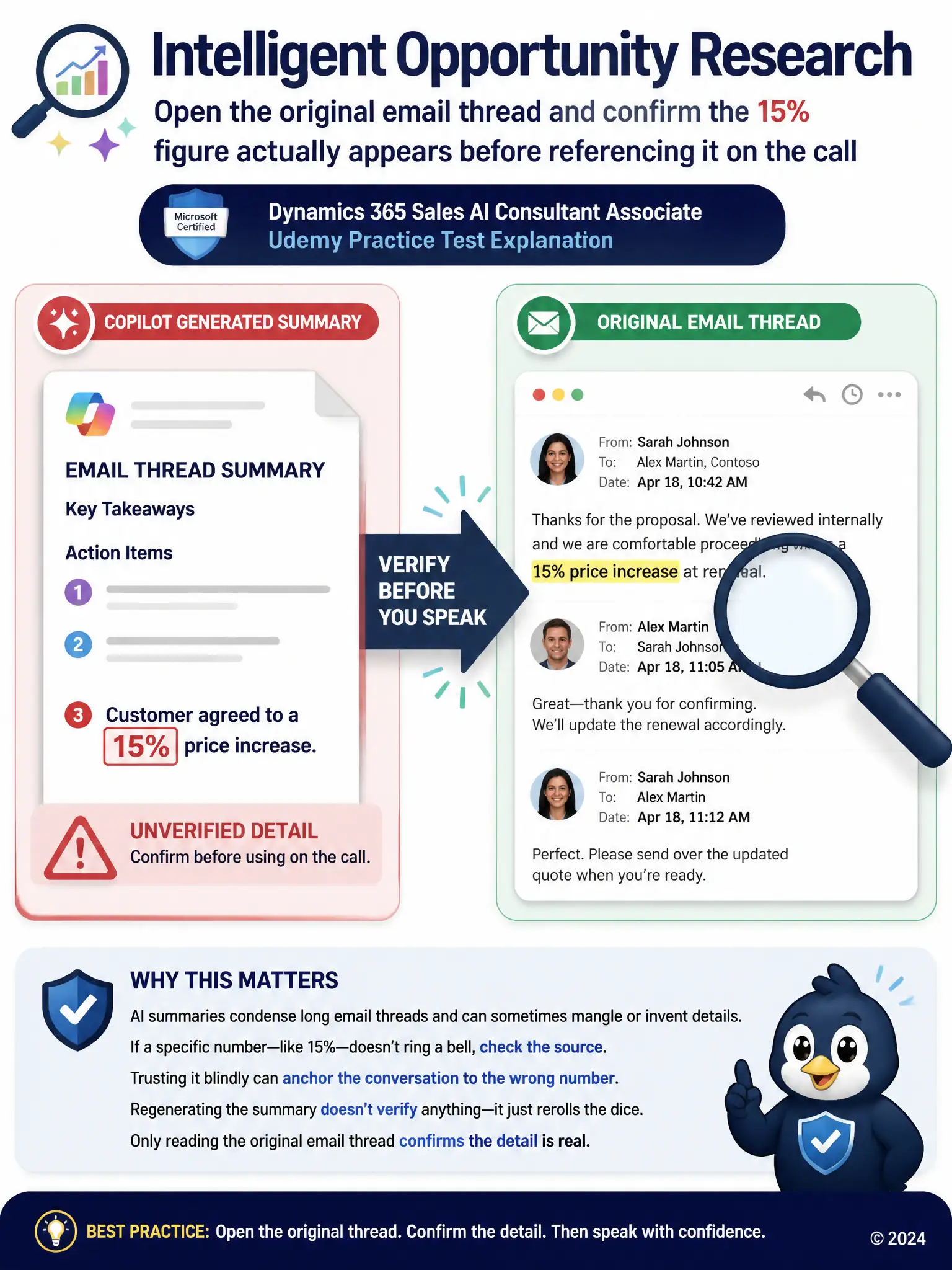
If Copilot hands you a number you don't remember, go check the receipts before you repeat it to the customer. Generated summaries can mangle or invent details, so open the original email thread and confirm the 15% figure before referencing it on the call.
Full Explanation
The correct choice is to open the original email thread and confirm the 15% figure actually appears before referencing it on the call. Generated summaries are produced by interpreting the language in the underlying emails, and language-based generation can occasionally misstate or fabricate a specific detail such as a numeric figure; the safest step before citing something as consequential as a pricing agreement is to open the source thread and verify the figure actually appears there. The option that says to trust the summary as accurate because generated summaries pull directly from verified transaction data is incorrect because these summaries are built from unstructured email text, not from verified transaction or quote records, so accuracy of a specific figure cannot be assumed without checking the source. The option that says to ask the customer directly on the call to restate their agreement to the increase, replacing the need to check the thread, is incorrect because raising an unverified 15% figure directly with the customer risks anchoring them to a number that was never actually agreed, or damaging credibility if it turns out to be wrong, when a quick source check would have avoided the risk entirely. The option that says to regenerate the summary a second time and use whichever version appears first is incorrect because regenerating the summary does not guarantee a more accurate result and provides no actual confirmation that the figure is genuine; only checking the original content does that.