
A consultant is setting up conversation intelligence for a sales team that uses Microsoft Teams for all customer calls. The team wants reps to receive an in-call alert whenever a prospect brings up a competitor by name, so the rep can respond immediately rather than after the fact. The consultant has enabled call recording and transcription, but reps report the alerts never appear during live calls. Which configuration step most likely resolves this?
Select an answer to reveal the explanation.
Short Explanation
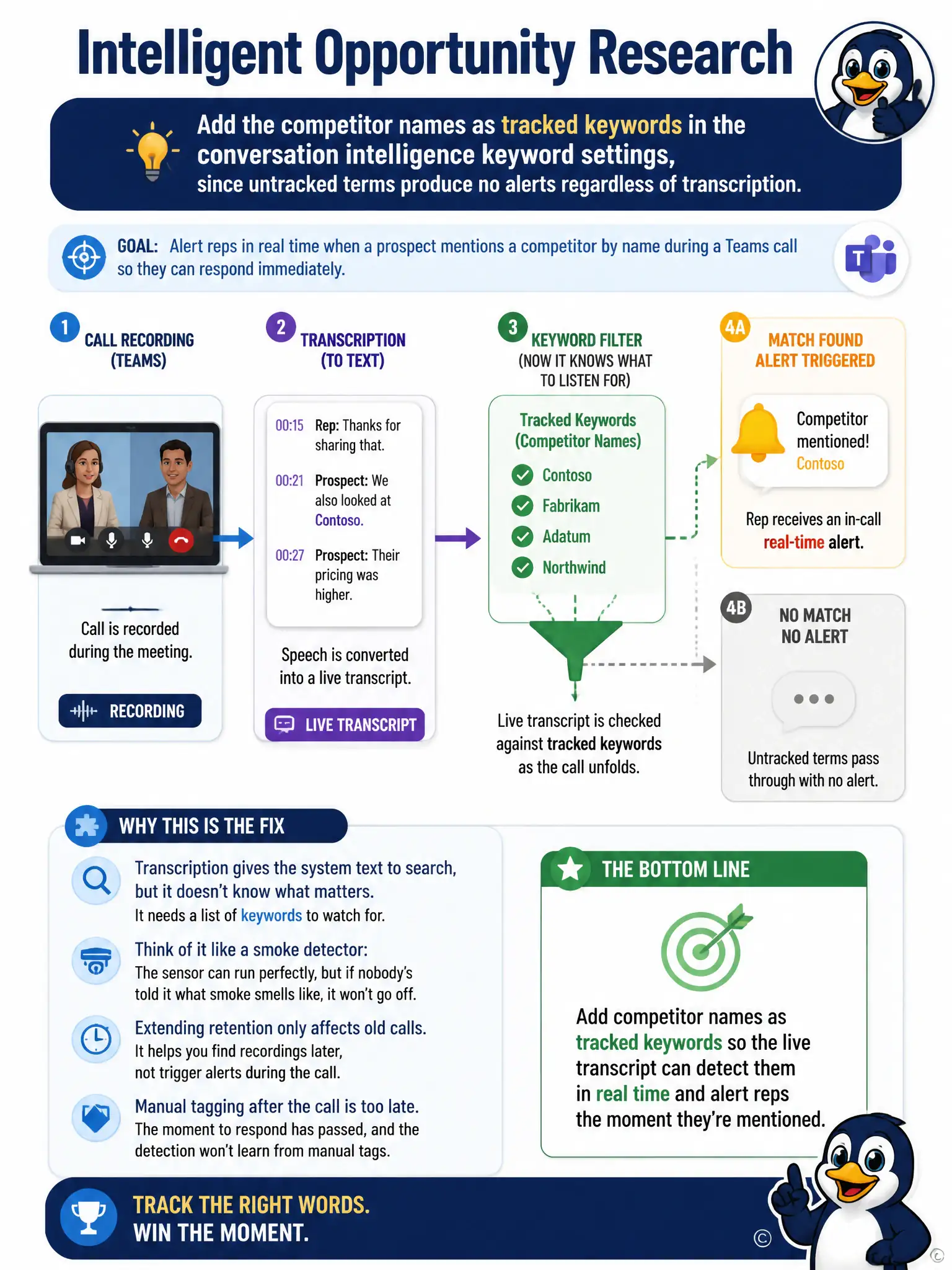
You don't need more recording history or after-the-fact tagging. You need to add the competitor names as tracked keywords, because live alerts only fire for terms the system has been told to watch for.
Full Explanation
The correct configuration step is adding the competitor names as tracked keywords in the conversation intelligence keyword settings, since untracked terms produce no alerts regardless of transcription. In-call keyword alerts only fire for terms the system is explicitly configured to track; recording and transcription supply the raw conversation data, but without the competitor names entered as tracked keywords, nothing triggers an alert even though the words are being spoken and transcribed. Adding the names to the keyword list is what connects the transcript stream to a real-time notification. Increasing the call recording retention period is incorrect because retention period controls how long recordings are stored for later review, not whether real-time detection happens during the call; a longer retention window has no effect on live alerting. Asking reps to manually tag competitor mentions in the transcript after each call is incorrect because conversation intelligence keyword detection does not rely on reps manually tagging transcripts to train recognition; it matches configured keyword lists directly against the transcript as the call happens, so manual tagging after the fact would not enable a live alert anyway. Disabling predictive opportunity scoring is incorrect because predictive opportunity scoring and conversation intelligence keyword alerts are separate capabilities that do not compete for a shared processing pipeline, and disabling scoring would remove a different feature entirely without addressing the missing keyword configuration.