
A consultant configuring Dynamics 365 Sales for an account-based sales team wants reps to see, during opportunity research, whether a customer already using one product line has unaddressed needs that map to other products the company sells but has never purchased. Which AI-supported capability should the consultant point the team to?
Select an answer to reveal the explanation.
Short Explanation
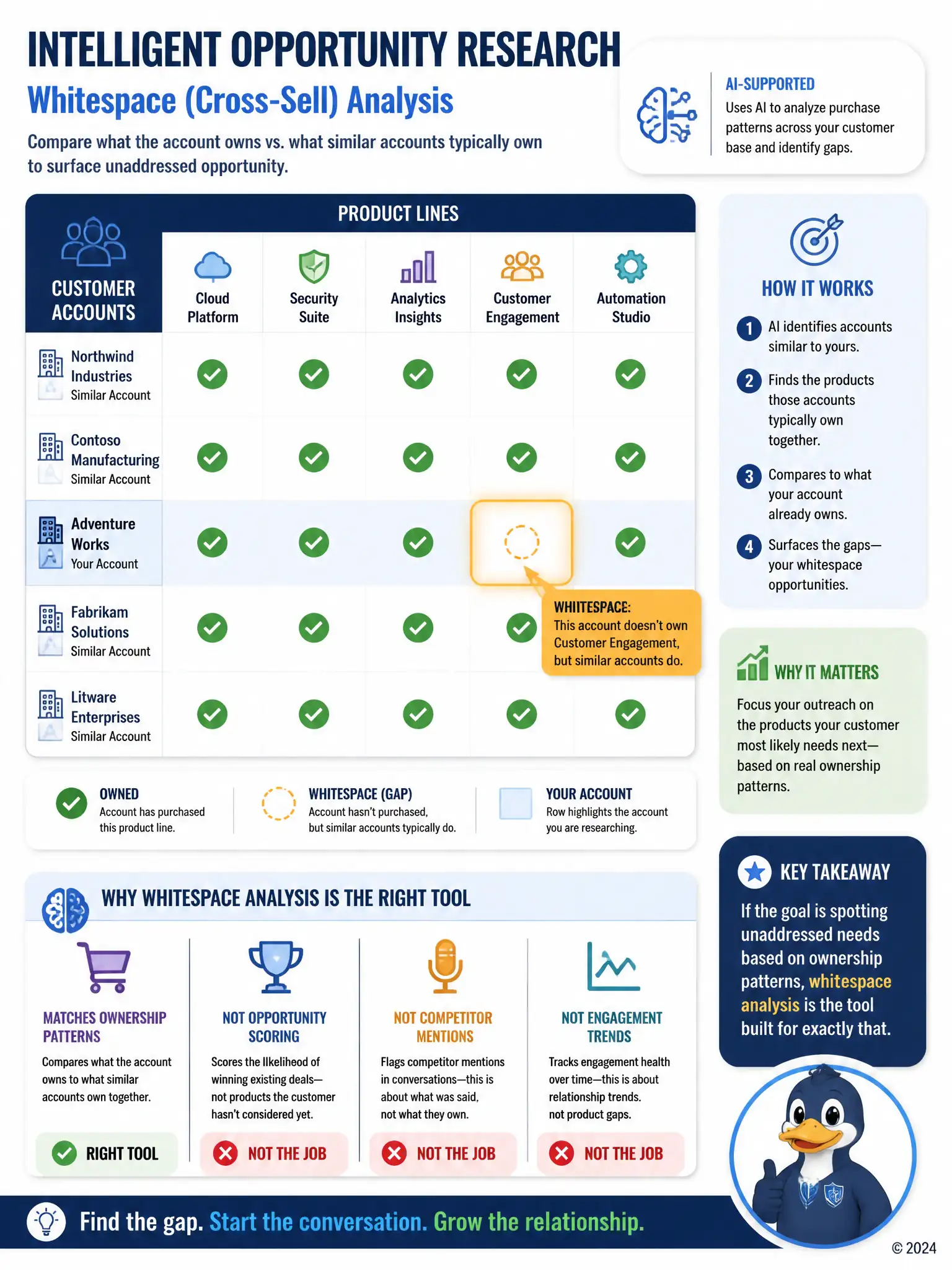
You're looking for a matching problem: what does the account already own, and what do similar accounts usually own together? Whitespace or cross-sell analysis lines up the customer's current footprint against common product combinations and points out the gap. Scoring open deals, flagging competitor mentions, or tracking engagement trends won't reveal products the customer hasn't purchased yet.
Full Explanation
Whitespace or cross-sell analysis is built specifically to compare what an account already owns against common product combinations seen across the customer base, surfacing gaps where a customer's existing footprint suggests an unaddressed need for a product line they have never purchased; that is exactly the research task described. Predictive opportunity scoring is incorrect because it evaluates the likelihood that existing, already-created opportunities will close, which says nothing about identifying unpurchased products the customer might need, since there is no opportunity for those products to score in the first place. Conversation intelligence transcript analysis is incorrect because it is focused on surfacing content spoken during calls, such as competitor mentions or sentiment, not on comparing an account's purchase footprint against typical product combinations. Relationship health trend indicators are incorrect because they measure the trend of engagement activity with an account over time, which speaks to how connected the team is with stakeholders, not to which products the account has or has not adopted.