
A consultant is configuring Copilot-driven lead qualification for a client that sells industrial equipment through a network of regional dealers. The client wants Copilot to flag which assigned leads a seller should qualify next, but the dealer network submits leads through a mix of a web form, a partner portal, and manual entry by dealer reps, so lead detail completeness varies widely from one source to another. Sellers report that leads from the partner portal, which capture only company name and phone number, are almost never surfaced by Copilot as ready to qualify, even when those leads are genuinely promising. What should the consultant do to address this pattern?
Select an answer to reveal the explanation.
Short Explanation
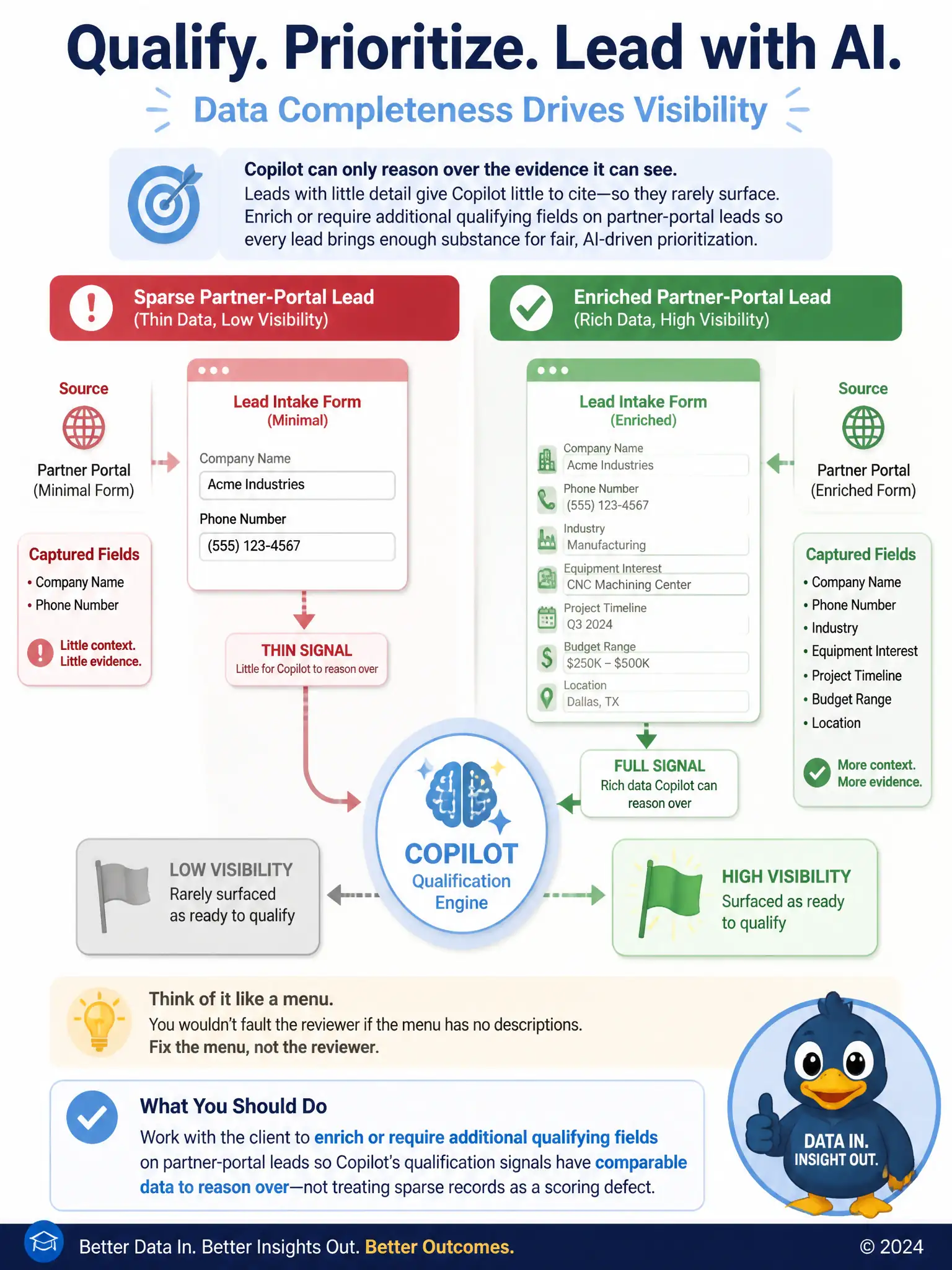
When Copilot keeps skipping leads from one source, don't blame the AI; those leads often lack enough detail to reason over. You need to fix the intake channel so partner-portal leads capture comparable qualifying fields. That gives Copilot evidence to recommend them fairly.
Full Explanation
The correct approach is to work with the client to enrich or require additional qualifying fields on partner-portal leads so Copilot's qualification signals have comparable data to reason over, rather than treating sparse records as a scoring defect. Copilot's qualification guidance reasons over the data present in a lead record; when partner-portal leads carry only company name and phone number, there is little signal for Copilot to cite as evidence of readiness, so those leads are underrepresented in recommendations even if they would convert well. The fix is a data-quality intervention at the source: enrich or require the fields Copilot needs, such as email engagement, company size, or role information, so partner-portal leads carry comparable signal to leads from other channels. Disabling predictive lead scoring entirely and ranking leads only by creation date is incorrect because it discards the qualification capability the client wants and does not address why partner-portal leads were being underweighted. Instructing sellers to manually re-enter partner-portal leads through the web form is incorrect because it does not add any qualifying data; the underlying sparseness persists and the rework burden falls on sellers for no analytical gain. Turning off Copilot recommendations for any lead missing a value in one or more fields is incorrect because it would suppress a large share of the partner-portal channel outright, hiding leads from sellers rather than helping Copilot reason about them, and would not distinguish a lead that is merely missing a nonessential field from one that lacks any qualifying signal at all.