
A regional sales director instructs his team to automatically ignore any lead scored below the Cool threshold and never review them, since the predictive model already accounts for everything relevant. A consultant reviewing this policy raises a concern. What is the most likely reason for that concern?
Select an answer to reveal the explanation.
Short Explanation
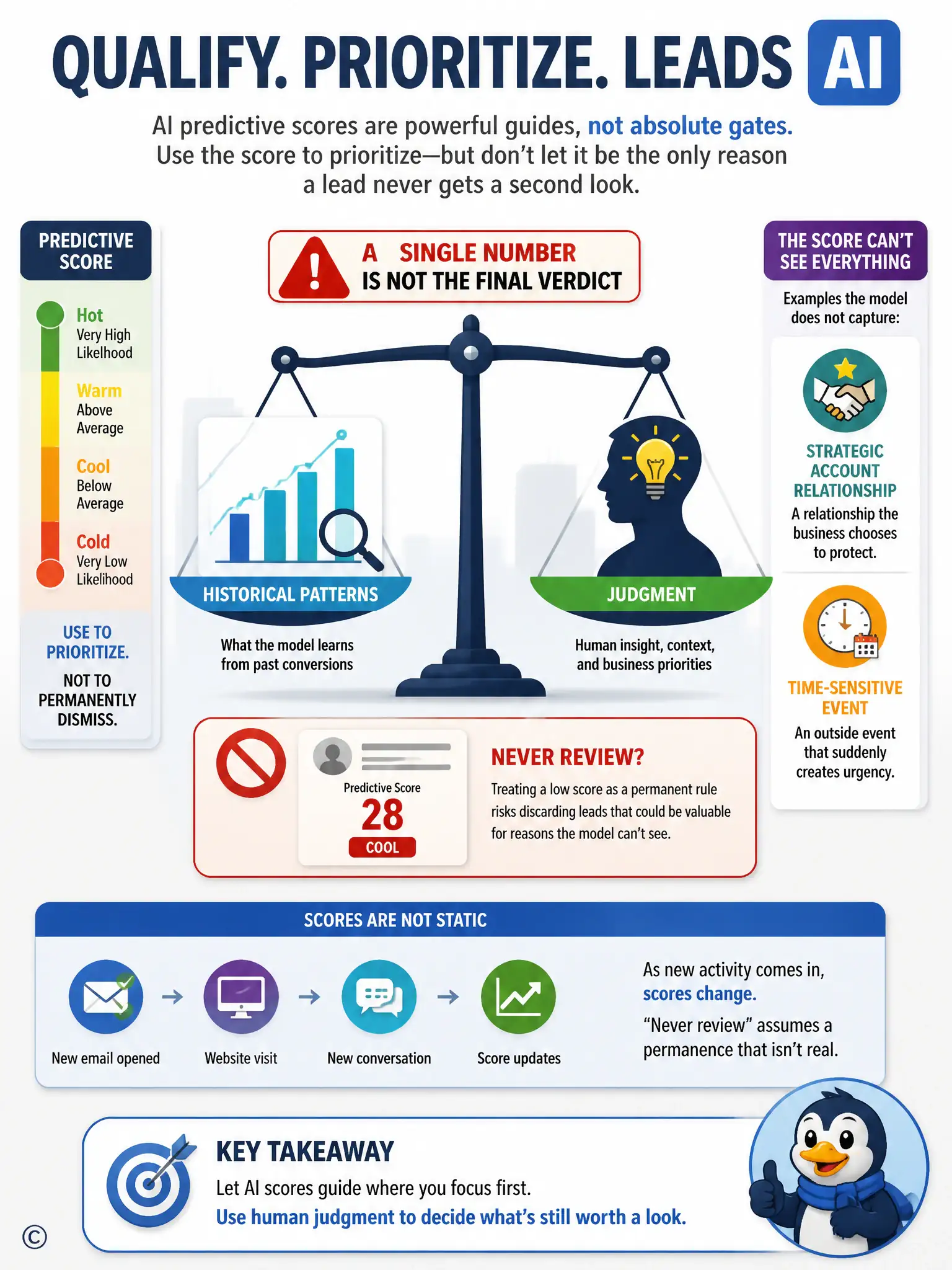
You can use a predictive score to prioritize leads, but it's not the whole picture. It can miss a strategic relationship or urgent event, so a blanket rule to never review low-scoring leads can throw away good opportunities. Scores also change as new activity comes in, so 'never review' assumes a permanence that isn't real.
Full Explanation
The concern is best explained by the view that the predictive score reflects patterns in historical conversion data and should inform prioritization, but it does not capture every factor, such as a strategic account relationship or a time-sensitive event, so treating it as the sole qualifying criterion risks discarding leads worth a second look. The predictive score is a useful, data-driven signal for prioritization, but it is trained on historical patterns and cannot know about every relevant circumstance, such as a lead tied to a strategic account the company wants to nurture regardless of score, or a time-sensitive event that makes a low-scoring lead suddenly worth a look; treating the score as the single, final word on whether a lead deserves any review at all removes human judgment from cases where it still adds value. The claim that a lead scored below the Cool threshold this morning is mathematically guaranteed to remain below that threshold indefinitely is incorrect because a low score today does not lock a lead out permanently; new engagement or updated information can change a lead's standing over time, so 'indefinitely' is an overstatement not supported by how scoring works. The claim that the Cool threshold only applies to leads created through web forms, making the policy redundant for other sources, is incorrect because band thresholds apply uniformly across leads regardless of source channel, so there is no carve-out that makes the policy redundant for non-web leads. The claim that predictive scoring cannot be applied to leads at all, only to opportunities, is incorrect because predictive scoring does apply to the Leads table itself, which is the very reason the director's policy is operating on real, meaningful scores in the first place. The concern is about over-reliance on a single signal, not about the feature's scope or permanence.