
A consultant is preparing a client's Dynamics 365 Sales environment to get the most reliable results from AI opportunity scoring and Copilot-generated summaries before go-live. (Select TWO.) Which two actions should the consultant prioritize?
Select all correct answers, then click Submit.
Short Explanation
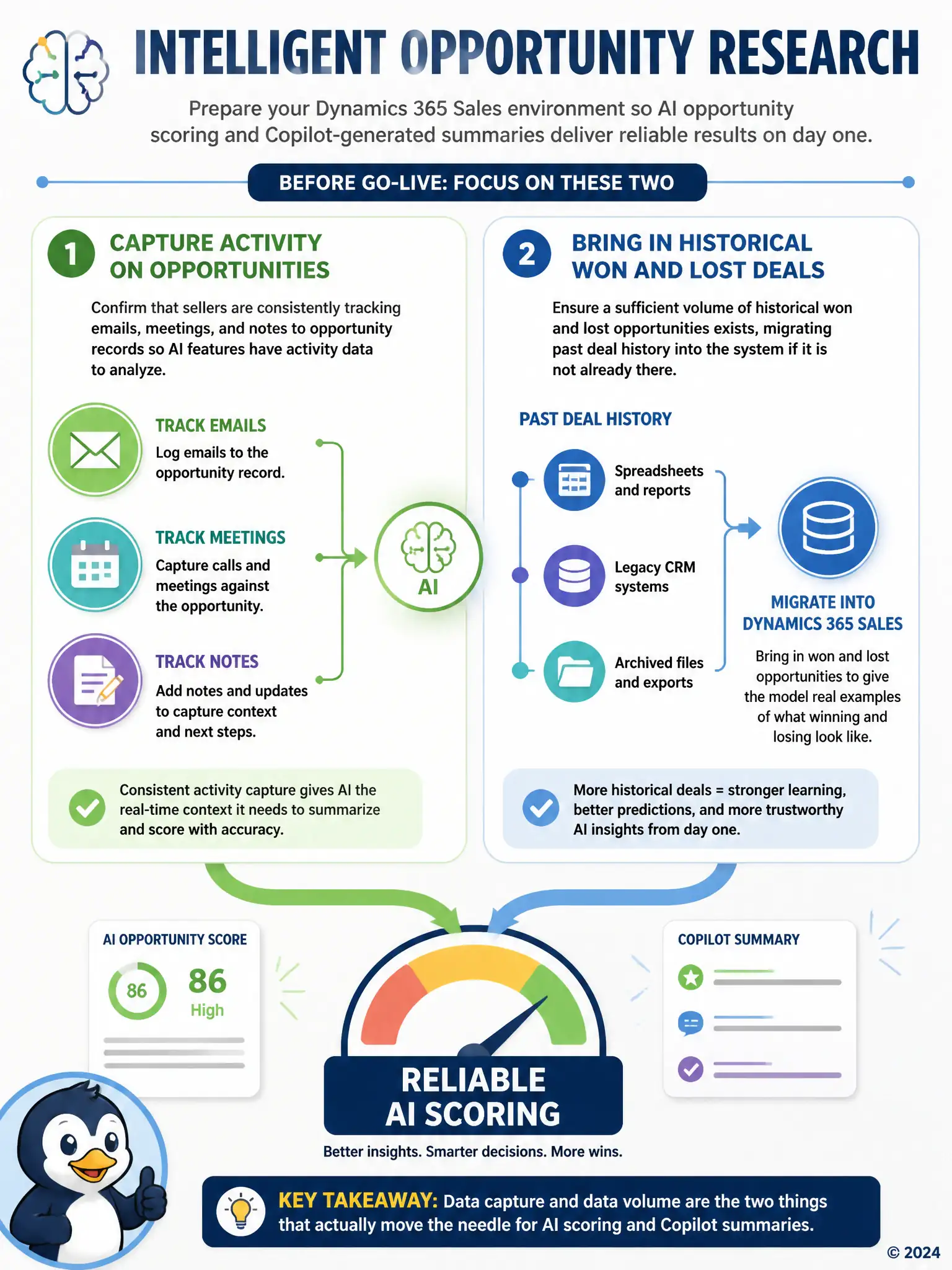
If you want AI opportunity scoring and Copilot summaries to work well before go-live, make sure sellers log emails, meetings, and notes to opportunities. You also need enough historical won and lost deals in the system, so migrate old deal history if it's not already there. Data capture and data volume are what move the needle.
Full Explanation
The correct actions are confirming that sellers consistently track emails, meetings, and notes to opportunity records, and ensuring a sufficient volume of historical won and lost opportunities exists, migrating past deal history into the system if it is not already there. Both predictive scoring and Copilot summaries depend on activity data being tracked to the record, so confirming sellers log emails, meetings, and notes against opportunities ensures the AI features have material to analyze. Predictive scoring also depends on learning from a meaningful volume of historical won and lost deals, so migrating past deal history where it is missing gives the model enough examples to identify patterns before go-live. The option that disables manual entry of the probability field is incorrect because the probability field is a standard seller-editable field independent of AI scoring, and disabling manual entry does not improve model accuracy; it only removes a data point sellers use for their own tracking. The option that reduces the number of opportunity stages in the sales process to the minimum allowed is incorrect because there is no requirement or accuracy benefit tied to minimizing the number of sales stages; stage count is a process design decision, and collapsing stages to satisfy a scoring preference is not a documented or necessary step, and could actually reduce the granularity of data the model can learn from.