
A consulting firm's Dynamics 365 Sales environment uses a custom Copilot Studio agent that answers reps' questions about internal policies (expense limits, discount approval thresholds) during live deal reviews, pulling answers from a SharePoint site. The firm wants the agent's answers to stay current as policies change without a developer redeploying anything. Which extension approach fits best?
Select an answer to reveal the explanation.
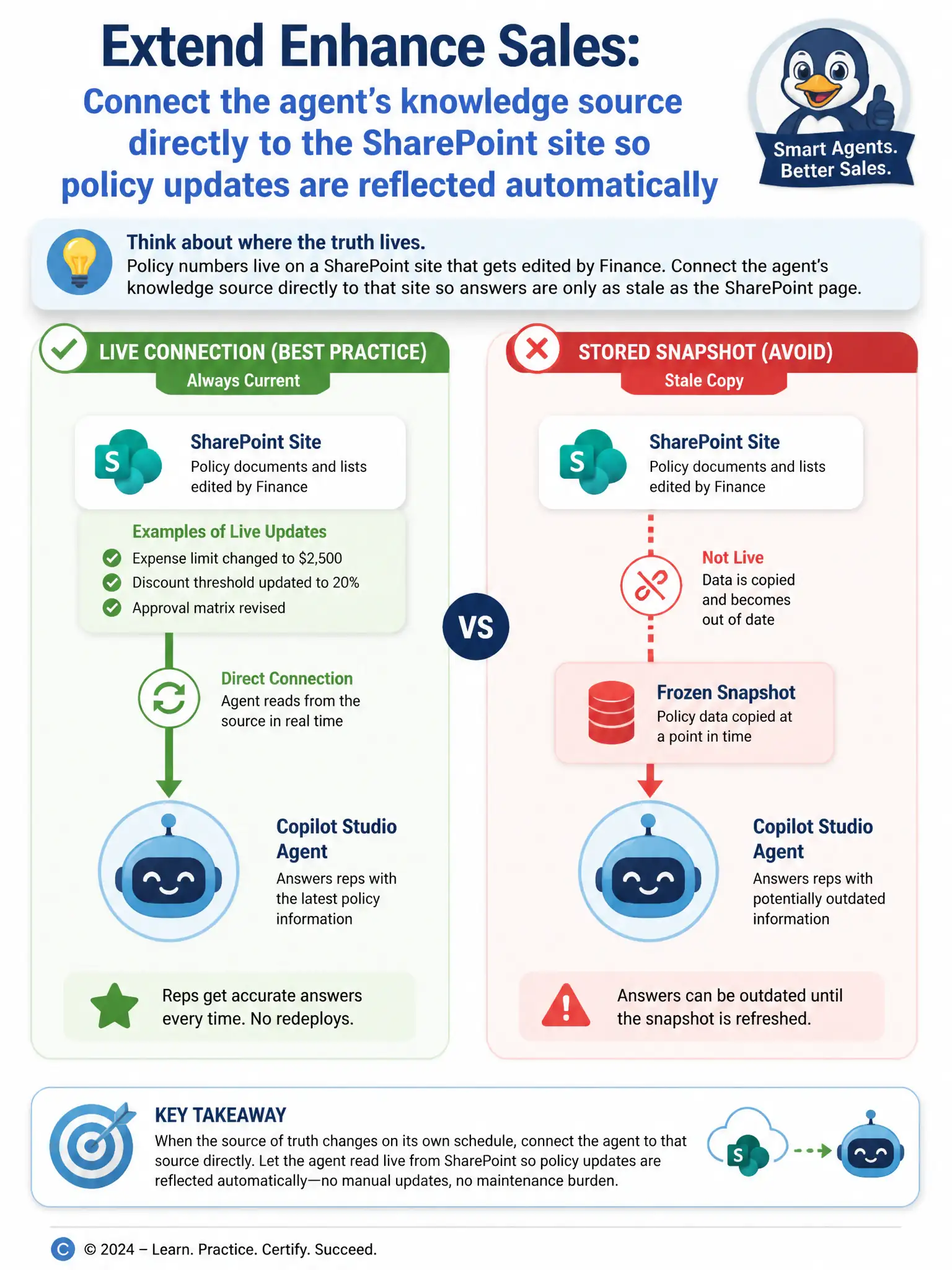
Short Explanation
The policy numbers live on SharePoint, so you should let the Copilot Studio agent read that site directly. That keeps answers current as soon as finance edits the page, without a developer redeploying anything. Hardcoding values, nightly copies, or sequence steps just freeze or misplace the truth.
Full Explanation
Connecting the agent's knowledge source directly to the live SharePoint site means the agent always retrieves the current policy text at query time, so updates to expense limits or discount thresholds are reflected the moment the source changes, with no redeployment needed. Hardcoding current policy values into the agent's system instructions is incorrect because those values go stale the instant a policy changes and require a developer to edit and republish the agent, defeating the goal of low-maintenance currency. Exporting the SharePoint content into a static Dataverse table refreshed by a nightly batch job that is paused during business hours is incorrect because that job can leave the Dataverse copy out of sync for most of the business day, and it introduces an unnecessary duplicate data store to maintain. Storing policy answers inside individual sales sequence steps is incorrect because sequence steps are for guiding rep outreach actions, not for hosting reference answers to ad hoc policy questions; embedding policy text there does not give the agent a queryable knowledge source and would need manual updates in yet another place. Grounding the agent directly in the authoritative live source is the only option that satisfies both accuracy and low ongoing maintenance.