
A consultant is rolling out AI-based opportunity scoring for a client whose sales team only started using Dynamics 365 Sales three months ago and has fewer than 40 closed opportunities logged in the system. During testing, the opportunity scores appear inconsistent and do not clearly separate strong deals from weak ones. What is the most likely root cause?
Select an answer to reveal the explanation.
Short Explanation
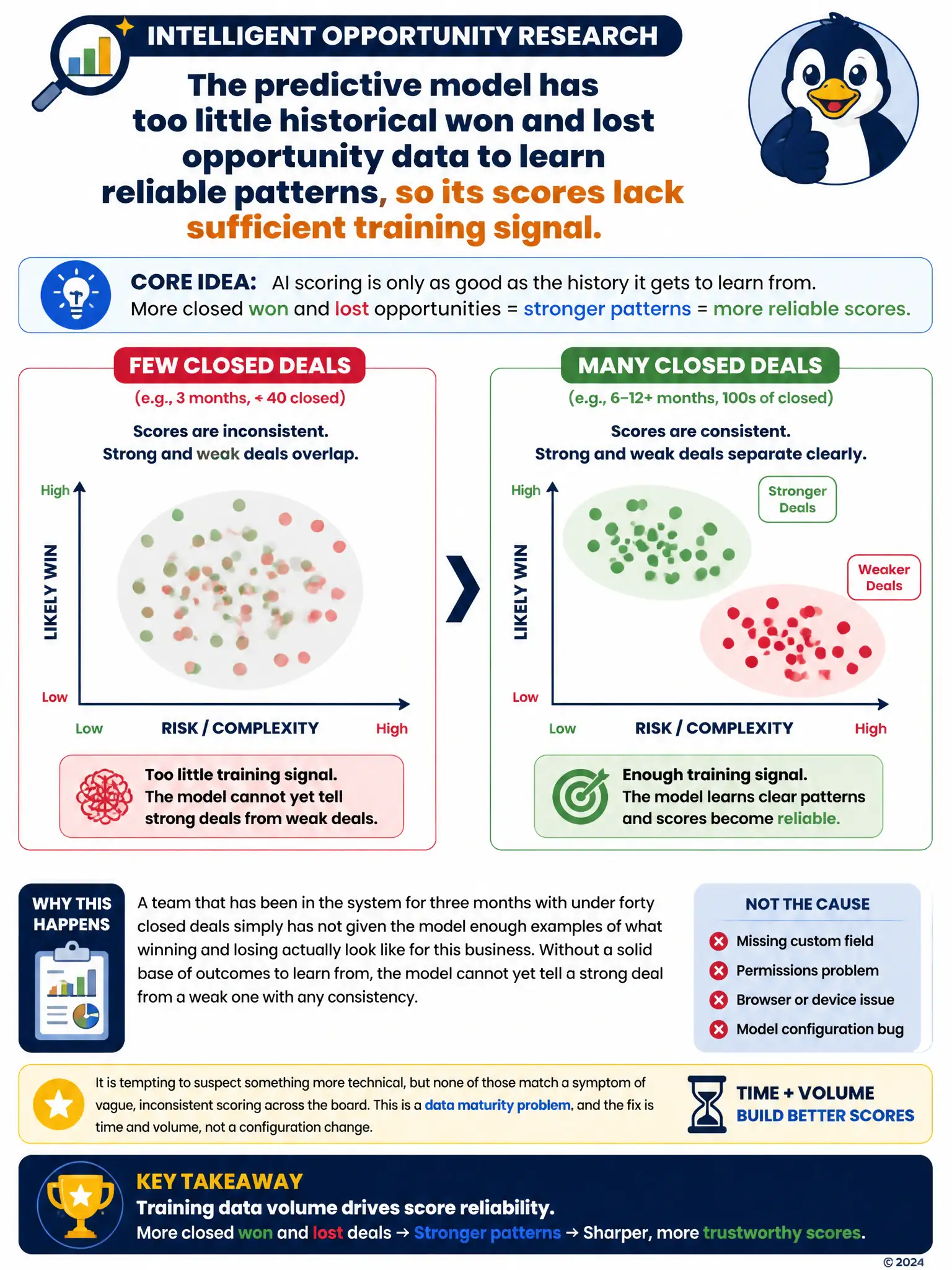
Opportunity scoring is only as good as the history it gets to learn from, and with just three months of use and under 40 closed deals, you haven't given the model enough examples of what winning and losing look like. Without that outcome base, the scores can't consistently separate strong deals from weak ones.
Full Explanation
The root cause is that the predictive model has too little historical won and lost opportunity data to learn reliable patterns, so its scores lack sufficient training signal. Predictive opportunity scoring is a machine learning capability that learns from an organization's own history of won and lost deals, and it needs a meaningful volume of closed opportunities to identify patterns that reliably distinguish strong deals from weak ones. With only three months of use and fewer than 40 closed records, the model has too little training data to produce consistent, differentiated scores, which matches the inconsistency observed in testing. The requirement for a minimum number of custom fields on the opportunity entity is incorrect because opportunity scoring does not require a minimum number of custom fields; it works with standard and available opportunity data and does not gate activation on schema customization. Security roles preventing the model from reading opportunity records is incorrect because a security role restriction would typically block record access entirely or cause errors, not produce scores that are merely inconsistent, and there is no indication in the scenario of an access failure. An unsupported browser causing the score to display incorrectly on the form is incorrect because browser compatibility issues would affect the rendering of the score on the form, not the underlying calculation, and would not explain a lack of separation between strong and weak deals. This is a data maturity problem, and the fix is time and volume, not a configuration change.