
An enterprise deal has twelve stakeholders spread across three departments, and the rep is unsure who the economic buyer is or who might be quietly blocking progress. Which Dynamics 365 Sales AI feature is designed to help infer these roles from contact interactions and email patterns?
Select an answer to reveal the explanation.
Short Explanation
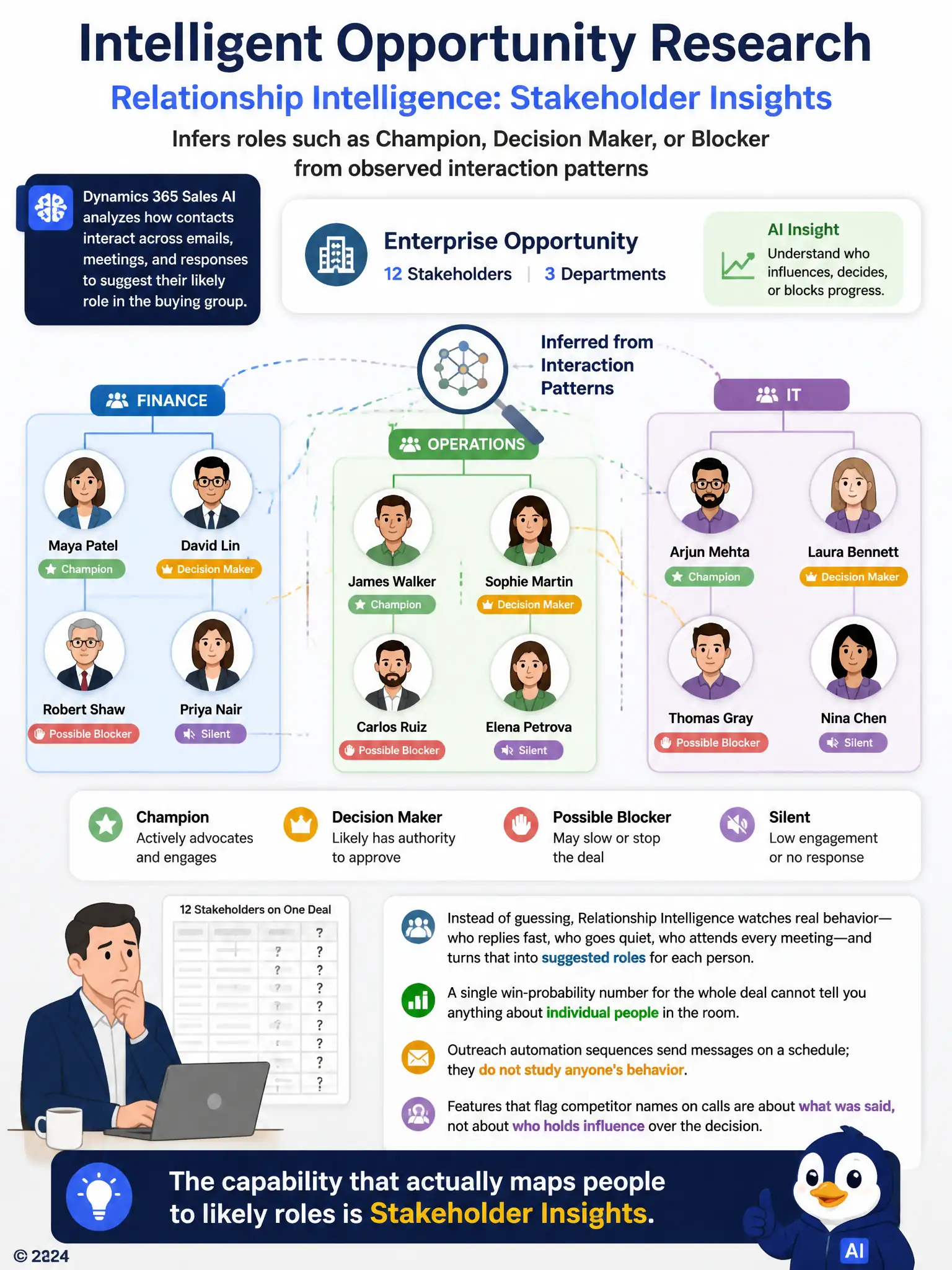
You don't need to guess who signs off or quietly blocks the deal. The relationship intelligence buying group or stakeholder insights feature watches how contacts actually engage—replies, silence, meeting presence—and suggests roles like champion, decision maker, or blocker. One deal score or outreach cadence won't map people to roles.
Full Explanation
The correct answer is the relationship intelligence buying group or stakeholder insights capability. It is designed to analyze the pattern of interactions across the contacts tied to a deal, such as who responds quickly, who is copied but silent, and who drives meetings, and use those patterns to infer likely roles such as champion, decision maker, or blocker, which is exactly the mapping the rep needs for a twelve-stakeholder deal. The predictive opportunity scoring model is incorrect because it produces one aggregate win-probability figure for the whole opportunity and has no mechanism for breaking down individual stakeholder roles. Sales accelerator sequences are incorrect because they are an outreach automation tool that sends a predefined cadence of activities to contacts; they do not analyze or infer anything about the roles those contacts play in the buying decision. The conversation intelligence competitor mention tracking capability is incorrect because it flags when a rival's name comes up during a call, which is unrelated to identifying who among the stakeholders holds influence or is blocking the deal. Only the buying group and stakeholder insights capability is built to surface these role inferences.