
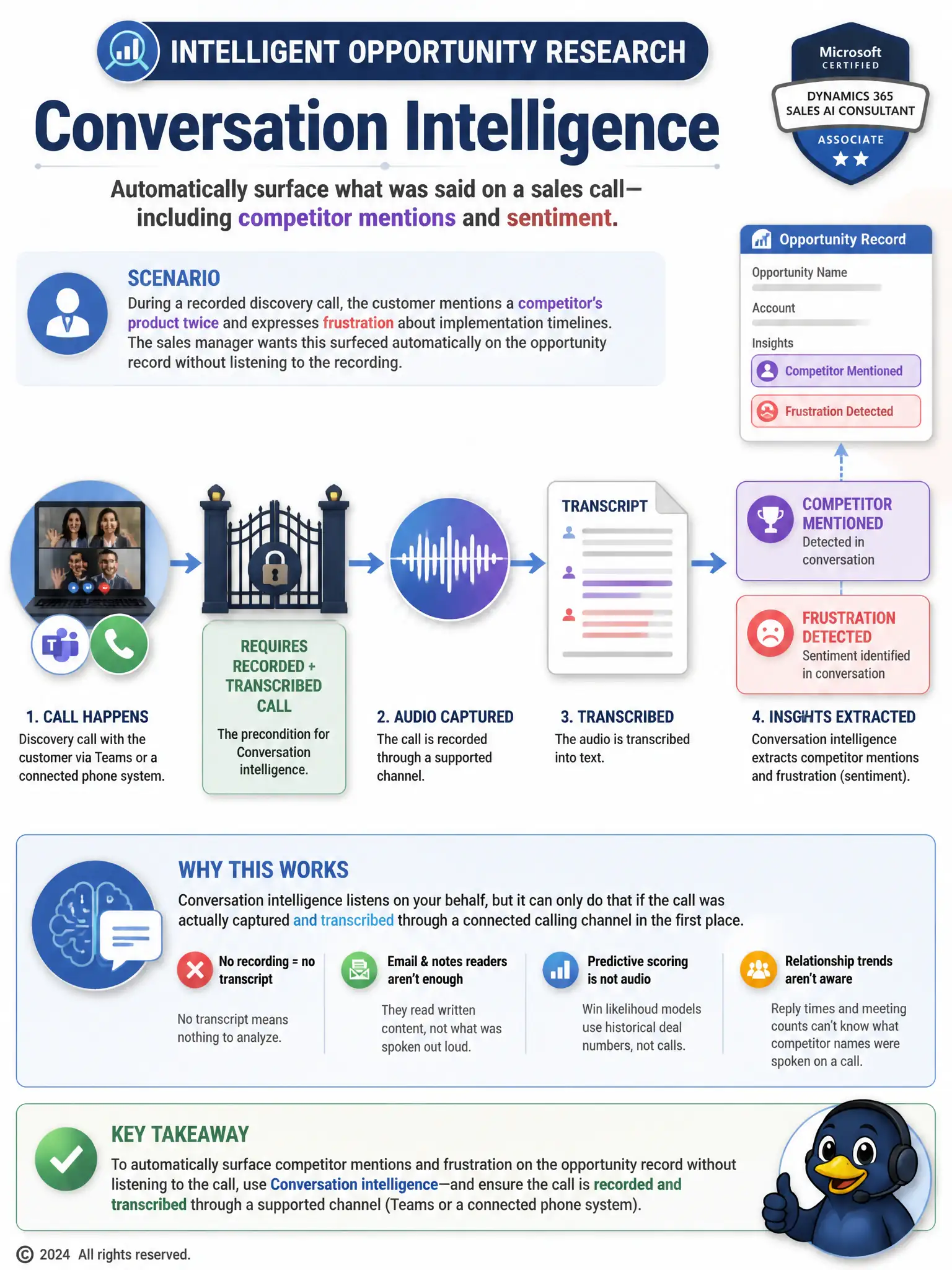
During a recorded discovery call, the customer mentions a competitor's product twice and expresses frustration about implementation timelines. The sales manager wants this surfaced automatically on the opportunity record without listening to the recording. Which capability delivers this, and what must be true for it to work?
Select an answer to reveal the explanation.
Short Explanation
You need conversation intelligence because it can pull competitor mentions and frustration from a recorded, transcribed call. If the call wasn’t captured through a supported channel like Teams or a connected phone system, there’s no transcript to analyze. Opportunity summaries, predictive scoring, and relationship health don’t listen to call audio.
Full Explanation
The correct capability is conversation intelligence, because it processes call recordings and their transcripts to detect signals such as competitor mentions, customer sentiment, and talk ratios. It depends on the call being captured through a supported, integrated channel like Teams or a connected telephony system so a transcript actually exists to analyze; without that recording and transcription step, there is nothing for the feature to process. The AI-generated opportunity summary that reads structured fields such as estimated revenue and close date, not call audio, would not reliably surface a spoken competitor mention on its own, because a summary that reads structured fields is not built to catch something spoken out loud on a call. Predictive opportunity scoring, which requires a sufficient volume of historical won and lost opportunities but does not process audio at all, works from structured historical deal data to produce a win-probability figure and has no capability to listen to or interpret call audio. Relationship health scoring, which is derived only from email cadence and meeting frequency, not from what was said on a call, is built from cadence-style signals like response times and meeting counts, so it would not catch a competitor mention or a frustration cue voiced during the conversation. Conversation intelligence, fed by a properly recorded and transcribed call, is the feature built for this exact scenario.