
A consultant is configuring AI-generated account summaries for a sales team covering strategic accounts with complex, multi-year histories. A seller preparing for an executive business review needs the summary to prioritize the most business-critical recent developments, such as a major support escalation last month, rather than routine older interactions. Which configuration approach should the consultant take to meet this need?
Select an answer to reveal the explanation.
Short Explanation
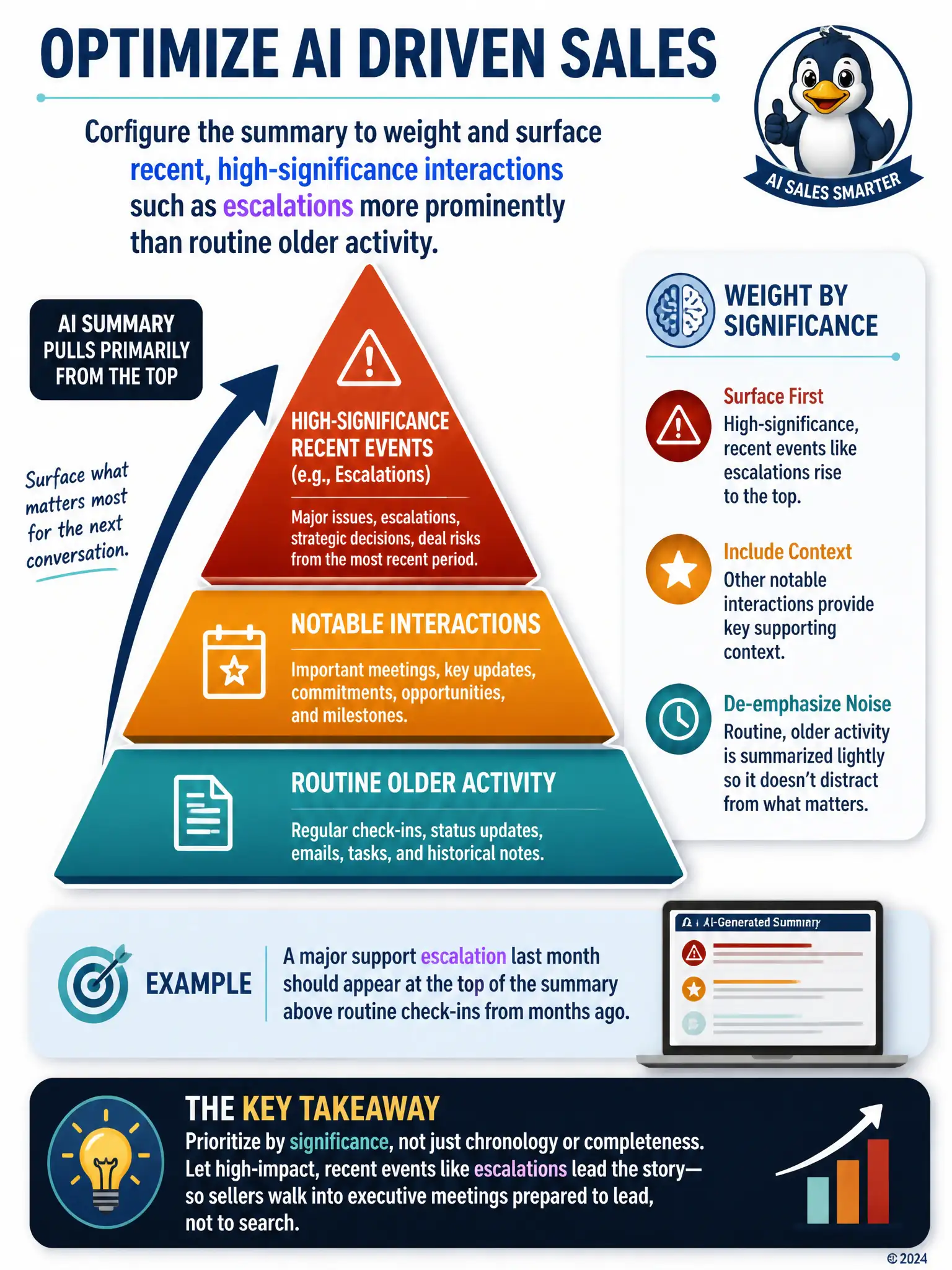
You need the summary to push the big, recent stuff—like a major escalation—above routine older notes. That gives the seller a focused view for an executive review instead of a dump or a guess. Manual notes or a seven-day cutoff just trade one problem for another.
Full Explanation
The correct approach is to configure the summary to weight and surface recent, high-significance interactions, such as escalations, more prominently than routine older activity. The seller's need is a summary that surfaces what matters most for an executive conversation, so the configuration should prioritize recent, high-significance events like a major support escalation over routine older activity, giving a focused view rather than an undifferentiated log. Including every logged interaction in full, in chronological order, so nothing is omitted is incorrect because it produces an exhaustive but unprioritized document that buries the escalation among routine notes, defeating the purpose of a summary. Limiting the account record to only show interactions from the last seven days so the summary stays short is incorrect because it could exclude relevant context that falls just outside that window while also not guaranteeing that significant events within it are actually highlighted over trivial ones. Turning off AI summarization for strategic accounts and requiring sellers to compile notes manually to guarantee accuracy is incorrect because it removes the efficiency benefit the AI feature is meant to provide and does not by itself guarantee better prioritization; it just shifts the burden entirely to the seller's own judgment under time pressure. Configuring the summary to weight significance, not just recency or completeness, is what produces the prioritized view the seller needs before an executive review.