
A consultant is helping a sales director evaluate whether an AI-driven opportunity scoring model deployed six months ago is still performing well. The director asks how to determine, on an ongoing basis, whether the model's predicted win probabilities remain trustworthy as market conditions shift. What should the consultant recommend as the primary practice?
Select an answer to reveal the explanation.
Short Explanation
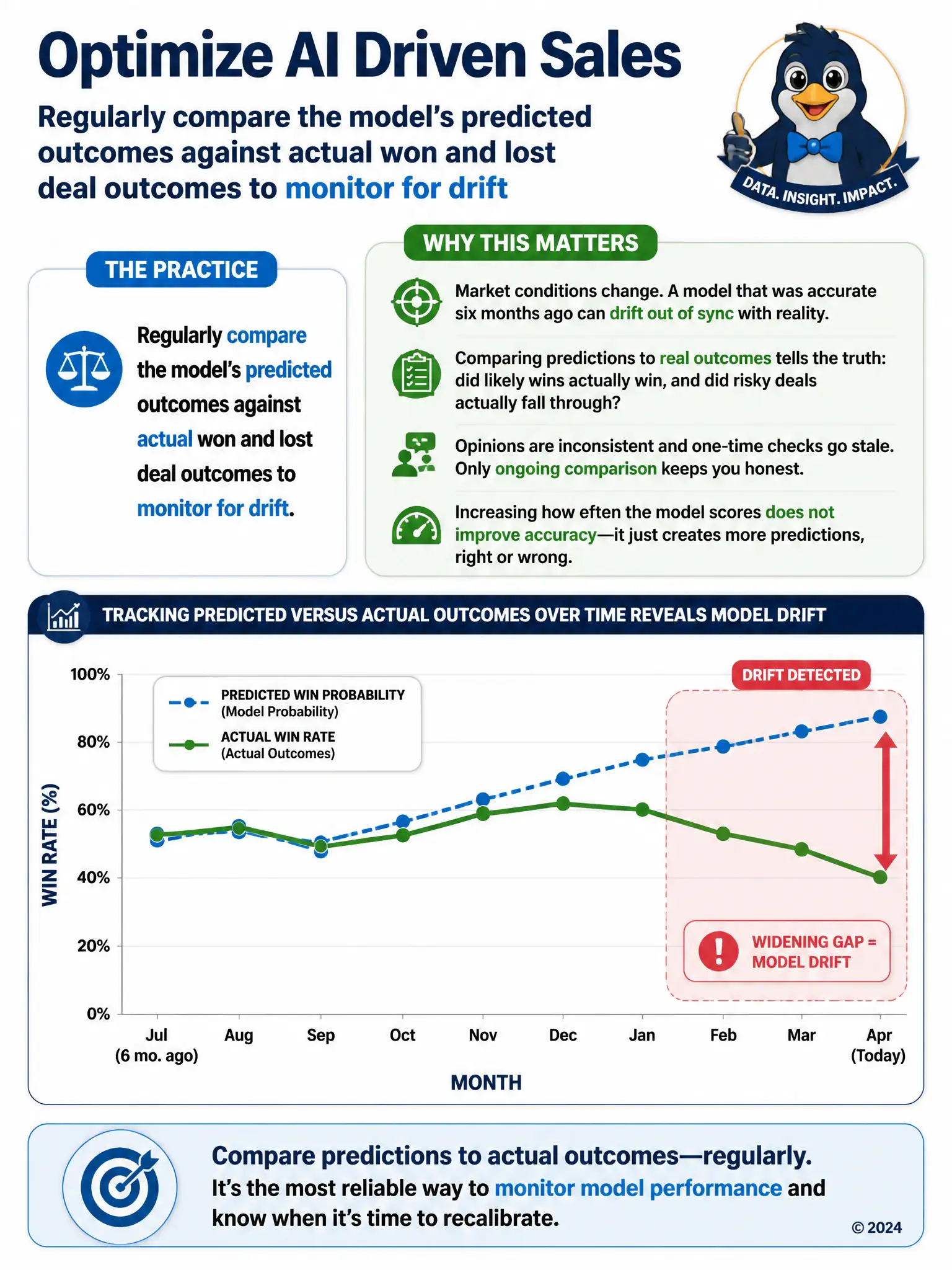
You can’t trust a model just because it passed its first test. Check its predicted win probabilities against actual won and lost deals on a regular basis; that’s how you spot drift when market conditions change.
Full Explanation
Ongoing trustworthiness of an AI scoring model is established by monitoring performance over time, specifically comparing predicted win probabilities against actual won and lost outcomes, which reveals whether the model's accuracy is holding up or drifting as market conditions and buying behavior change. Relying on the initial validation results from deployment is incorrect because a one-time validation at deployment reflects conditions at that moment only; markets, product lines, and buyer behavior evolve, and a model that was accurate six months ago can degrade without anyone knowing unless it is monitored continuously. Asking sellers informally in a hallway conversation whether the scores feel accurate is incorrect because informal, unstructured seller opinions are subjective and inconsistent, and they do not provide the systematic, outcome-based evidence needed to detect real accuracy drift. Increasing the model's prediction frequency so it generates scores more often is incorrect because generating scores more frequently changes how often output is produced, not whether that output is accurate, so it does nothing to validate the model's underlying performance. Regularly comparing the model's predicted outcomes against actual won and lost deal outcomes to monitor for drift is the concrete, evidence-based practice that lets the director know whether the model still deserves the sales team's trust.