
A consultant is advising a sales team that uses AI-generated email drafting suggestions in Dynamics 365 Sales to speed up outreach. A seller reports that a recent AI-drafted email to a prospect included a claim about product pricing that was outdated by several months. What is the most appropriate process control the consultant should recommend to prevent this from reaching customers again?
Select an answer to reveal the explanation.
Short Explanation
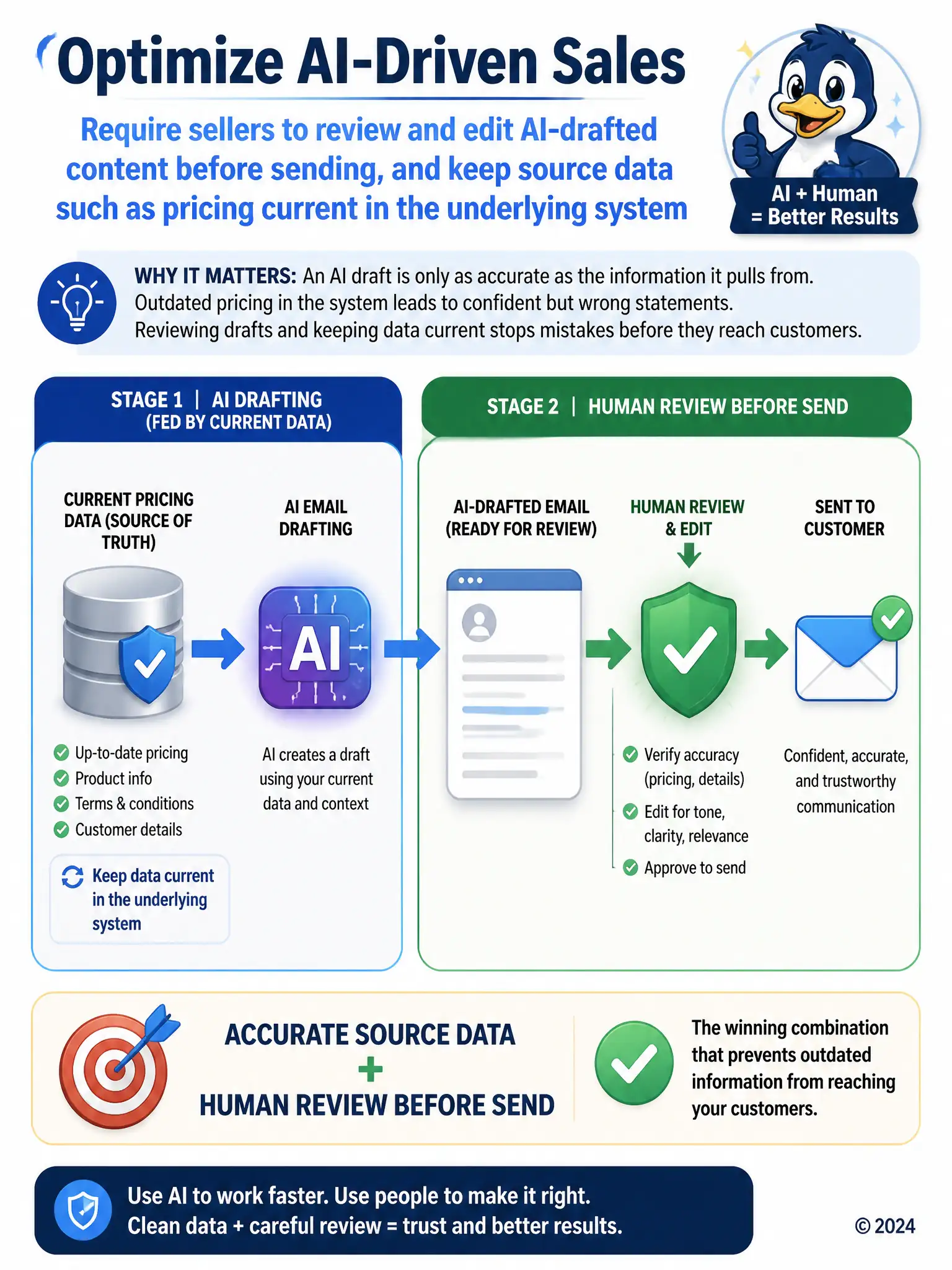
An AI draft is only as accurate as the data behind it, so if pricing hasn't been updated, it can write a confident, polished sentence with a number that's flat out wrong. You need sellers to review and edit drafts before sending, and you need the source pricing data kept current. Review plus clean data is what stops this from reaching customers again.
Full Explanation
The recommended control is requiring sellers to review and edit AI-drafted content before sending, while also keeping source data such as pricing current in the underlying system. AI drafting tools generate content based on available data and language patterns, so they can surface outdated or incorrect details when the underlying source data, such as pricing, has not been kept current. This control addresses both the immediate risk and its root cause. Disabling AI email drafting for the entire team is not appropriate because it discards the efficiency benefits for all correct drafts to guard against a data-currency problem that has a more targeted fix. Instructing sellers to only use AI drafts for internal notes, never for customer-facing communication, is not appropriate because it removes the productivity benefit for the exact use case the team wanted, external outreach, rather than fixing why the content was wrong. Configuring the AI to only draft emails shorter than two sentences is not appropriate because shortening emails does not address factual accuracy; a two-sentence email can still contain the same outdated pricing claim, so length is unrelated to the actual defect. Pairing mandatory human review with accurate, current source data directly targets both the immediate safeguard and the underlying cause of the error.