
A sales enablement consultant is rolling out an AI-generated lead scoring model. During a pilot, sellers notice the model consistently assigns high scores to leads from a specific industry segment that historically converted well, but the company is now expanding into new industries where it has little historical data. Sellers worry the AI will systematically undervalue promising leads from these new segments. What should the consultant recommend to address this concern?
Select an answer to reveal the explanation.
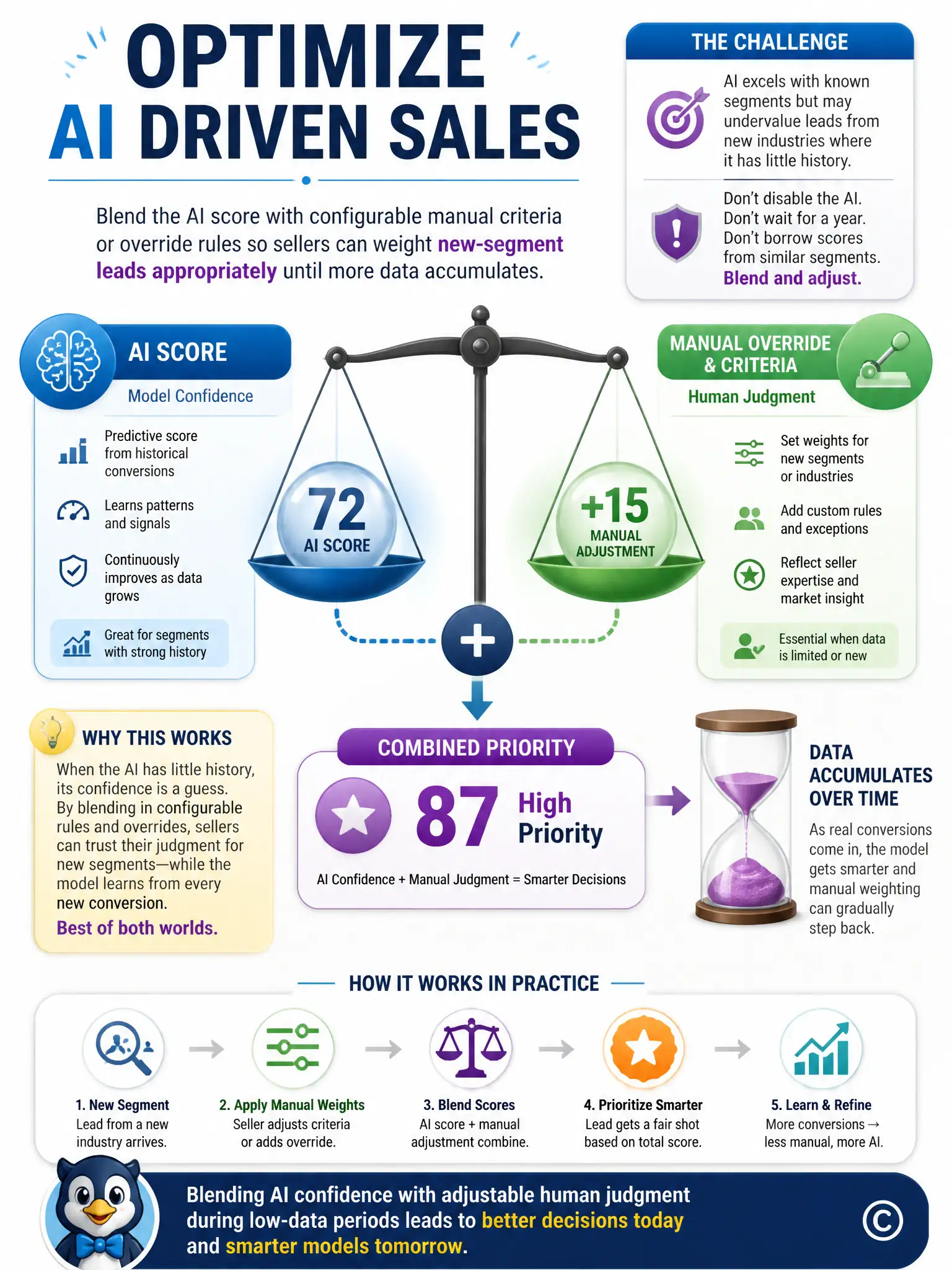
Short Explanation
When the model hasn't seen enough new-segment leads, its score is just a guess with confidence. You should blend that score with manual criteria or override rules so sellers can adjust for new industries until real conversions give the model better data.
Full Explanation
The correct recommendation is to blend the AI score with configurable manual criteria or override rules so sellers can weight new-segment leads appropriately until more data accumulates. When a model has thin or no historical data for a new segment, its scores for that segment carry higher uncertainty, and the practical mitigation is to let sellers apply configurable criteria or override rules alongside the AI score so human judgment can fill the gap until enough conversion data accumulates for the model to learn the new pattern. Turning off lead scoring entirely for the new industry segments is incorrect because removing the score entirely leaves sellers with no prioritization signal at all, which is a step backward rather than a fix, and abandons a capability that still adds value for existing segments. Waiting one full fiscal year before evaluating any leads from the new segments is incorrect because pausing evaluation for a full year means sales activity on those leads proceeds without any structured prioritization in the interim, which is impractical and unnecessary when a blended approach is available immediately. Applying the same score generated for the closest matching old segment to all new-segment leads is incorrect because applying a score from a superficially similar old segment assumes the segments behave alike, which is precisely the unverified assumption that could mislead sellers and is riskier than acknowledging the uncertainty directly. Blending AI scoring with adjustable manual weighting gives sellers a usable signal now while the model catches up on new-segment data over time.