
A hospital sends short coding suggestions and long nurse-note summaries through one oversized model. The suggestions cost as much as the summaries. What should the architect introduce?
Select an answer to reveal the explanation.
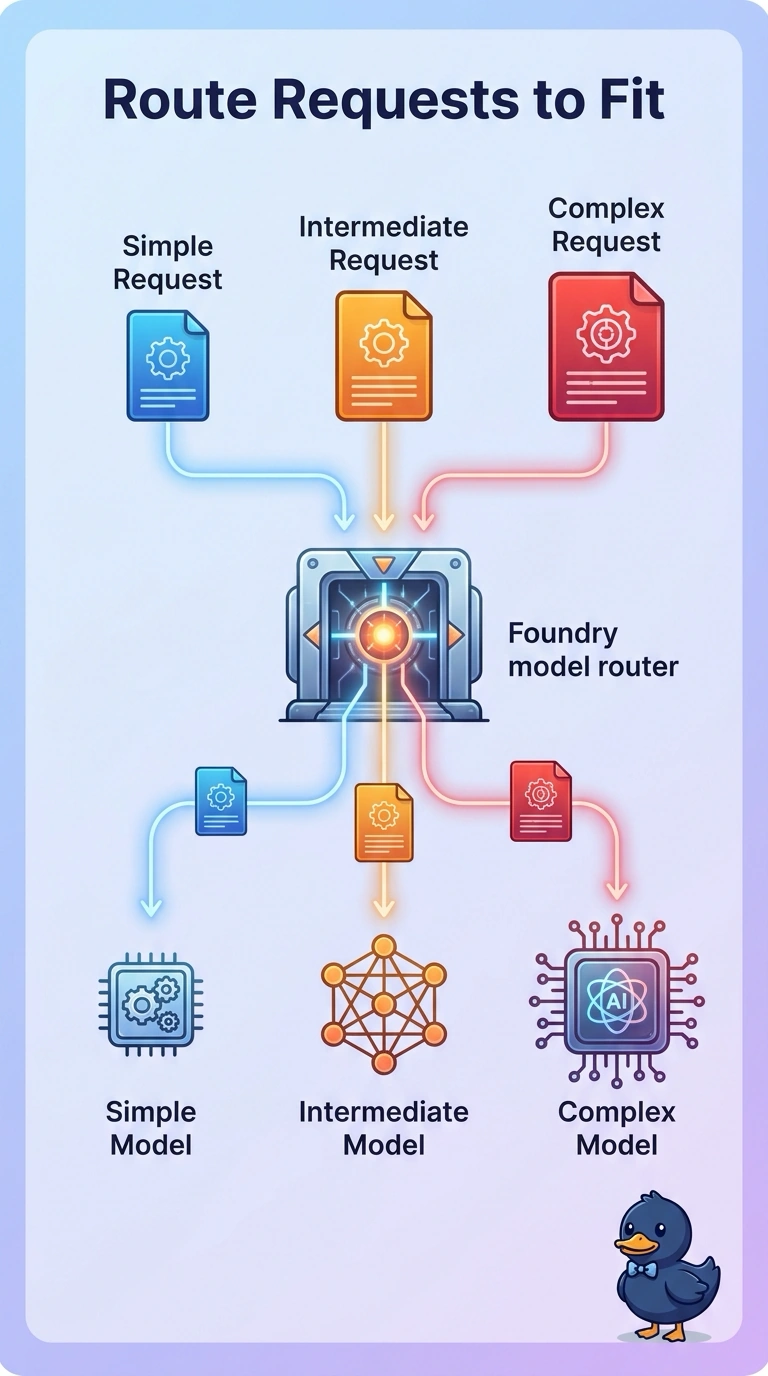
Short Explanation
You would not dispatch a long-haul crew for every hop across town. You put a model router in front of the hospital's work so each request goes to a model that fits its difficulty. A second copy of the oversized model still prices a short code like a long note.
Full Explanation
A Foundry model router is one deployment that selects a suitable model for each request. Coding suggestions are the lighter job and nurse-note summaries are the heavier one, and they should not share one oversized model at the same cost, so the router sends each request according to its difficulty. A second copy of that same oversized model gives the suggestions their own deployment and still spends the large model on the easy job. A small language model that replaces the oversized model for nurse-note summaries takes capacity away from the harder writing, which is the wrong half of the split. A daily cap stops both workloads once the suggestion count is high and does not choose a model at all. Exam caveat: compare quality on a set of real suggestions and real summaries before you retire the single oversized deployment, because routing is a measured change. Operational check: send one coding suggestion and one nurse-note summary through the router and confirm they were served by different models. Repeat with a second suggestion of similar length and confirm the pattern holds before the single oversized path is retired.