
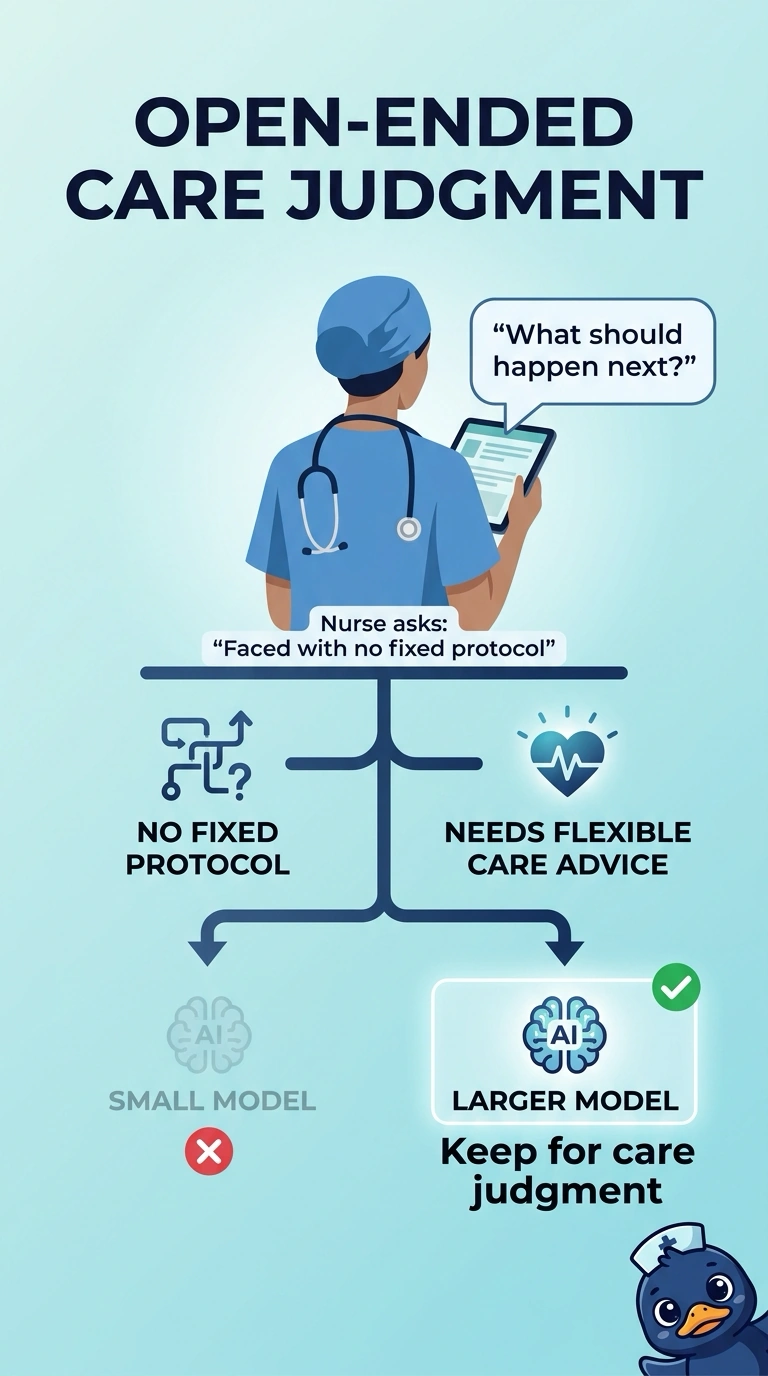
A hospital wants a small language model to give open-ended care advice when a nurse asks what to do next and no fixed protocol applies. What should the architect keep for that judgment?
Select an answer to reveal the explanation.
Short Explanation
A pocket phrase book will not carry an open clinical conversation. You keep the larger model for that open-ended care judgment and you do not hand it to a small language model. A small model fits a narrow tag, not this question.
Full Explanation
A small language model is for a narrow, high-volume classification or extraction, not for an open-ended assistant. Care advice with no fixed protocol is that open judgment, so the architect keeps the larger model on it and does not assign it to the small language model. Putting the small model on the advice and retiring the larger model removes the model that can hold the broader context the question needs. Giving the small model both the open-ended advice and a narrow tagging job still places the judgment on the model that was meant for the narrow job. Using the largest chat model only to tag a fixed field, and no model on the advice, spends the large model on the small task and leaves the nurse's question with nothing. Exam caveat: keeping the larger model on the advice does not authorize the model to be the clinician of record. A person remains accountable for care. Operational check: route a fixed-field tagging sample to the small model and route one open-ended care question to the larger model, and confirm the small model is not the one answering the care question.