
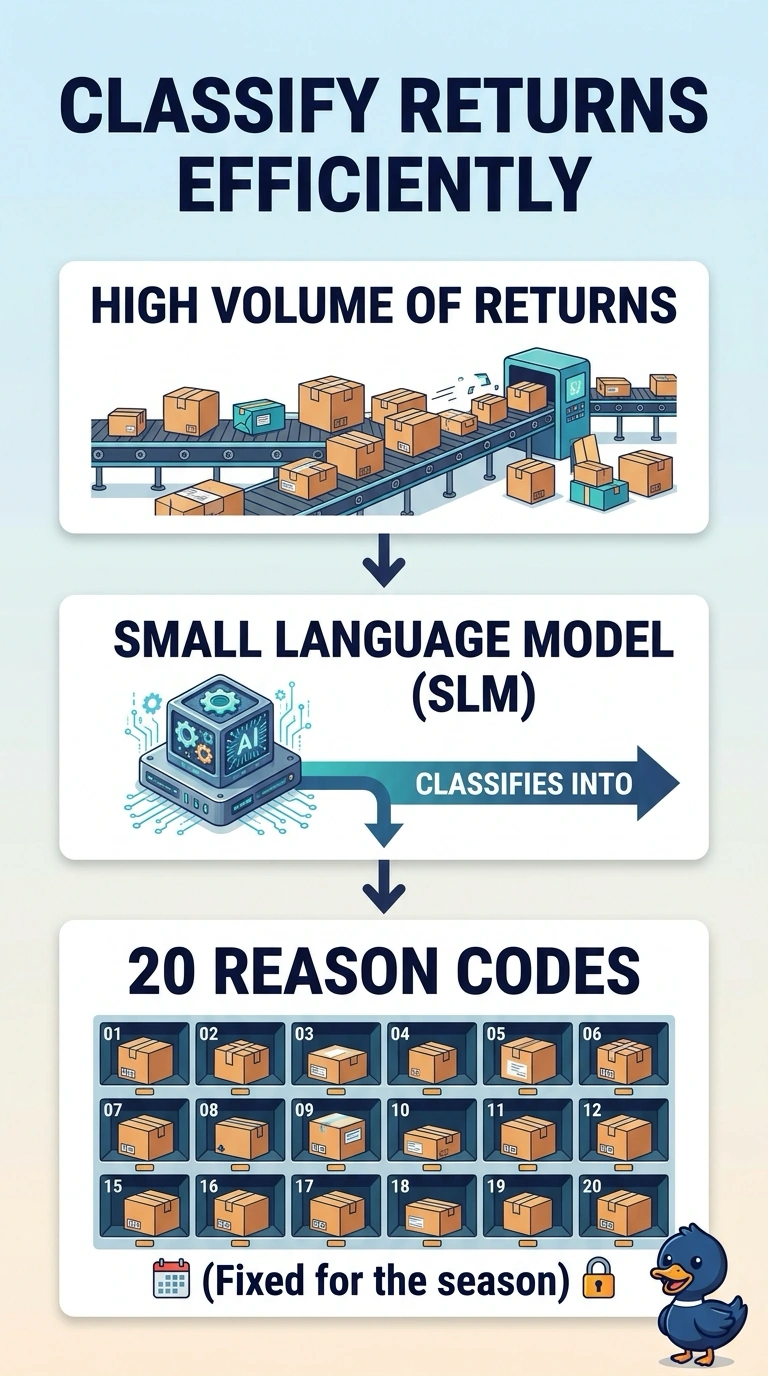
A retailer must classify each return into one of twenty known reason codes. Volume is high, the code list stays fixed for the season, and nobody needs an open conversation. Which model choice fits?
Select an answer to reveal the explanation.
Short Explanation
Sorting mail into slots you already labeled is a clerk's job, not a novelist's. You use a small language model for the twenty known return codes at this volume. The largest chat model is built for an open conversation this line does not need.
Full Explanation
A small language model fits a narrow, high-volume classification when the labels are a closed set. This retailer has twenty known reason codes, a fixed list for the season, and no open conversation, so a small language model aimed at those codes is the fit, and the largest chat model is extra cost and extra room to wander. The largest chat model would be the right shape for an open-ended essay or an assistant that must handle unforeseen questions, which this return line is not. A custom model that invents a new reason code breaks the closed list the warehouse and the finance posting already share. Skipping a model and letting a clerk type a fresh code off the list creates codes the downstream process does not accept and does not use the throughput a small model is for. Exam caveat: twenty is this retailer's label count, not a platform maximum. The fit is the closed set and the volume. Operational check: send a batch of returns through the small model and confirm every output is one of the twenty codes, and send an open-ended product question elsewhere.