
A hospital wants dictated clinician notes turned into readable text before they are filed. A Foundry Tools speech skill already performs that cleanup. A vendor proposes training a custom model on the same audio. What should the architect choose?
Select an answer to reveal the explanation.
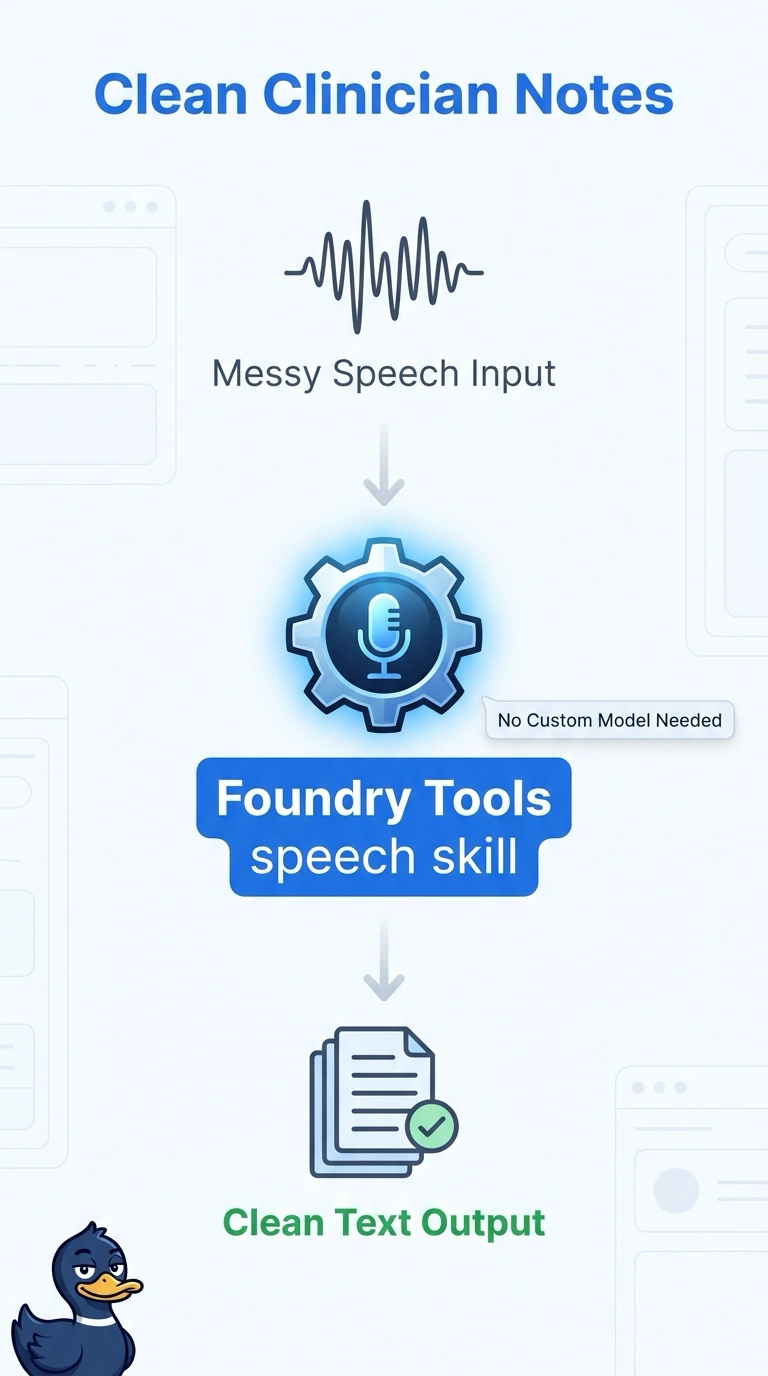
Short Explanation
You would not machine a new ear when the clinic already has one that hears. You use the Foundry Tools speech skill to turn the dictation into text and skip a custom model. The trap is treating a finished skill as a training project.
Full Explanation
A custom model is justified when prompting, grounding, and existing tools cannot produce the behavior and labeled data is stable. Here the behavior is turning dictation into readable text, and a Foundry Tools speech skill already does that cleanup, so another model would duplicate a skill the hospital can call. Training a custom model on the dictated audio would spend labeled audio on a job the speech skill already covers, and retiring that skill would throw away the maintained path. Fine-tuning a chat model to imitate a clinician's voice changes the speaker, which is not the filing task, and it does not produce the cleaned text. Storing the raw audio as a knowledge file and asking staff to type the transcript puts the work back on people and ignores the speech skill that was proposed for this step. Exam caveat: a speech skill that returns text is not a clinical decision. Someone still reviews what is filed. Operational check: run one dictation through the speech skill, confirm readable text comes back, and confirm no custom-model training job is queued for that same audio.